
Essentials Inside The Story
- After the IOC changed its 2022 ruling against the bans on Russia and Belarus in May, the ITF was also supposed to ponder upon their next steps.
- Considering how strict the ITF has been, it's understandable why their proposals were not changed.
- The two top ten players from Belarus and Russia could truly help their national teams.
For Mirra Andreeva and doubles partner Diana Shnaider, that proud moment of putting your country’s flag on your shoulders in front of hundreds of thousands of spectators came at the Paris 2024 Olympic Games. They had just won the country’s first medal (silver) at the event. But instead of featuring the familiar national colors of blue, red, and white, with the country’s symbol, they wore neutral colors, very well suiting their status in the event as Individual Neutral Athletes (AIN). They did not even want to talk about the geopolitical tensions or the bans on their country. They just wanted to play. On May 7, 2026, a part of the 2022 ruling changed, giving them a glimmer of hope to perhaps do both.
Watch What’s Trending Now!
Four years ago, the International Tennis Federation (ITF) and the International Olympic Committee (IOC) ruled that athletes from Ukraine, Russia, and Belarus would not be allowed to compete in international events unless they wanted to participate under neutral flags. In May, however, the IOC backed away from that stance, deciding that it was athletes’ fundamental right to “access sport and compete free from political interference.” A similar decision by the ITF was bound to be made at October 13th’s Annual General Meeting. As it turns out, however, the federation has once again defied the IOC and its players.
During the ITF’s General Assembly in Almaty, Kazakhstan, the delegates were presented with two resolutions. First, to resume participation by the Russian and Belarusian national teams in international team competitions. Second, the reinstatement of the membership rights of those countries’ tennis federations within WT. The votes came out as expected.
Neither of the two proposals received the necessary support, ensuring that the initial ban from 2022, which blocked the participation of players from the two countries in team competitions such as the Billie Jean King Cup and the Davis Cup under the national flag. Considering how the ITF reacted in May to the IOC’s change in stance, we saw the decision coming.
“The International Tennis Federation confirms that the IOC’s announcement does not change its existing position regarding the Belarus and Russian Tennis Federations’ suspensions, which remain in place,” ITF wrote in a statement in May 2026.
The athletes could, and have, participated on the international stage as neutral athletes. The wins and the medals would not be counted against the country, however, and that remains an issue for these players, as Aryna Sabalenka of Belarus said in 2023, and then in 2025.
“Nobody in this world, Russian athletes or Belarusian athletes, support the war. Nobody. How can we support the war? Nobody, normal people will never support it,” she said in 2023 at the French Open.
“It is really sad to see that sports are involved in politics in many ways, because I feel like sport was created to avoid some of the more difficult times. I really hope that we’re not going to face it again. I think people will learn that sport has nothing to do with politics,” Sabalenka said in 2025.
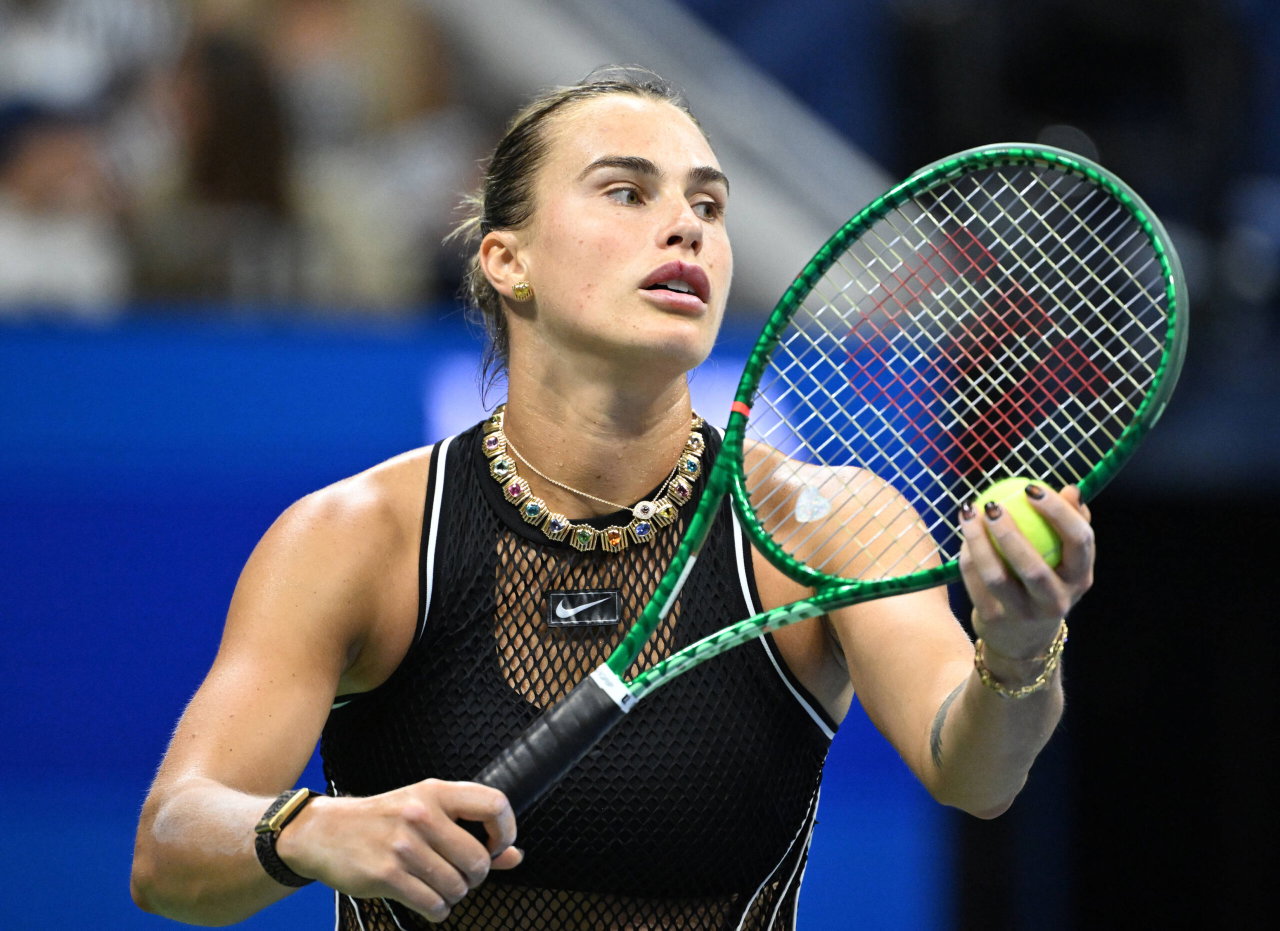
Owing to geopolitical tensions among the group of banned countries, six of the Top 50 players do not have a flag next to their names in their respective player profiles. Two of the most prominent among them are Aryna Sabalenka and Mirra Andreeva, who are ranked in the Top 10, with the former being the World No. 1 before the US Open. That distinction does not give them much power, though.
While external circumstances had the final say on the ruling, it does deprive tennis fans of the opportunity to see stars like Sabalenka and Andreeva compete for their countries. Playing for one’s own country brings out a lot of emotions in players, as seen in the Czech Republic players who won the competition this year.
How Sabalenka and Andreeva changed their country’s results on an international scale
Sabalenka, the former World No. 1, has a 10-6 win-loss record in singles and a 1-4 record in doubles at the Billie Jean King Cup, as she regularly featured in the Belarusian team before the ban. Sabalenka was instrumental in helping Team Belarus achieve their best-ever result in the competition by finishing runner-up in 2017. Sabalenka won three of her six singles matches during the campaign, including a win over Sloane Stephens in the final, who had just won the US Open a couple of months before.
While Sabalenka was fortunate to represent her country before the ban, Andreeva has yet to play for her country. However, she could’ve only added to Russia’s results, which has been a dominant force in the Billie Jean King Cup in recent times.
Consisting of players of the caliber of Elena Dementieva, Anastasia Myskina, Vera Zvonareva, Svetlana Kuznetsova, and Elena Vesnina, among others, the Russian team won the title four out of five times during the 2004-2008 period. Their latest triumph was in the 2021 edition, where the likes of Liudmila Samsonova, Daria Kasatkina, and Ekaterina Alexandrova helped deliver a fifth title for the Russian team. The ban has also affected them on the Tour.
When Andreeva won the French Open this year, security personnel asked fans in the stands to put the Russian flag back inside after they had taken it out to wave in celebration of the 19-year-old’s win.
Not to mention, should the Russian team be eligible for team competitions like the Billie Jean King Cup, their squad depth would be seriously compromised given the number of Russian tennis players who have changed their nationalities in recent times, with even Andreeva being linked to such rumors in the recent past.
While the female players have been prevented from playing in team competitions, their male counterparts have suffered in the Davis Cup.
Top Russian players have not been able to play at the Davis Cup as well
While Belarus has not made its mark in the Davis Cup (barring a semifinal appearance in 2004), Russia has a history in the competition. The ban could not have come at a worse time for the country, as both the men’s and women’s teams had won their respective national competitions in 2021 and were unable to defend their titles in 2022 because of it.
The likes of Daniil Medvedev and Andrey Rublev were forces to be reckoned with for the Russian team that won the Davis Cup title back in 2021, following in the footsteps of the 2002 and 2006 Russian contingents who won the title, having the likes of Marat Safin, Yevgeny Kafelnikov, and Mikhail Youzhny in their ranks.
Someone like Medvedev was at the peak of his powers back in 2021, winning all five of his singles matches during the campaign, including a win over Marin Cilic in the final. 2021 was a marquee year for the Russian, as he won his only Major at the US Open and even clinched the No. 1 ranking for a few weeks in the early part of 2022.
For now, however, the ITF’s stance remains the same, while the players would hope to soon represent their countries.