
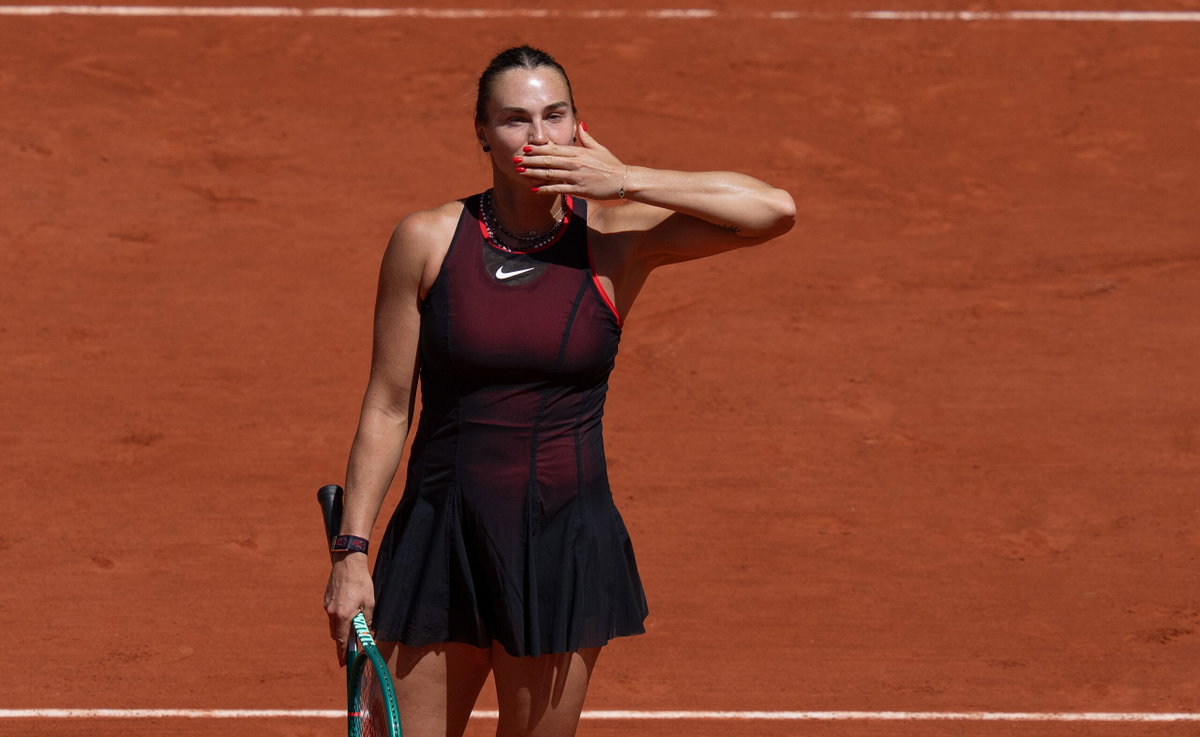
On Tuesday, Aryna Sabalenka, who was wearing over $100,000 worth of jewelry, stepped onto Court Philippe Chatrier. She defeated Bouzas Maneiro 6-4, 6-2 in 75 minutes, extending her Grand Slam first-round streak to 22, before sitting for her post-match press conference. If a player is leading a “protest for higher prize money,” how is it that they can go on the court wearing a diamond-circled necklace?
Watch What’s Trending Now!
Sabalenka did not flinch. “I don’t really see how it can be possible to cross these two completely different worlds,” she said. “As I said before, prize money is not about me at all. It’s just fighting for lower-ranked players who are really struggling to survive in this tennis world. It has nothing to do with me that I’m fighting for the prize money. Everyone knows that I’m okay. We are fighting for a fair percentage of the revenue and also for the lower-ranked players, players coming back after injuries, next generation to be more comfortable coming into the top 10. So it’s not about me.”
The jewelry in question came from a partnership with New York designer Material Good. Material Good provided three necklaces and earrings worth $148K. Sabalenka wore two, saying, “It’s supposed to be the third necklace, but I was like, ‘OK, it’s kind of like too much probably,’ so I decided to keep it just two,” she said.

Aryna Sabalenka was asked if she sees how people could think it’s hypocritical that she’s calling for extra prize money while walking on court with very expensive diamonds “I’ve seen a few people making a comparison between you calling for extra prize money and then wearing the Show more

The collection includes more than 200 carats of garnets and 23 carats of diamonds. When it comes to the logistics of wearing big necklaces on a court with temperatures reaching 33 degrees on Tuesday, she was just as relaxed. “I don’t really feel the heaviness of it. For me, it’s important to look good. If I feel good looking-wise, I perform better, and I feel great.”
However, there were always going to be questions about the optics. The jewelry Sabalenka wore on court was worth more than the prize money her opponent earned for the entire match. Bouzas Maneiro, ranked 50th in the world, is precisely the kind of player the protest is ostensibly designed to help, someone operating in the zone where prize money at the Slams has a direct and material effect on the financial sustainability of a career. Sabalenka, who earned $15M last year, leading the charge for lower-ranked players while wearing six-figure diamonds, was always going to invite reaction.
Aryna Sabalenka was in control of the match throughout, taking a 4-0 first-set lead and a 5-0 second-set lead before giving Bouzas Maneiro some moments to rally. It was her 22nd straight win in the first round of a Grand Slam, following her last defeat in the first round of a Grand Slam to Carla Suarez Navarro at the 2020 Australian Open. She will next face French youngster Elsa Jacquemot in the second round.
The protest, the percentage, and the players it is actually fighting for
The 15-minute media cap on Friday was a symbolic gesture calculated around a specific number, as Aryna Sabalenka gave 10 minutes to the written media and five to the world feed. Prize money at this year’s French Open is expected to represent around 15% of the tournament’s total revenue. Players are asking for 22%, in line with what they receive at regular ATP and WTA tour events. It would take the French Tennis Federation an extra £25m to bridge the gap at this year’s prize pot.
The French Tennis Federation is now said to be considering a counteroffer in the coming weeks and has met with player representatives. It’s not certain that the offer will significantly advance the 22% demand, nor that it will represent the middle ground between that demand. Another, less ambitious, percentage raise talks are at least underway, and that is a move from where they were in March at Indian Wells, where the players rejected a joint meeting over the core revenue and welfare issues.
The financial realities of life outside the top tier were clearly spelled out on Friday by Francesca Jones, who then went on to win against Beatriz Haddad Maia, her first Grand Slam main draw win at the seventh attempt. She said that no player below the top 75 is able to break even in the present structure, a statement that carries more weight than any revenue percentage. They are professional athletes at one of the most challenging sports on earth, playing at the top of their game and often struggling to make ends meet.
This is the world Aryna Sabalenka is battling for. Is it a fair question whether the image of her doing so in $100,000 worth of diamonds gives the tournament ammunition to dismiss the cause as something other than genuine advocacy? However, her response, that the two things exist in entirely separate worlds, makes logical sense even if it does not sound aesthetically pleasing. The cause does not become less valid because its most prominent voice is wealthy. However, in a protest that is fundamentally about optics and symbolism, the optics will always be a factor.