
Imago
Andy Roddick defeats Roger Federer in their quarter final of the Sony Ericsson Open – Key Biscayne USA s Andy Roddick defeats, 7-6, 4-6, 6-3, Switzerland s Roger Federer in their quarter final match of the Sony Ericsson Open at the Crandon Park Tennis Center in Key Biscayne, FL, USA on April 3, 2008. Photo by Corinne Dubreuil/Cameleon/ABACAPRESS.COM Key Biscayne FL USA PUBLICATIONxNOTxINxFRAxESPxUKxUSAxBELxPOL Copyright: xAbacax 148766 DubreuilxCorinnex 148766_23
Imago
Andy Roddick defeats Roger Federer in their quarter final of the Sony Ericsson Open – Key Biscayne USA s Andy Roddick defeats, 7-6, 4-6, 6-3, Switzerland s Roger Federer in their quarter final match of the Sony Ericsson Open at the Crandon Park Tennis Center in Key Biscayne, FL, USA on April 3, 2008. Photo by Corinne Dubreuil/Cameleon/ABACAPRESS.COM Key Biscayne FL USA PUBLICATIONxNOTxINxFRAxESPxUKxUSAxBELxPOL Copyright: xAbacax 148766 DubreuilxCorinnex 148766_23
If there’s one thing Andy Roddick has never been quiet about, it’s getting the details right, especially when it comes to tennis balls. Back in 2009, after a second-round win at the Rogers Cup, he didn’t hold back, openly criticizing organizers for “changing tennis balls midsummer.” For Roddick, the inconsistency of using different balls across tournaments during the hardcourt swing never sat right.


That’s just how he operates, everything, especially his gear, needs to be in sync. So it wasn’t surprising that after playing at a recent exhibition match, the American once again voiced his frustration, this time over the quality of balls being used at the event.
Watch What’s Trending Now!
Speaking on the March 31 episode of the Served Podcast, Andy Roddick shared strong criticism about tennis balls. He had just played an exhibition event before the inaugural Latin America Open, an ATP 100 Challenger tournament held at the São Paulo Jockey Club in Brazil.
“They gave us the Dunlop balls, so they gave us whatever the challenger was using. I don’t often like to throw straws unnecessarily, but they’re unusable. They are terrible.”
He went into technical detail to explain the issue with the balls. According to him, the problem starts with how the ball is constructed and finished.
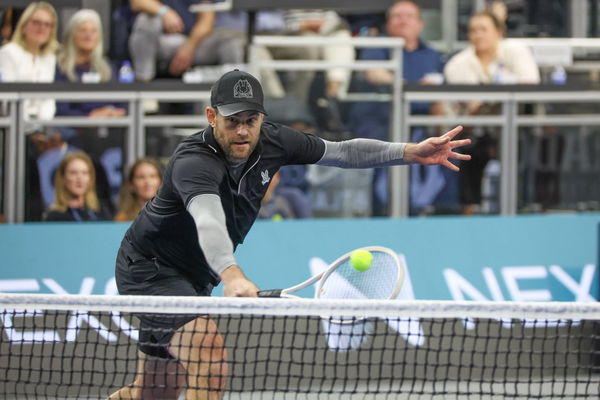
Imago
FRISCO, TX – FEBRUARY 07: American tennis icon Andy Roddick hits a backhand during the All-American Classic held during the Nexo Dallas Open on February 7, 2026 at the Ford Center at The Star in Frisco, TX. Photo by George Walker/Icon Sportswire TENNIS: FEB 07 Dallas Open EDITORIAL USE ONLY Icon260207034
“The seam on the ball, where you have the felt, and the seam should look level. The rounded edges should be continuous and at least predictable. But there were bumps, nodules, and it blows up quickly. If this is what Medvedev and all these people are talking about, they are absolutely right,” he added.
Roddick continued to highlight more flaws in the ball’s design and manufacturing. He pointed out inconsistencies that affect how the ball behaves during play.
“Even the seams and where they use the glue is uneven. It’s horrible. We are not trying. My mind goes to I understand the business side of it, but there has to be some sort of quality control. There has to be something. It was shocking.”
This is not the first time Dunlop balls have been criticized across both tours. Before the 2022 US Open, Iga Swiatek didn’t hold back, calling the balls “horrible,” while Ashleigh Barty’s camp once claimed she’d never win there unless conditions changed. Even today, as Dunlop balls dominate, Andy Roddick continues to hammer the issue, keeping the debate alive.
In early March last year, Daniil Medvedev also raised concerns. He spoke out during the Dubai Tennis Championships after losing to Tallon Griekspoor.
“I think the last game we played was ridiculous, how slow the balls were,” he said. “I do not understand how it’s not 5-7, ball change on the ATP Tour, I don’t get it. The balls when they fly through the air slower, gets an advantage to the guys that volley, because they have more time to react, to adapt to the shot that is going to them when they have more time.”
The complaints continued this year at the Rotterdam Open. Medvedev again raised concerns during his first-round match against Ugo Humbert.
He even called the tournament supervisor onto the court during the match. In a direct conversation, he questioned the quality of the balls being used:
“Head balls, are they round? It is round? Are you sure because I see it not round, I see it with a bit of, how you say it, narrow. I don’t know how you call it.” Later adding, “It’s a bit of… let’s see, scars. So it’s not super round. Isn’t it strange? So I think maybe we should consider not playing with HEAD balls. HEAD Tour XT balls is not round so we should not be playing with it, nobody should be buying it.”
And these repeated complaints show a growing frustration among players. It is not limited to one player or one tournament.
Alexander Zverev and Casper Ruud slam the growing ATP ball issue
In 2019, the ATP signed a partnership agreement with Dunlop that will run until 2028. This deal made Dunlop one of the main ball suppliers on the tour. Different Grand Slams still use different manufacturers. The Australian Open uses Dunlop, while the French Open and the US Open use Wilson, and Wimbledon uses Slazenger.
However, Dunlop balls are only used in about half of the ATP tournaments. This creates constant adjustments for players who must switch balls almost every week. Casper Ruud highlighted this challenge clearly.

Imago
MELBOURNE, VIC – JANUARY 12: Casper Rudd of Norway shows his frustration during Round 1 of the 2025 Australian Open on January 12 2025, at Melbourne Park in Melbourne, Australia. Photo by Jason Heidrich/Icon Sportswire TENNIS: JAN 12 Australian Open EDITORIAL USE ONLY Icon250112145
“Playing a series of four tournaments in the same continent using four different balls can be difficult and demanding,” he said.
Players often say that these differences affect their rhythm and performance.
Alexander Zverev, who is part of the ATP Player Advisory Council, also shared his concerns. He believes the COVID-19 pandemic played a role in the decline of ball quality.
“They’ve gotten a lot slower,” the German said. “Because of Covid, the companies tried to cut costs, and they’re using a different rubber material now. They’re using a different material for the tennis balls, which makes the tennis balls between 30 per cent and 60 per cent slower on average.”
Many players also believe that these slower and lower-quality balls are causing physical problems. Injuries related to the elbow and wrist are becoming more common on tour.
Zverev even explained the technical issues behind this problem.
Even Stan Wawrinka spoke out strongly about the situation.
“Four weeks – four different balls. When are tournaments going to listen to players??” he added.
As concerns over ball quality continue to grow on the ATP Tour, the time has come for the ATP to acknowledge the issue and take decisive action for the players’ benefit.
Written by

Edited by

Deepali Verma