

Andy Murray’s dream of making a Wimbledon coaching debut was left unfinished as Jack Draper withdrew from his first-round match with a recurrence of the arm injury that has plagued him for the best part of a year. However, that led the former World No. 1 to examine the injury in greater detail.
Watch What’s Trending Now!
“There does seem to be more upper limb injuries than there was and in my opinion, ” Murray said in an exclusive interview with Tennis 365. “That is due to the change in racket technology and the strings that players are using.”
Murray pointed out that using lighter frames and strings with higher tension strains the arm more, which was not the case a decade ago. “Players have gone to much lighter rackets than they used to use before. And with quite, like, stiff strings in the racket, so a lot of force is going through the arm,” he said.
“Whereas before, players use much more forgiving strings and heavier rackets, and that meant more of the force went through the racket than the arm.” He added that the modern game is played at a higher speed, and the need for players to hit the ball faster was a primary reason they were moving to these lighter frames. “Because the game has got quicker and faster, players feel like they need a lighter racket. I feel like that’s something that maybe some of the players should look at,” Murray stated.
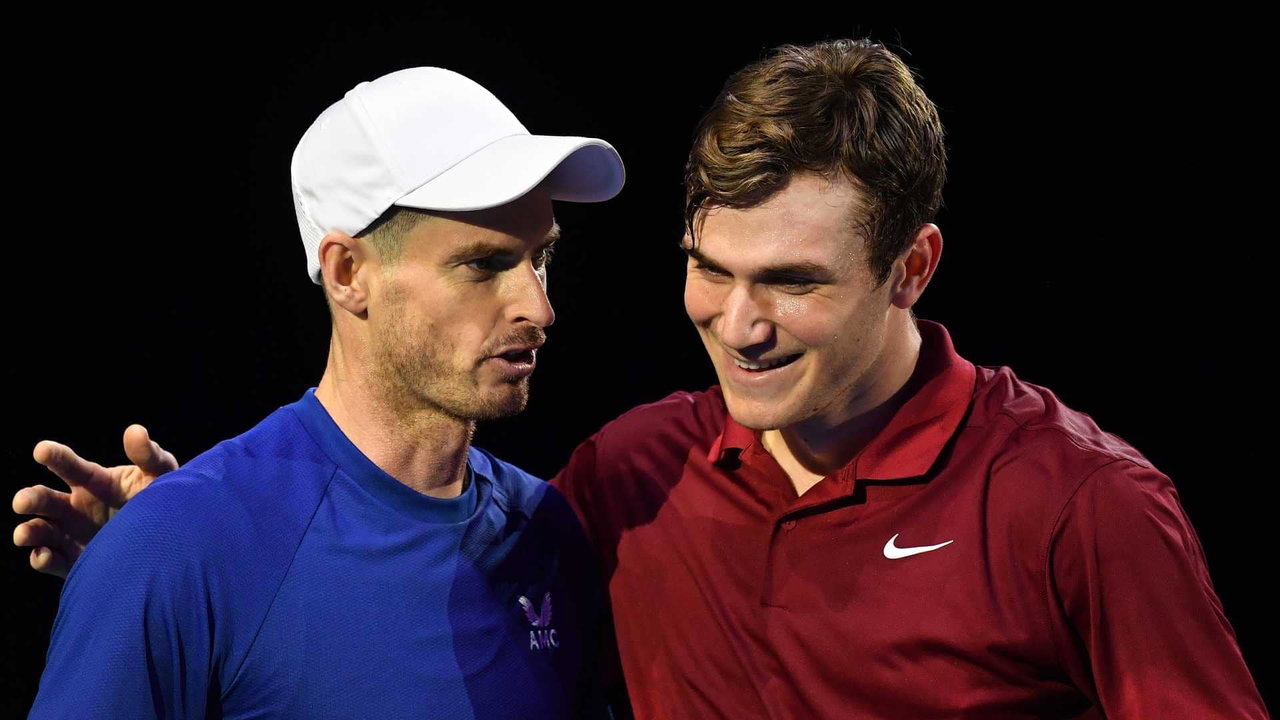
Getty
ABERDEEN, SCOTLAND – DECEMBER 21: Andy Murray of Scotland (L), reacts as wins his match with Jack Draper of England during day one of the Battle of the Brits at P&J Live Arena on December 21, 2022 in Aberdeen, Scotland. (Photo by Mark Runnacles/Getty Images for Battle of the Brits)
Carlos Alcaraz, who’s been out of the tour for more than two and a half months, has almost missed the entire clay and grass season. His injury is also related to the arms, specifically the wrist, where string tension and racket weight come into play. The world No. 2 has still not announced when he will be back on tour. Therefore, the consequences are huge if the problem stated by Murray is the obvious reason.
Draper’s own plight is the most obvious illustration of the severity of the problem. In a statement confirming his withdrawal from Wimbledon, he made a statement about how special the moment was for him. “There have been a lot of painful moments in the last 12 months but this one is definitely the absolute worst as there is no greater honour for a British player than playing at Wimbledon. I will continue to persevere through this,” Draper said.
The former world No. 4 was scheduled to play sixth seed Taylor Fritz in the first round, a high-octane battle in the opening round. Draper specifically got a two-time Wimbledon champion in his corner to get positive results in his home slam, but nothing went according to plan. The duo was together for the Eastbourne Open, where they reached the semifinals before losing to Ugo Humbert in straight sets.
For now, Andy Murray’s theory offers one of the more concrete explanations yet for a worrying pattern that has sidelined several of the sport’s leading players at the worst possible moments.