
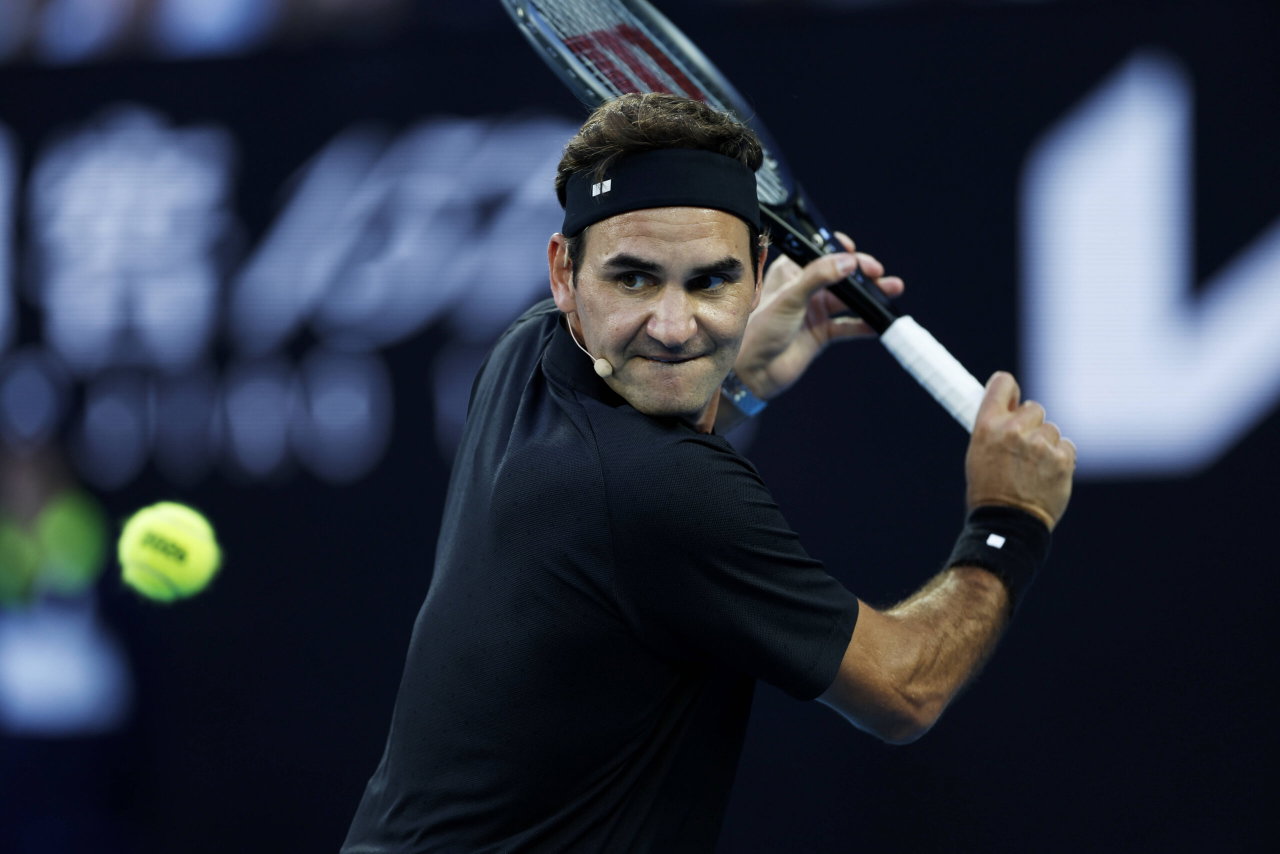
When Roger Federer bowed out of the sport back in 2022, the Swiss penned an emotional note, which ended with the words, “Finally, to the game of tennis: I love you and will never leave you.” That love was well alive when the Swiss went up the stage to be formally inducted into the Tennis Hall of Fame in 2026. The Swiss Maestro’s emotional speech reflected on his journey in the sport, which began as a ball boy and ended as a player with 20 Grand Slam titles.
Watch What’s Trending Now!
Roger Federer’s humble beginning as a Ball Boy in Basel
Now part of tennis folklore, his journey began in a rather fitting place, Basel, where he first experienced the sport not as a star, but as a ball kid at his home tournament. In 1992 and 1993, a teenage Federer was already soaking up every possible moment around the players he admired, getting to watch his heroes from just a few feet away.
One moment, in particular, stayed with him. Seeing his childhood idol Stefan Edberg in the 1993 final left such an impression that years later, Federer would go on to bring the Swede into his own team as a coach. And perhaps that’s why those ball-kid days still mean so much to him. During his Hall of Fame speech, Federer made sure to give a special shout-out to the ball kids who were once part of his own story.
“I’m 13 years old and it’s a Swiss Indoors. I’m not competing. I’m a ball boy. I’m standing against the back wall, hands behind me, eyes on the ball. I’ll never forget how the game looked from there and how it felt, the thrill of standing so close to the players, feeding them the ball, handing them the towel, seeing them sweat, watching them fight it out, figure it out,” said Federer in his induction speech.
He further added, “The adversity, the intensity. I remember the next morning my legs were gone, standing all day. It’s a lot of work. So I really want to thank every ball kid who ever stood through my matches, or all our matches for that matter, for hours on end. I see you. I thank you.”
Federer’s ball-kid days in Basel never really left him. He went on to dominate his home tournament too, lifting the title a remarkable 10 times. But, true to form, it wasn’t just the trophies that made Basel special for the Swiss legend. He always made sure to remember the ball kids who were once in his shoes, treating them to a pizza party every year he reached the final, regardless of the result.
And when it came to inspiration, Federer had no shortage of legends to look up to. His admiration for Pete Sampras was no secret, making it all the more fitting that one of Federer’s first major breakthroughs came against his childhood idol, when he ended Sampras’ Wimbledon reign in 2001. He also took a moment to acknowledge both Martina Hingis and Martina Navratilova in his speech. While Navratilova inspired his wife, Mirka, to take up the sport, Hingis’s rise as a Swiss star at 16 gave Federer the confidence to succeed on the Tour.
“And of course, there’s Pete Sampras, the best serve ever. What a privilege to share the court. Your turn now. Oh, okay. And two, not one but two. Martina’s first Martina Hingis,” said Federer. “Swiss like me, world number one by the age of 16. Unlike me and Martina Navratilova, you know her for winning 59 majors, but in our house, she’s famous for inspiring Mirka to play tennis.”
It was a very emotional tribute from Federer to his idols, as the Swiss choked up while mentioning the former legends, especially Sampras.
Roger Federer expressed gratitude towards his family and coaches
Federer may have been the one dazzling crowds with his effortless strokeplay, but there was a whole team making sure everything behind the scenes stayed on track. His journey to 20 Grand Slam titles was never a solo act, with his wife, parents and coaches all playing their part, and Federer made sure to acknowledge them in his Hall of Fame speech.
Interestingly, Federer’s parents first introduced him to the sport, and they backed their son’s ambitions wholeheartedly, giving him the freedom and support to chase his dream. While his mother instilled the values of deep family ties and humility, his father gave a teenage Federer a reality check whenever he seemed to be struggling with his temper. The Swiss thanked his parents, with love and affection being apparent in his voice.
“My mom had a full time job, but she found time to work the badge office for the Swiss Indoors and probably did some badges for you guys. So she was also the one who organized my lessons, to sign me up for matches and supported my coaches. Mom made it happen,” said Federer. “Thank you Mom.”
Federer had a twinkle in his eye when he cheekily paid tribute to his father, attributing his legendary aggressive game to the latter.
“What I remember was my dad’s total ban on moon balls. When I played him, he had the old continental grip that made it—that made me for sure more and more aggressive tennis player. Thanks, Dad,” added Federer. “Robbie Federer, the real RF.”
And then there was Mirka Federer, who stood by the 20-time Grand Slam champion throughout every twist and turn of his career. On a journey that began in 2000, when they met in Sydney, the couple has balanced their personal and professional lives, which has played a massive part in extending Federer’s career.
“As you know, Mirka’s my wife—duh—which is the greatest understatement I can make because she’s also been my coach, my hitting partner before matches, and my reality check,” said a tearful Federer. “Also my stylist. A wonderful mother to our four kids who makes the impossible happen in all our lives. She and I grab each other’s hands and we run through walls. Thank you.”
Lastly, across a career spanning more than two decades, Federer’s journey would be hard to imagine without the coaches who helped shape his game and guide him through the years.
Given the stage of his career, the role of his coaches varied. For a temperamental teenager, Federer needed the calm heads of Peter Lundgren and Peter Carter at the beginning of his career to help him navigate the Tour.
“I’m talking about the phenomenal Peter Carter. Super cool Peter Lundgren, two men who unfortunately are no longer with us, who not only helped my game but helped me grow up fast on the road. I love you guys,” said Federer. “Thank you.”
By the time he was an established name on the Tour, Federer needed coaches with the tactical expertise and experience to hone his skills. This is where the veteran trio of Tony Roche, Paul Annacone, and Jose Higueras came into the picture, improving the Swiss’s game in their own unique way. Federer was also not shy about having the opportunity to work with his idol, Stefan Edberg, who helped him get past the hurdles of Novak Djokovic and Rafael Nadal.
“Also, legendary coaches Jose Higueras, Paul Annacone and Tony Roche,” added Federer in his speech. “I loved my time with them and I learned so much from their stories and expertise, and I was lucky to have my childhood hero, Stefan Edberg.”
Lastly but not least, Federer always had Severin Luthi to fall back on, with the latter being a mainstay of the Swiss player’s team for almost eighteen years. Federer was also not averse to hiring his peers as coaches, players who could give candid feedback on his game, having played against him. The hiring of Ivan Ljubicic shows Federer’s openness to trying new things.
“Ivan Ljubicic, who had a tremendous impact working with me for the last six years in the twilight of my career. It’s getting tough now. I thought it was going to be easy,” said Federer. “This one and Severin, my longest tenured coach. 18 long years together. Severin’s role in my life and my career is even bigger than that number. He kept me motivated when I needed motivating, and he protected me when I needed protecting.”
Given Federer’s success, one could safely say that the Swiss only made good decisions when choosing his inner circle.
Roger Federer Pays Tribute to Some of the Iconic Rivalries He Had
A major part of Federer‘s on-court legend has been the iconic rivalries he shared with other greats of the sport. The Swiss came to the sport when the Sampras-Agassi duopoly was still making headlines in men’s tennis. While the 2001 Wimbledon win is the only match Federer played against Sampras, he had an 8-3 record against Agassi, winning his last eight matches against the American.
Federer dominated his peers, which included the trio of Andy Roddick, Lleyton Hewitt, and Marat Safin. The Australian was the only one who had the upper hand against the Swiss in the early days, as he won seven of the first nine matches. However, once he became a force to be reckoned with, Federer won fifteen matches in a row, finishing with an 18-9 head-to-head against Hewitt. Against Roddick and Safin, the Swiss had dominant 21-3 and 10-2 records, respectively.
The two main rivalries for Federer came from players younger than him: Rafael Nadal and Novak Djokovic. The Swiss finished on the losing side of both rivalries, ending with a 16-24 record against the Spaniard and a 23-27 record against the Serb. However, his battles with both players resulted in some of the sport’s iconic matches, such as the 2008 Wimbledon final against Nadal and the 2019 Wimbledon final against Djokovic. Federer paid tribute to all the significant rivalries that shaped his career.
“The International Tennis Hall of Fame shows the evolution of tennis, and I’m honored to be part of that, and I’m incredibly lucky to have bridged the generations from Pete and Andre, the superstars, to champions my own age like Roddick, Hewitt, Safin, and Ferrero, to the epic rivalries I have with the next generation, Andy, Novak, and Rafa,” said Federer in his speech.
Perhaps, Federer’s journey from a ball boy in Basel to a 20-time Grand Slam champion was never a solo act. Along the way, the support of his loved ones and the rivalries that pushed him to raise his game played their part. And now, after a career spanning more than two decades, the RF has officially taken his place in the Tennis Hall of Fame.