
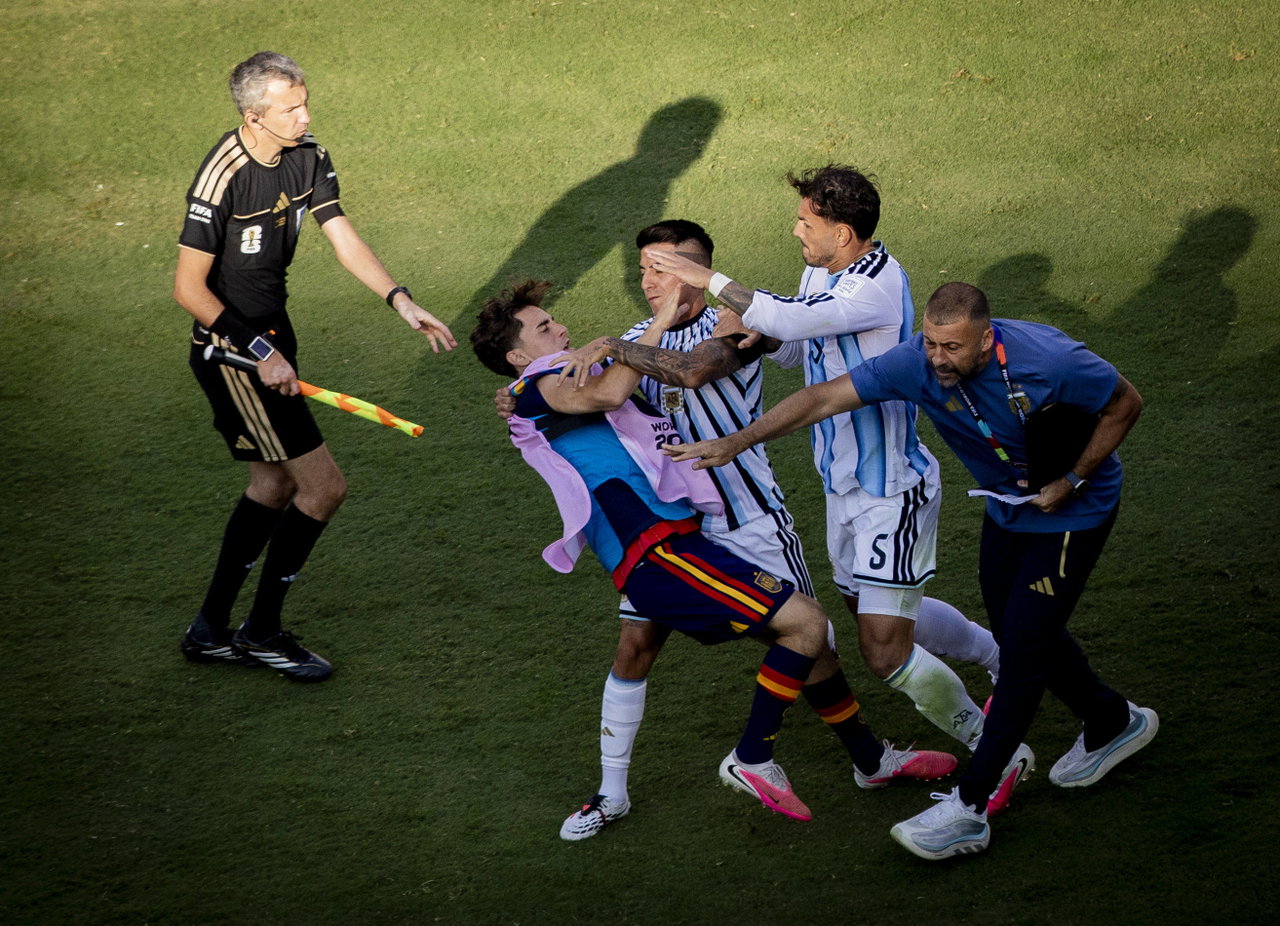
FIFA has finally drawn a line under the chaos surrounding the 2026 World Cup final. But for journalist Henry Winter, the punishment raises another question: did Argentina’s football association get off too lightly while individual players took the heavier hit?
Watch What’s Trending Now!
The sanctions came more than a month after Spain’s 1-0 extra-time victory over Argentina, when emotions boiled over after the final whistle. Leandro Paredes received the harshest punishment, a 10-match international ban and $90,000 fine, while Nahuel Molina was suspended for seven games and fined the same amount.
Winter tweeted, “Probably what we expected of FIFA’s Argentina punishment for assorted World Cup excesses: relative leniency for the Argentinian FA and chunky bans for two scrap-happy individual players.” His criticism focuses on the contrast between the penalties imposed on the AFA and the players involved in the post-match confrontation.
The AFA was fined $321,000 for several disciplinary breaches, including the display of a Falkland Islands banner after Argentina’s semifinal against England, team misconduct, discriminatory chants and gestures from supporters, and security-related offences. The association must also play its next two home matches at 50% capacity, although one match and $100,000 of the fine have been suspended during a probationary period.
That figure also needs context…
Argentina’s football association reportedly earned around $33 million from its World Cup campaign. Winter therefore questioned whether the financial punishment carries the same weight as the bans handed to the players.
In addition to Paredes and Molina, Thiago Almada was handed a one-game suspension. Also, Argentina team official Roberto Ayala was banned for three matches, and Spain’s Gavi was also suspended for one.
But Paredes has not accepted the decision quietly. Reacting to the punishment, he accused FIFA of showing favoritism toward Spain, arguing that the governing body focused on his response rather than what happened before it.
“I get 10 games ban and $90,000 after I defended myself. It’s obvious they didn’t care to know what the guy said to me but are interested in how I reacted,” Paredes said.
He then added, “If reverse was the case, everyone will say FIFA is helping Argentina but they are all mute now. Argentina remains the best team in the world with our captain Leo.”
The AFA is also refusing to let the matter end here. Its legal department said it would request the full reasoning behind the decisions before filing appeals with FIFA’s Appeals Committee, while keeping the possibility of taking the case to the Court of Arbitration for Sport as a final option.
For now, though, FIFA’s verdict stands. The players will carry the sporting consequences onto the international stage, while the AFA faces a financial penalty and restrictions at home.
And that is precisely where Winter’s argument lands: the question isn’t whether Argentina was punished, but whether FIFA punished the institution and its players in proportion to their roles in the controversy.