
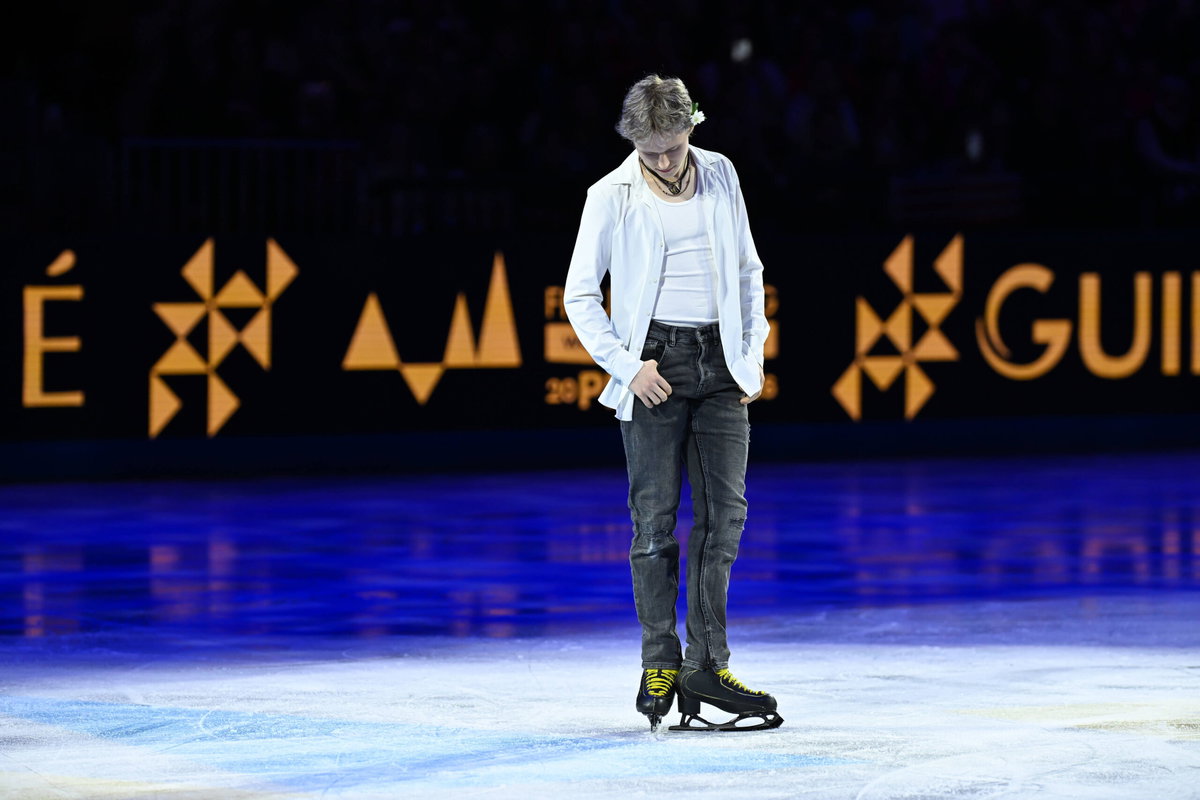
At the 2025 Grand Prix Final in Nagoya, the “Quad God” made history by landing seven quads. But that achievement now sits under a changing system. The International Skating Union (ISU) has reduced jump elements from seven to six and also cut jump combinations from three to two. These decisions made Ilia Malinin feel helpless, and he voiced his frustration on May 29.
Watch What’s Trending Now!
Speaking to Figure Skating Life magazine after the 2026 World Championships, the three-time world champion said, “I honestly don’t understand why the current reality is that we don’t even know where or how to voice our opinions. For us, the fact that athletes’ voices aren’t heard is very painful. What worked well in the past might not function now. However, fans also need time to understand things, and if the rules keep changing constantly, I think fans won’t be able to keep up.”
Malinin’s path to seven quads was itself a struggle. At the 2024 Grand Prix Final, he fell on one attempt. Later, in 2025-26, he finally landed it clean. “I personally had problems with having to go from six jumps to seven jumps, and that honestly caused me a lot of problems with my previous competitions,” Malinin candidly said. And now that he can do it, the rules are changing.
This is not the first time he has spoken about the rule changes. After winning the 2026 World Championships in Prague and securing his third straight world title, Ilia Malinin shared how the beautiful sport is shifting. He said figure skating depends on a balance between artistry and technical difficulty, and that frequent changes make it harder for athletes to build stable programs.
He added, “Looking at the specifics of some of these changes, I think it really takes away the level of competition and what we have developed as skaters throughout the years, especially from an audience perspective.”

“I think that the ISU should really listen to the athletes because to be honest, we're the reason ISU is blowing up. Without the skaters, the ISU would not be able to have all of us and this recognition.” — Ilia Malinin c̶l̶o̶c̶k̶i̶n̶g̶ I̶S̶U̶ voicing his opinion on the planned Show more

The sport has seen drastic changes over the past few years. 2022 saw refined program component scoring and GOE criteria, updated technical wording, and early adjustments to the criteria for the junior grades. 2023-24 saw fine-tuning of the assessment of elements without changing the structure of the programs.
Then the ISU Congress came in 2024 and made more substantial changes. It changed age rules and reclassified some ‘illegal’ elements, such as somersault-style moves, and approved future technical changes that could then be made available in the next cycle. The largest structural change is a jump reduction.
For athletes like Malinin, though, it is a means of creating new programs in line with their new limits. But why was this change made in the first place?
ISU rule changes on jump limits spark debate in figure skating
In early 2024, the ISU Singles and Pairs Technical Committee recommended reducing the number of free skate jumps from seven to six and reducing the number of free skate combinations from three to two. However, the ISU Congress in Las Vegas approved the proposal in June 2024. The union waited until after the 2026 Olympic season so that skaters could adapt.
The ISU framed the change differently. Fabio Bianchetti, chair of the Technical Committee, said the goal was “to give more time for transitions and choreography.” The ISU has even discussed a future format that could separate competitions into a Technical Program and an Artistic Program, potentially beginning in the 2027-28 season.
However, Ilia Malinin sees the change as hitting at the core of what made him one of the sport’s biggest stars. He scored 238.24 points on his free skate at the 2025 Grand Prix Final in Nagoya, which featured seven quadruple jumps. However, with the new rules, that type of layout would not be possible.
Removing one jump reduces the base value, a loss skaters cannot offset with spins, steps, or component scores. The American has repeatedly expressed doubts about the changes proposed. Speaking after the 2026 World Championships, he explained how even minor adjustments can completely alter an athlete’s preparation.
“For example, they want to change from seven jumps to six jumps, that’s why we have to set up our programs completely differently,” Ilia Malinin said. “With last season, they weren’t sure with how many jumps were going to be there.”
He also argued that athletes should have a greater role in the decision-making process. “ISU and everyone who is in charge of making these decisions should really listen to the athletes,” Malinin said. “Because, to be honest, we’re the reason the ISU is, you know, blowing up and really here, and because without the skaters the ISU would not be able to, you know, have all of us, and this recognition, so that’s what I think about, and I think that you should really reconsider.”
Clearly, Ilia Malinin is not alone in his concerns. After the proposal gained attention, several of the world’s top skaters questioned the direction of the changes. On March 28, 2026, Yuma Kagiyama, the 2022 world silver medalist and 2026 Olympic silver medalist, said, “I can’t support it. The current rules are what make figure skating so appealing.”
Meanwhile, 2026 Olympic bronze medalist Shun Sato also pushed back against the proposal, saying, “I want to skate under the current system as much as possible.”
With more voices joining the debate, whether the ISU will heed their pleas and make an exception remains to be seen.