
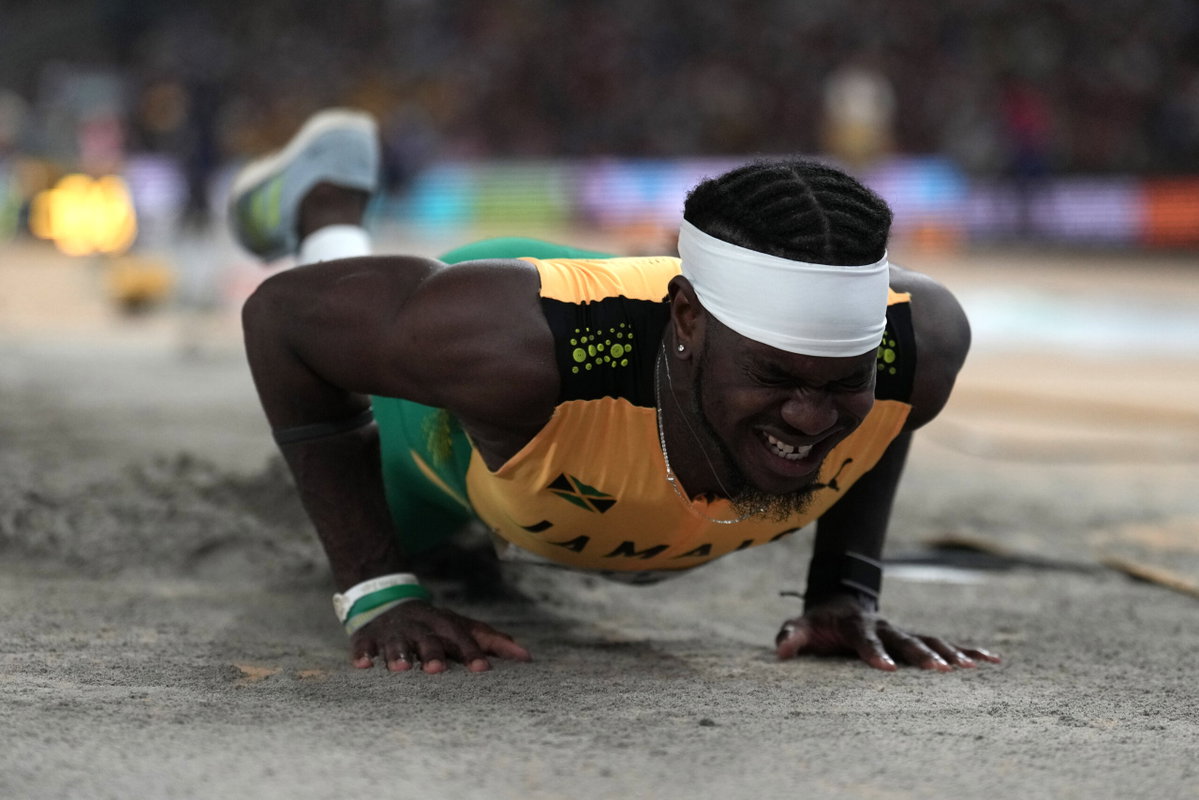
A two-time national champion’s career has been halted by whereabouts failures. It’s 2024, and Carey McLeod is at the peak of his athletic powers. The now 28-year-old has picked up not one but three medals, including a bronze at the World Indoors and gold in a DL meet. Fast forward to 2026, and the two-time national champion’s career has come to a screeching halt. That’s after he voluntarily accepted a two-year ban from athletics for whereabouts failures, one he didn’t dispute.
Watch What’s Trending Now!
“The AIU has banned Carey McLeod (Jamaica) for 2 years from 28 May 2026 for Whereabouts Failures. DQ results from 1 May 2026,” reads the social media post from the Athletics Integrity Unit (AIU).
The 28-year-old has reportedly voluntarily accepted the anti-doping rule violation after he missed three tests in 12 months. As an Olympic and World Athletics-level athlete, McLeod is obligated to make himself available for random testing. However, missing three tests within 12 months is subject to harsh sanctions, with a maximum ban of two years usually imposed. The most recent of these violations occurred in May 2026, when doping control officers were once again unable to locate McLeod at his given address.
“Therefore, on 26 May 2026, the AIU confirmed the Whereabouts Failure on 1 May 2026 against the Athlete,” reads the AIU’s statement. “He was afforded the right to request an administrative review of that decision by no later than 9 June 2026 and advised that, if he failed to do so, the Whereabouts Failure would be considered as a Whereabouts Failure for Rule 2.4 ADR.”

The AIU has banned Carey McLeod (Jamaica) for 2 years from 28 May 2026 for Whereabouts Failures. DQ results from 1 May 2026. Details here: bit.ly/McLEOD-Decision

However, the AIU said that McLeod wanted the matter to move “forward urgently,” and so, voluntarily accepted the ban.
“On the same day, 26 May 2026, the Athlete’s appointed attorney confirmed by e-mail to the AIU that the Athlete did not dispute the decision to confirm the Whereabouts Failure on 1 May 2026 against him and asked that the Whereabouts Failure be recorded so that the “case can move forward urgently,” reads the statement.
There are exceptions to the two-year ban rule of thumb; Alysha Newman, Yul Moldauer, Christian Coleman, and others received reduced bans. However, the norm has been a two-year ban, and as per the AIU, McLeod missed testing on three occasions from June 2025. The first occurred on June 30, 2025, when a doping control officer arrived at an address provided by the athlete during his designated time window.
However, the now 28-year-old wasn’t present, and he failed to respond to the AIU’s request for an explanation. The second incident took place during the World Athletics Continental tour event in Budapest. That was when the Jamaican filed inaccurate whereabouts information. He listed Arkansas, USA, as his location despite competing in Hungary.
McLeod first corrected his location to Budapest, then reverted to Arkansas, which the AIU flagged as a failure to update. All that happened in the space of two days, and as per the rules, the AIU considered it as the athlete failing to update his information. Then came the third incident, which was the breaking point.
McLeod’s decision to waive his right to appeal and push the case forward quickly is unusual. Yet it’s far from unprecedented, as several athletes have done something similar in the past.
Carey McLeod is not the first athlete to voluntarily accept the ban.
Carey McLeod was a superstar during his collegiate career, but struggled at the pro level until 2024. That year, he claimed a World Indoors bronze and Doha Diamond League gold. Afterwards, he won consecutive national titles in 2024 and 2025.
However, his ban does cast a shadow over his achievements. However, McLeod isn’t the only one to have voluntarily accepted it. Alysha Newman is a big example, as the 31-year-old Canadian pole vaulter was recently handed a twenty-month ban. That is four months fewer than the standard two-year ban for whereabouts failure, but Newman voluntarily accepted the result.
Not only that, but the AIU reduced Newman’s ban after she cited personal hardship. Furthermore, the Canadian had also confirmed that she had retired from athletics, which was another reason why her ban was reduced. Like McLeod, USA skier Breezy Johnson accepted a whereabouts ban in October 2023 after missing three tests.
The Alpine star missed three anti-doping tests and, as per the rules, was subject to a two-year ban. However, the USADA determined that her degree of fault was relatively low and only imposed a 14-month ban. Like McLeod, officials disqualified any competitive results she achieved until October 2023.
Canadian swimmer Penny Oleksiak also went through a similar case. The three-time Olympian had committed three whereabouts failures within 12 months from October 2024 to June 2025. As a result, they provisionally suspended her, and she withdrew from the championship team then. Oleksiak was eventually handed a two-year ban, backdated to July 2025, and will be eligible to compete again from 2027.
For McLeod, the decision brings an immediate end to a chapter that recently included national titles and a world medal. Now, instead of building on those results, the Jamaican faces a two-year wait before he can return to competition.