
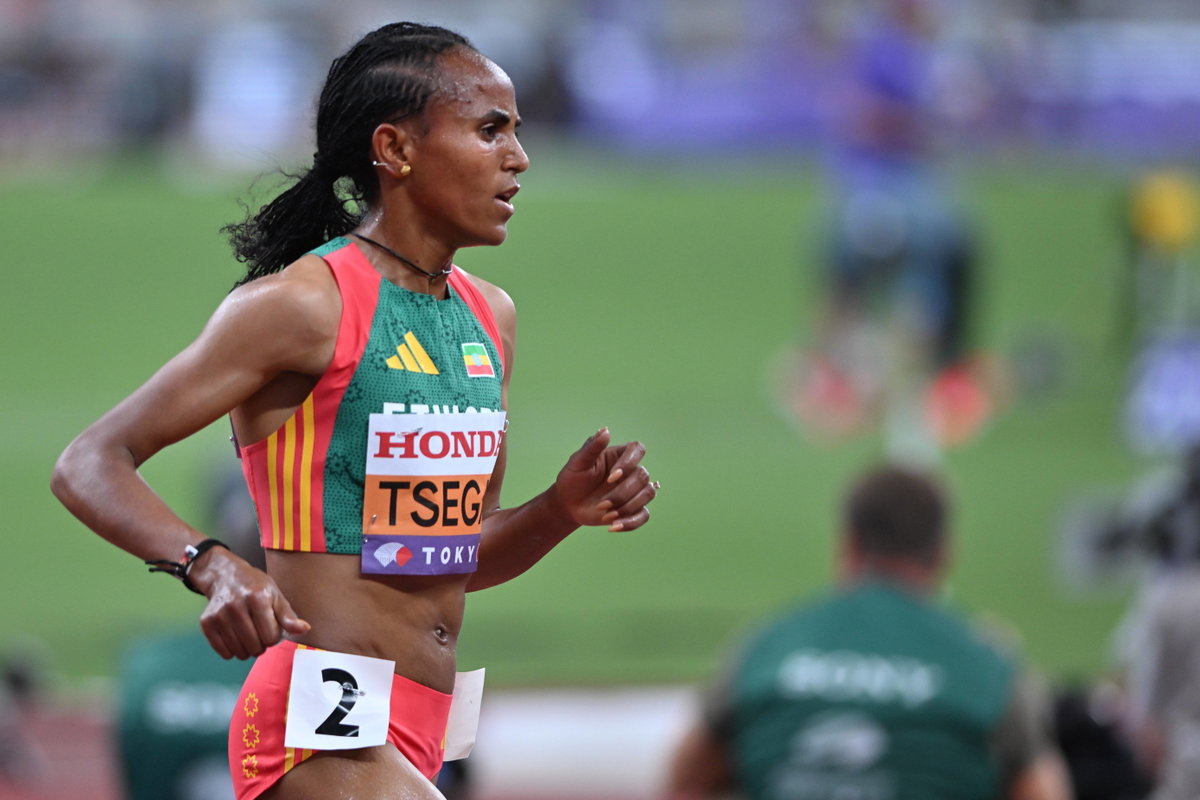
Ethiopian distance runner Gudaf Tsegay has been handed a four-month ban after testing positive for a prohibited substance. The suspension comes as a major setback for one of the sport’s biggest stars, whose career has been defined by both remarkable success and significant personal challenges.
Watch What’s Trending Now!
Tsegay rose to prominence despite enduring a difficult period during the Tigray conflict in Ethiopia, when she was separated from her father and brothers for almost 18 months. She went on to win gold at the 2022 World Championships, claim the 10,000m title at Budapest 2023, and run 3:50.30 in the 1500m in 2024. But now, things have gone awry.
The AIU announced on June 12 that the 29-year-old Ethiopian has received a four-month suspension for having a metabolite of Letrozole in an out-of-competition doping test taken on 5 December 2025. The violation falls under Rule 2.1 (Presence of a Prohibited Substance) and Rule 2.2 (Use or Attempted Use). Letrozole is listed under WADA’s Prohibited List (S4.1 aromatase inhibitors) and is banned at all times in and out of competition.
On January 26, 2026, Tsegay was notified that her test result had come back positive. The following day, she provided medical documentation showing that she had been prescribed the medication for a valid medical condition. She then requested a Therapeutic Use Exemption on February 17, 2026, which the World Athletics TUE Committee subsequently confirmed met the medical criteria set out in Article 4.2.

Gudaf Tsegay 🇪🇹 has been banned for 4 months after testing positive for a metabolite of Letrozole in an out-of-competition test conducted on 5 December 2025! Tsegay acknowledged the anti-doping rule violations and entered into a Case Resolution Agreement with the Athletics Show more

But WADA denied her appeal for a TUE to be granted retroactively, under Article 4.3, meaning that the violation was still in effect because the exemption was not issued before the sample was taken.
After the two parties reached an impasse, the AIU and WADA finally agreed that she had been granted a reduced sanction for this violation, according to Rule 10.6.1(a) (No Significant Fault or Negligence), as a result of the mitigating factors, including that she had admitted to the violation as soon as it occurred and that she would have been granted a TUE if she had applied for it beforehand.
In a statement, Tsegay said, “To all athletics fans, following recent news, I would like to share an update. I took the letrozole supplement to improve my fertility, as prescribed by my Doctor. Currently, my pregnancy is progressing perfectly, and I hope to return to sports as soon as my baby is born. Thank you to all the fans for your love. I miss you all. I also appreciate the understanding and support from AIU.”
Following the announcement by the AIU of a four-month suspension, 🇪🇹 Gudaf Tsegay has issued a statement saying she was taking Letrozole to improve her fertility and is currently pregnant.


Two-time World champion and Olympic medalist Gudaf Tsegay 🇪🇹 has been banned for four months after testing positive for a metabolite of Letrozole (an aromatase inhibitor prohibited at all times under the WADA Prohibited List). The ban runs from June 1 to September 30, 2026.

Tsegay’s suspension is from June 1, 2026, through September 30, 2026, but all results for December 5, 2025, are void. The decision also rules her out of major events during that period, including Diamond League meetings and the inaugural Ultimate Championships in Budapest (September 11-13, 2026).
But Tsegay is not the only marathon runner to face a recent sanction, with Deborah Sang receiving a much harsher punishment.
Deborah Sang’s verdict after positive drug test
Kenyan marathon runner Sang has been handed a five-year ban after testing positive for two banned substances, testosterone and prednisolone.
The 26-year-old first returned a positive result for testosterone in late 2025, before later samples also detected prednisolone. The violations were linked to testing carried out around major races, including the Belgrade Marathon on April 6, 2025, and the Riyadh Marathon in January 2026.
Following the findings, Sang admitted the anti-doping rule violations through the Anti-Doping Agency of Kenya. On March 25, 2026, she submitted a signed admission form confirming she accepted both the violations and the sanctions listed in the official notice. Her suspension officially started on March 11, 2026, and will last for five years.
Sang was performing well on the marathon circuit in recent months. She finished the 2025 Belgrade Marathon in 2:26:51, her PB and course record, and in 2:29:49 at the Lisbon Marathon in 2025, as well as 2:30:29 at the Mersin Marathon in 2024.
Sang herself has stayed silent on the matter. But it comes just one day after Rhonex Kipruto, another long-distance runner from Kenya, was also handed a five-year suspension. Cases like these have put greater focus on Kenya’s persistent doping problem. Authorities have increased testing in recent years, with recent reports stating that around 140 athletes from the country are currently suspended.
Brett Clothier, in an interview from 2023, explained why Kenya is a hotbed for athletes found to be doping. “The difference in ability, in that pyramid, between the top and those below is not very much because of the depth of their talent,” he said, per BBC.
“In the past, we have been testing the top of that pyramid, but the bottom ones have not been subject to out-of-competition testing. That pyramid is hundreds, or even thousands, of athletes.”