
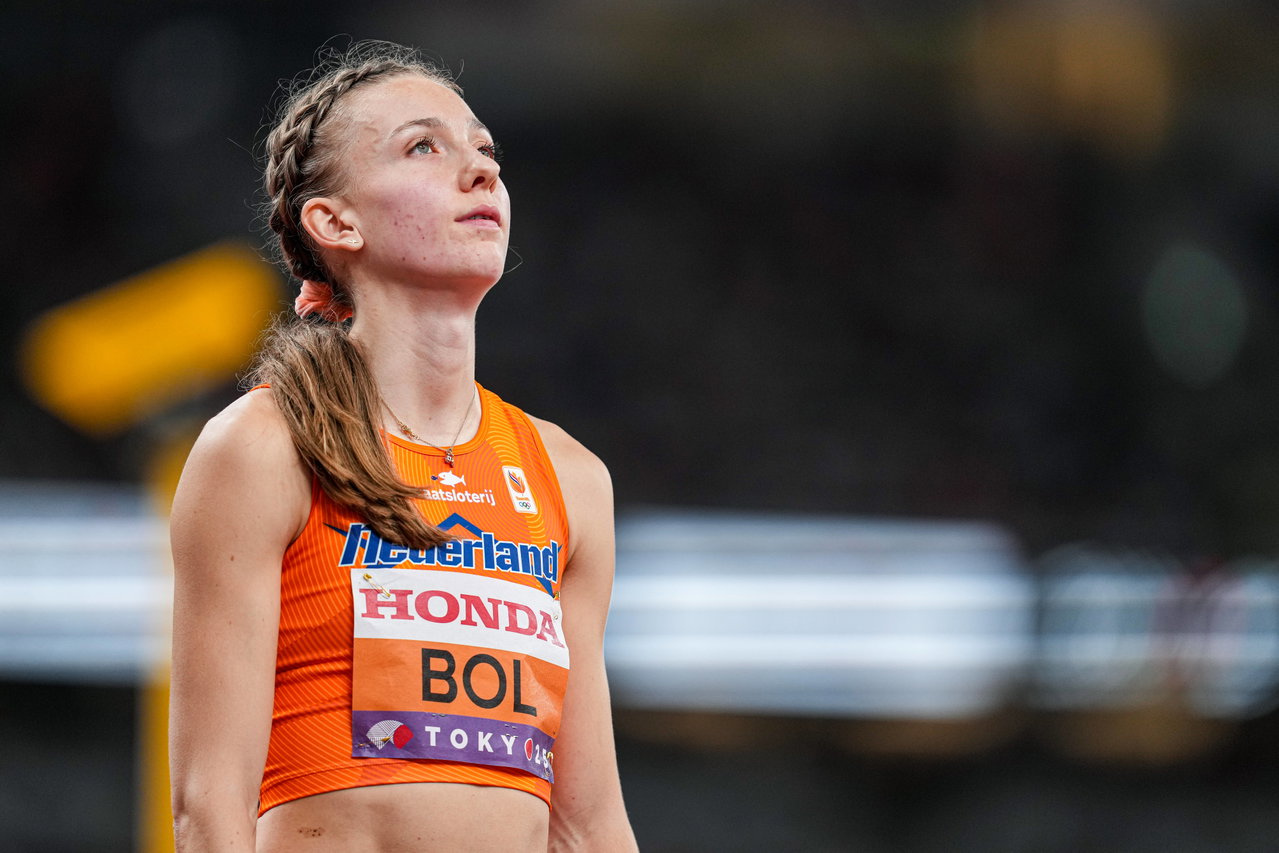
Being the second fastest woman in history in the 400m hurdles is a dream most hurdlers chase, but Femke Bol wants something more! Despite being only the second woman, alongside Sydney McLaughlin-Levrone, to go under 51 seconds, Bol still decided in October 2025 to shoot for the 800m. Set to make her outdoor debut at the Golden Spike meeting on June 16, the Dutch star has laid bare the challenges of entering uncharted territory.
Watch What’s Trending Now!
During a press conference ahead of her outdoor showdown, Bol was questioned regarding her move up in distance. In response, she elaborated on her mindset and training methods. When asked to highlight the biggest challenge in the transition, she offered a straightforward answer.
“I think all of it,” Femke Bol said, as shared by Zlatatretra on YouTube. “Of course, there are certain things that are tougher than other parts. I do like the long running, but in the beginning it was quite hard for me to understand how this works, to not get so high in lactic, to look at heart rate, things like this.”
The transition isn’t only about distance; it underscores how the body creates and utilizes energy. The 400m hurdles relies heavily on anaerobic power, unlike the larger aerobic phase required in the 800m.
Additionally, elite middle-distance runners typically boast a much higher aerobic base than sprint hurdlers. For Femke Bol, it’s been a new rhythm regarding training and races. And her first test wasn’t too shabby.

Imago
Track & Field: World Athletics Championships-Morning Session Sep 20, 2025 Tokyo, Japan Femke Bol NED poses during the women’s 400m hurdles ceremony during the World Athletics Championships at National Stadium. Tokyo National Stadium Japan, EDITORIAL USE ONLY PUBLICATIONxINxGERxSUIxAUTxONLY Copyright: xKirbyxLeex 20250920_kdl_al2_43
In February 2026, she ran her first-ever 800m at the Meeting Metz Moselle Athlélor in France, clocking 1:59.07 indoors. She clinched the race and set a new Dutch indoor record, breaking a mark that had stood since 2001.
But as she now approaches outdoor season, Femke Bol admits the challenge has shifted from physical adjustment to something more mental.
“I also like it when it’s sometimes uncomfortable and when you get into new places, because you can push yourself,” she stated. “I think the tactics I will really need to learn throughout the season. I’ve been watching a lot of 800m races to see how people deal with different tactics.”
Still, she is embracing the discomfort that comes with learning a new event.
As Bol says, “But I think overall it’s been the change of the unknown that’s been maybe the hardest in training and mentally, but overall I’m enjoying it a lot.”
For someone who has already won two Olympic gold medals in the 400m hurdles, why make the switch at all? The answer lies in timing. Bol has wanted to make the jump while still performing at her peak.
“I think it’s not necessarily for my body, because I think the hurdles are tough on you, but I think the 800m training will also be tough on my body,” said the 26-year-old athlete.
So, she is thinking of a long-term career. Even her coach, Laurent Meuwly, believes the transition could yield a quick impact, even in a new event.
“I think she’ll surprise a lot of people in this first month of competition,” he said. “There’s a lot of excitement because it’s been a long period without racing. We’re looking forward to a new challenge.”
But Bol’s first bow is unlikely to be easy, with a strong field waiting in Ostrava.
Fierce rivals and records await Femke Bol’s 800m debut
As she takes a leap of faith, Bol’s biggest challenge is Audrey Werro, who arrives in red-hot form after running 1:53.98 in Stockholm. The Swiss athlete’s searing pace pushed her to third on the all-time list. Interestingly, she is ranked #2 in the world and stands a whisker away from world record pace.
However, the women’s 800m world record still belongs to Czechoslovakia’s Jarmila Kratochvílová, who notched up 1:53.28 in Munich in 1983, a mark that has stood for decades.
Besides Werro, another threat is Keely Hodgkinson, the reigning Olympic champion. Currently ranked #1 in the world, Hodgkinson’s personal best of 1:54.87 cements her as one of the best middle-distance runners ever. However, she might still feel a slight sting having suffered a recent defeat to Werro in Stockholm.
As for Bol, the writing is on the wall. Despite achieving her best time of 1:59.07 at her indoor debut in Metz, her performances must improve to overthrow the records dotting the event. She, however, plans to arrive with humility and determination.
“I’m going into it as a rookie because I have no idea how fast I can go,” she said. “I just hope people don’t expect me to run a world record in my first race because that’s impossible. The goal is to peak at the Los Angeles Olympics in 2028.”
So, Ostrava isn’t about delivering a statement, but building a path towards further greatness.