
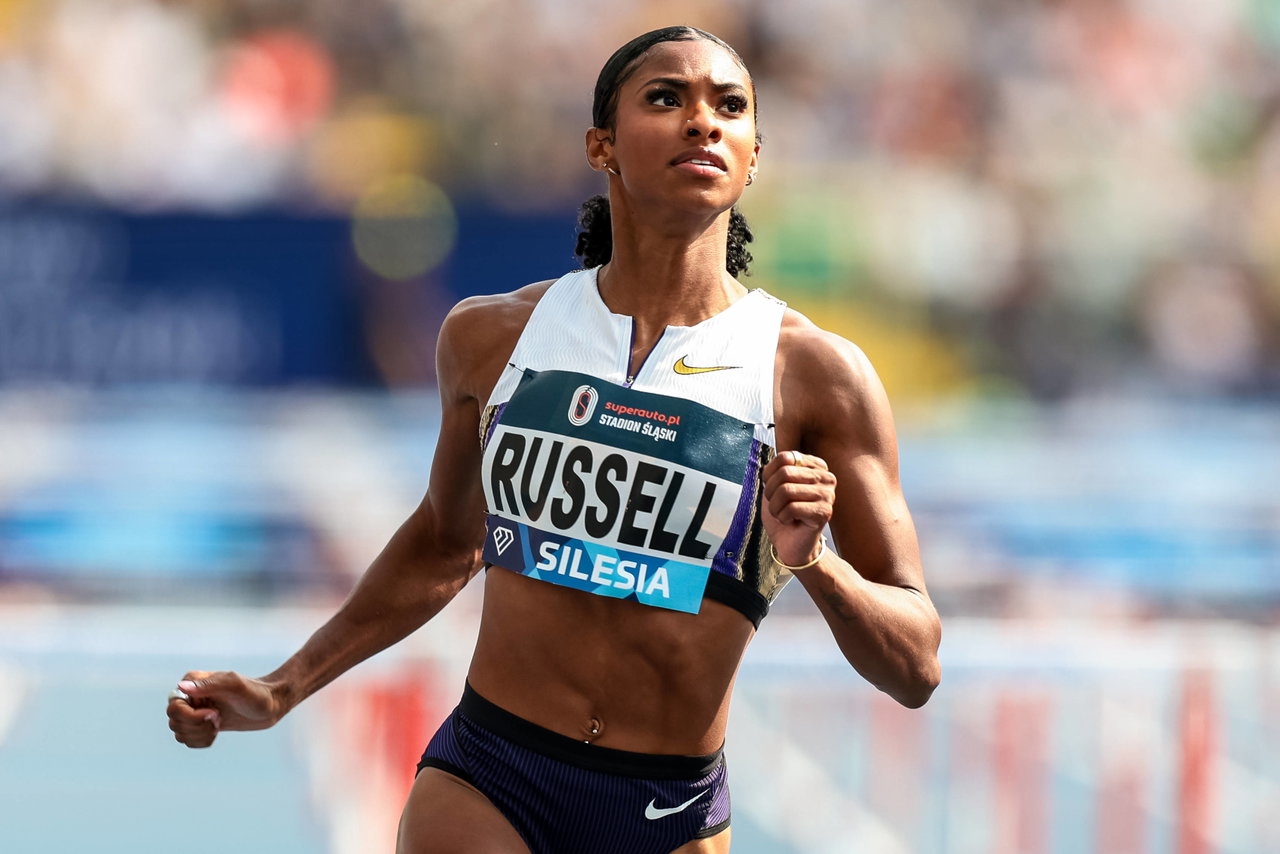
Winning an Olympic gold medal should have been the ultimate reward for Masai Russell. Yet, even as the American hurdler continued breaking records, something felt missing. Her performances were getting better, but her connection with the sport was slipping away.
Watch What’s Trending Now!
In a recent interview with Scripps Sports, Russell opened up about the mental battle that followed her triumph at the Paris Olympics. The 26-year-old admitted that running fast and collecting victories no longer brought the satisfaction she once felt. Recognizing that disconnect forced her to reconsider what she wanted from athletics and how she could protect her career in the long run.
Russell did not experience the familiar post-Olympic slump immediately after Paris. The difficult period arrived during the following season, when she returned to competition and found herself struggling to understand why she was still doing it.
On the track, the results gave little reason for concern. She was winning races, posting world-leading times and eventually setting an American record of 12.17 seconds in the 100m hurdles. But the numbers could not capture what was happening mentally. “Every single time I stepped on the track, I just felt like, ‘Alright, like, what is the point of all of this?'” Russell recalled.
Even the record-breaking performance did not provide the emotional lift she expected. For an athlete accustomed to finding joy in competition, that realization was difficult to ignore. “Even when I got to the outdoors and I broke the American record, I ran 12.17; it didn’t feel as rewarding as anything else from the previous year,” she explained.
Rather than dismissing those feelings or pushing through them, Russell took a step back. She realized that her ambitions extended beyond winning the next race. She wanted to build a legacy, collect more medals, and remain at the top of the sport for years. “I just had to relearn myself, and I had to relearn who I was as an athlete,” she said.
That change in perspective became especially important when she considered the consequences of burning out so early in her career. “If I’m burnt out two years after the Olympics or a year after the Olympics, that’s just only going to hurt my career further and further down the line,” she added.
Russell’s honesty comes after a career that has already tested her ability to handle setbacks. Her competitive instincts developed early in Upper Marlboro, Maryland, where she grew up racing her older brothers, Philip and Devine. Their basketball training often brought them to the track, giving their younger sister an opportunity to chase them.
“I think my competitive drive definitely came from growing up with my brothers,” she recalled. “I think that’s why I was so fast because I was just competing against them, trying to keep up with them.”
Her parents, Sharon and Mark, also played a major role in shaping her approach. Her father spent long days at track meets, setting up tents and making sure she had everything she needed. Her mother balanced raising a family with her work as a doctor, showing Russell what dedication looked like.
Those lessons became valuable when her progress hit obstacles. At the 2023 NCAA Championships, Russell ran 12.32 seconds but finished behind Ackera Nugent.. Later that year, she made her World Championships debut but failed to reach the final after clipping a hurdle in the semifinals.
She found another difficult stretch in 2024 before finally winning her first national title at the US Olympic Trials. That victory earned her a place in Paris, where she produced the biggest moment of her career.
Russell edged France’s Cyréna Samba-Mayela by just 0.01 seconds to win Olympic gold in the 100m hurdles. She initially had no idea which medal she had secured. “Crossing the line in Paris, I didn’t know that I won,” she said. “I looked up and was like, ‘I know I got a medal, but which one?’ And when I saw my name come up, I just lost it.”
The Olympic title fulfilled a dream, but the following season showed her that success alone could not sustain her motivation.
The challenges did not disappear overnight. Russell endured a frustrating 2025 campaign, finishing fourth at the World Championships despite entering the season with enormous expectations. That disappointment forced her to confront what she wanted from the sport.
“I’ve had to lose in front of the world, I had to be humiliated, I had to take the ‘L’s,” she said ahead of her historic performance in Zurich. She also acknowledged that those uncomfortable moments had helped her understand what she needed to change.
The work paid off spectacularly in 2026. Russell went unbeaten across 14 races in the 100m hurdles, establishing herself as the dominant force in the event. At the Diamond League meeting in Zurich on August 27, she clocked 12.09 seconds to break Tobi Amusan’s world record by three-hundredths of a second.
Even more impressive, she achieved the feat without any wind assistance. Russell admitted that the scale of the achievement had not immediately sunk in.
“I’m still processing it,” she said after the race. “It’s a blessing just because I’ve been chasing it, and the world’s been talking about it. So just to finally do it, it’s like, ‘All right, I can breathe a little bit. Not all the way, but partially.'”
She later capped her season by winning the inaugural World Athletics Ultimate Championships in 12.22 seconds. Her performances also earned her a nomination for the 2026 Women’s World Athlete of the Year award.
Masai Russell has bigger ambitions ahead
For all her achievements, Russell is not ready to settle. She has her sights set on the 2027 World Championships and the 2028 Los Angeles Olympics, where she will have another opportunity to strengthen her legacy.
Her ambitions stretch beyond medals. Drawing inspiration from Usain Bolt’s seemingly untouchable records, she wants future generations to look at her achievements and wonder how she managed to reach such heights.
“I want people to question the same thing about Masai, like, ‘How was she able to do this?'” she told CNN Sports.
But her recent admission about burnout offers another glimpse into the athlete behind the records. Russell understands that a long career requires more than physical preparation. Sometimes, protecting her future means stepping back, rediscovering her purpose, and remembering why she started running in the first place.
And after finding that perspective, she appears ready to chase even bigger goals.