
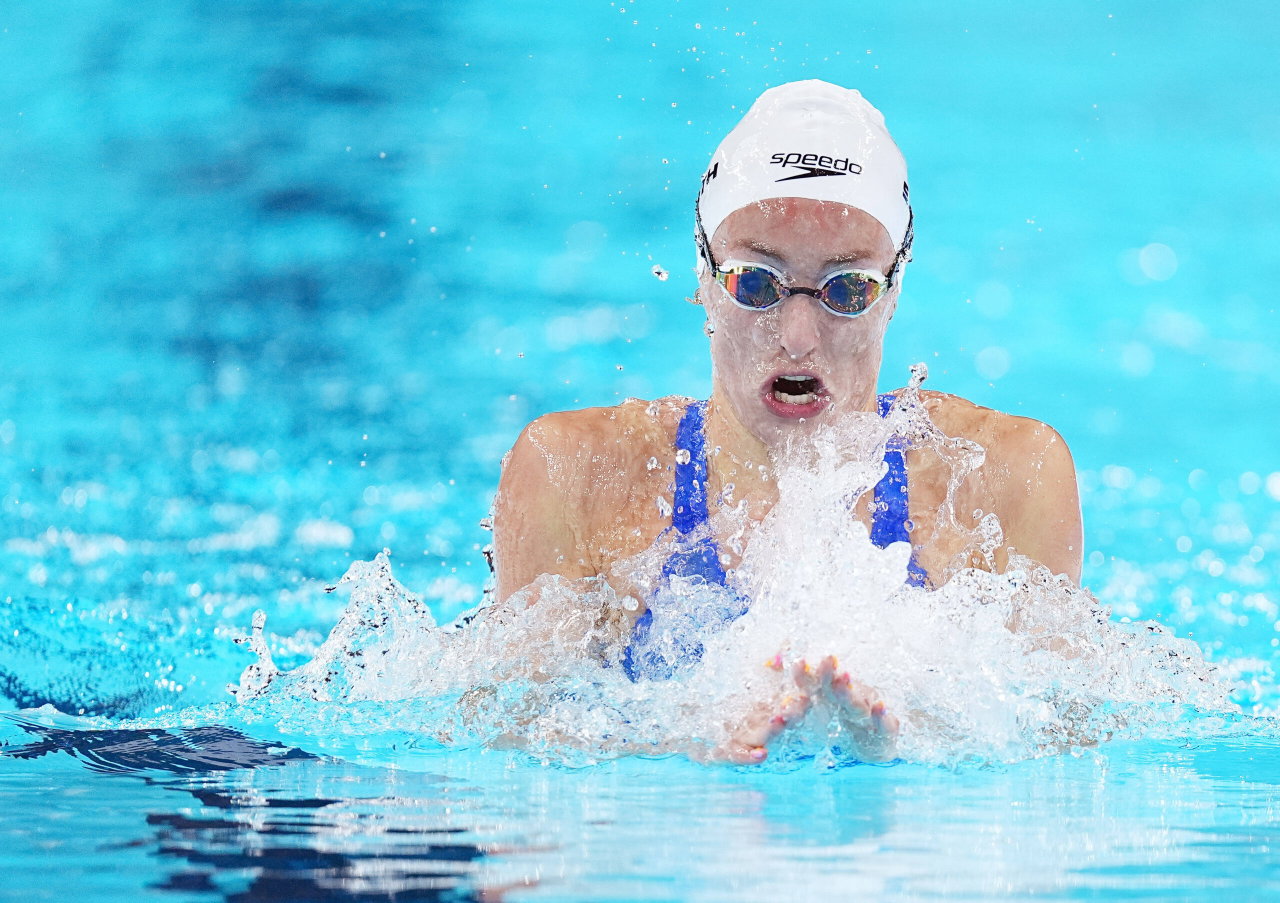
Tatjana Smith’s decision to leave South Africa and represent the Netherlands has put Swimming South Africa under scrutiny. The tensions between the swimmer and the federation date back to the 2023 World Aquatics Championships, where Swimming SA withheld her $35,000 prize money over a sponsorship dispute involving Arena and Speedo. After announcing her switch, Smith opened up about the financial struggles and lack of support she faced in South Africa. Now, Swimming SA Operations Manager Mafata Modutoane has come forward with his side of the story, explaining how the federation supported Smith.
Watch What’s Trending Now!
Speaking on Metro FM on November 11, Modutoane rejected the suggestion that Swimming SA had failed to support Smith during her career. He said the federation had backed her since she was 12, when she was first spotted in Mbombela. However, he also admitted that the support was not always financial because the federation did not have enough money.
“We’ve supported Tatjana. We really supported Tatjana. Sometimes it’s not financial because as the federation, we cannot afford it. We don’t have the financial means,” he said. But Modutoane also placed some of the blame on Smith, claiming that she had contributed to the problems between them. “But at the same time, Tatjana sabotaged herself,” he added.
He was referring to the disagreement between Smith and Swimming SA over the federation’s technical sponsor, Arena, and her personal sponsor, Speedo. Modutoane explained that the federation had an agreement with Arena, which required South African athletes to wear its kit when competing as part of the national team. They could choose other brands for private competitions, but the rules were different when representing the country.
The disagreement became public at the 2023 World Aquatics Championships in Fukuoka, Japan. Smith competed in Speedo gear despite Swimming SA’s agreement with Arena. She won silver in the 100m breaststroke on July 25 and gold in the 200m breaststroke on July 28, earning a total of $35,000 in prize money. Swimming SA withheld the money and threatened to fine her €46,000 over the kit dispute.
The federation later dropped the fine, but the prize money remained unpaid for more than a year. Smith eventually received the money after legal intervention. Modutoane defended the Arena agreement, saying it offered athletes financial rewards for wearing the sponsor’s kit. He claimed swimmers could receive €10,000 for an Olympic gold medal, €5,000 for silver, and €3,000 for bronze, provided they competed in Arena gear.
He also said the agreement brought around R300,000 to the federation, while athletes received a larger share of the benefits. According to Modutoane, Smith had accepted the Arena kit but continued to compete in different technical gear. “She accepted the kit. But when she appears to go and swim, she’s swimming in different technical gear,” he said.
Modutoane also brought Smith’s manager, Joel Smith, into the discussion. Joel, who is now her husband, was an agent for Speedo, according to the operations manager. He argued that this created a conflict between the swimmer’s personal sponsorship and the federation’s agreement with Arena. He further claimed that Smith had received a better sponsorship offer but had never brought it to the federation for discussion. However, he did not provide details of that offer during the interview.
The dispute also involved the money Smith believed she should have received from Swimming SA. Modutoane said she had complained about not getting financial support from the federation, but he argued that athletes who did not wear Arena kit were not eligible for the payments linked to the agreement. “I say, ‘But you’re not swimming with Arena. How do you get money?’” he said.
While Modutoane defended the federation’s position, Swimming SA had already admitted that withholding Smith’s prize money was wrong. On October 13, acting president Zikie Molusi apologised during the federation’s appearance before Parliament’s Sport, Arts and Culture Portfolio Committee. The apology came after the federation faced questions about why it had kept the $35,000 Smith earned at the 2023 World Championships.
“We believe that this issue could have been better handled,” Molusi said at the parliamentary meeting. The issue returned on November 12, when Molusi spoke to 702’s Bongani Bingwa. Asked directly whether withholding the money had been the right decision, he gave a clear answer. “Yes, it shouldn’t have happened,” he said.
Swimming SA responds to claims of poor support
Tatjana Smith’s concerns about swimming conditions in South Africa have put the country’s swimming federation under scrutiny. The four-time Olympic medalist retired after the Paris 2024 Games, having won two gold and two silver medals across her Olympic career. She returned to competitive swimming in 2026, two years after stepping away, but the challenges facing the sport in South Africa remain part of the conversation.
In a September 2026 interview with GQ South Africa, Smith spoke about the lack of swimming facilities and qualified coaches in underprivileged communities. Through her Lighthouse Sport Foundation, she hopes to give more children the chance to take up the sport. But she pointed out that many simply do not have access to the resources needed to get started. “There isn’t a lot of opportunity for swimming in those communities, there aren’t the facilities, and there aren’t coaches,” she said.
Smith explained that swimming is not like soccer, cricket, or rugby, where children can find a space and start playing. They need a swimming pool, lessons and someone qualified to teach them. Without those things, talented children may never get the chance to discover what they can achieve in the water.
Swimming SA Operations Manager Mafata Modutoane has disputed the idea that the federation is responsible for the poor condition of public swimming pools. Speaking on Metro FM, he said the responsibility for building and maintaining these facilities lies with municipalities. He added that Swimming SA has tried to help maintain some pools, even though it has limited financial resources. “We don’t own facilities. The municipalities are the ones responsible for building and maintaining those facilities,” Modutoane said.
He also said the federation was working towards owning a swimming facility in Franschhoek. His response comes as Smith continues to draw attention to the lack of access to pools and coaching in disadvantaged communities. While Modutoane points to the municipalities’ responsibility for public facilities, Smith’s comments highlight how those conditions can limit opportunities for the next generation of South African swimmers.