
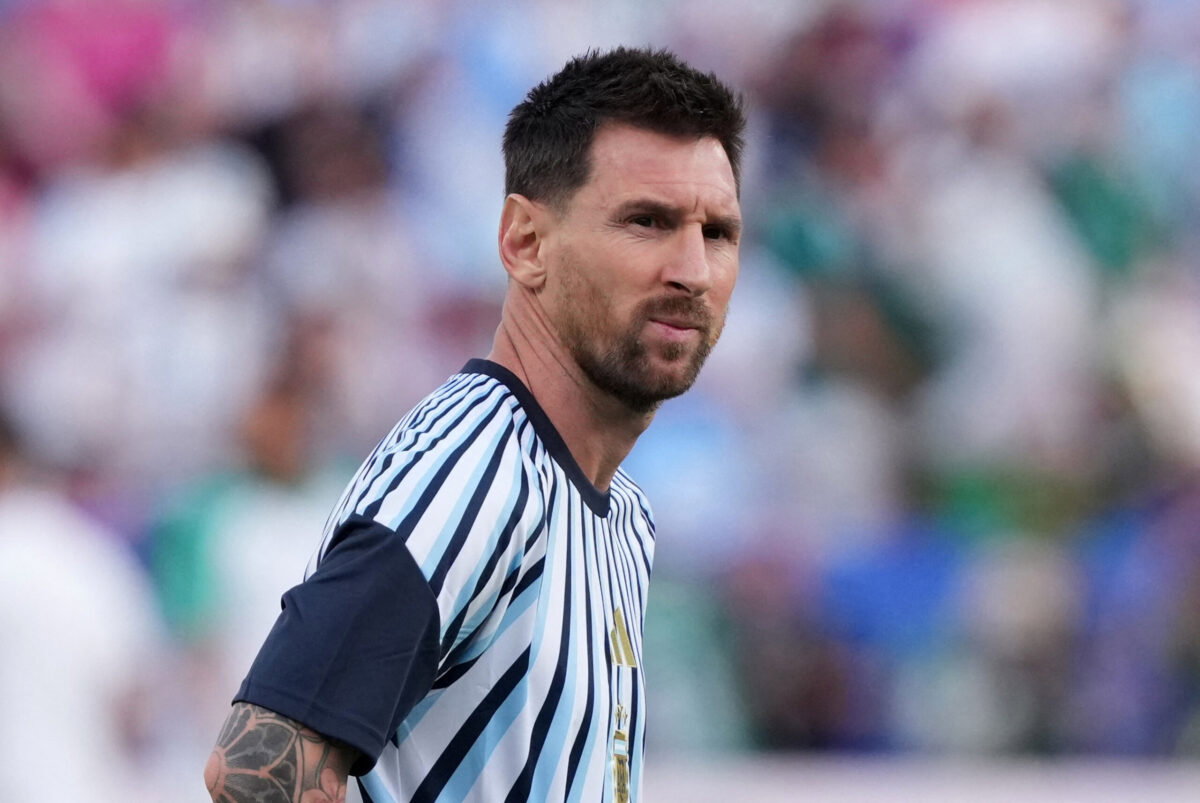
Outside of being left-footed forwards playing in the MLS, it turns out Lionel Messi and Miguel Almiron perhaps should have had more in common. Or so fans believe after they spotted the Argentine legend covering his mouth during the 2026 FIFA World Cup. After all, the Paraguayan was sent off for doing the same, and yet fans wondered why Messi wasn’t! As it turns out, Alexi Lalas explained exactly why.
Watch What’s Trending Now!
Responding to a fan who asked why Messi wasn’t sent off for covering, Lalas tweeted, “That’s not, as the law states, in a ‘confrontational situation with an opponent.'”

That's not, as the law states, in a "confrontational situation with an opponent."

There was a moment where Messi covered his mouth to a teammate right after a goal celebration. Nothing there?
This was after Miguel Almiron became the first-ever player in football history to receive a red card under the new IFAB rules. The referee sent off the Paraguayan after he saw a review of talking to Mert Müldür while covering his mouth. While it’s unclear what Atalanta United forward said to Müldür, under IFAB’s new laws, doing that results in a red card.
Lalas tweeted about the incident to explain to a fan who questioned the red card. That was when Lionel Messi came into play. The 38-year-old was at the center of everything during Argentina’s 3-0 win over Algeria. He even scored his first World Cup hat-trick. However, many Algerian fans believe that the referee should have shown him a straight red before he hit that mark.
As it turns out, not once but twice after Messi covered his mouth in the 68th minute, when the score was 2-0 to the Albiceleste. Although Lalas came to his defence, the American icon was exactly right. Created by the International Football Association Board (IFAB) in April, the new rule only applies in a “confrontational situation with an opponent.”
Messi wasn’t in that situation. Instead, the Argentine was in deep conversation with his teammates and even head coach Lionel Scaloni. That doesn’t fall under the purview of the rules, and he wasn’t the only one spotted doing the same. England’s Declan Rice, Sweden’s Victor Gyokeres, and other players have done the same thing.
The situation varied, but it was largely before set-pieces, with most of them taking place during free-kicks. That allows teammates to converse without fear of the opponent reading their lips or overhearing them. Almiron’s sending off, however, stems from an incident in February 2026 involving Vinicius Junior and Gianluca Prestianni.
The Real Madrid forward alleged that the latter, a Benfica midfielder, racially abused him while covering his mouth with his shirt. The incident saw Prestianni hit with a six-game ban and led to the rules being adjusted with the new addition. While the change took effect in April, IFAB implemented it from the start of the 2026 FIFA World Cup and will also apply to the regular season.
However, Lionel Messi’s problems may not be over after the Algerian Football Federation (FAF) filed a complaint with FIFA.
Algerian Football Federation files complaint over Messi’s red card
During the 30th minute of Algeria’s first group stage game of the 2026 FIFA World Cup against Argentina, the away side were enraged. That was because they believed Albiceleste captain Lionel Messi had caught Algeria captain Aissa Mandi on his right calf. The issue, they believed, was that Messi’s tackle was studs-up and should have resulted in a direct red card.
That has usually been the case for tackles at that height, especially since VAR debuted. However, the on-field referee, Szymon Marciniak, did not hand out a card, but he did give Algeria a free-kick. The incident took place with Argentina 1-0 up, after Messi opened the scoring. The Inter Miami star would go on to score two more times, with the game ending 3-0.
According to The Athletic, the situation has now changed, as the Algerian Football Federation (FAF) has filed an official complaint with FIFA over the decisions. The report indicates that the FAF believes that the Messi incident, alongside two other incidents, should have led to cards.
This comes after fans claimed that the eight-time Ballon d’Or winner received special treatment from the officials. Even Algeria’s head coach, Vladimir Petkovic, touched upon the incident.
“It’s pointless commenting on hypothetical situations, but everyone saw it, including me,” Petkovic said in his press conference after the game.
For now, FIFA has not yet decided on Algeria’s complaint, so both teams will focus on their next matches. Argentina will play Austria on June 22 in Dallas, while Algeria faces Jordan on the same day as Group J standings begin to form.