
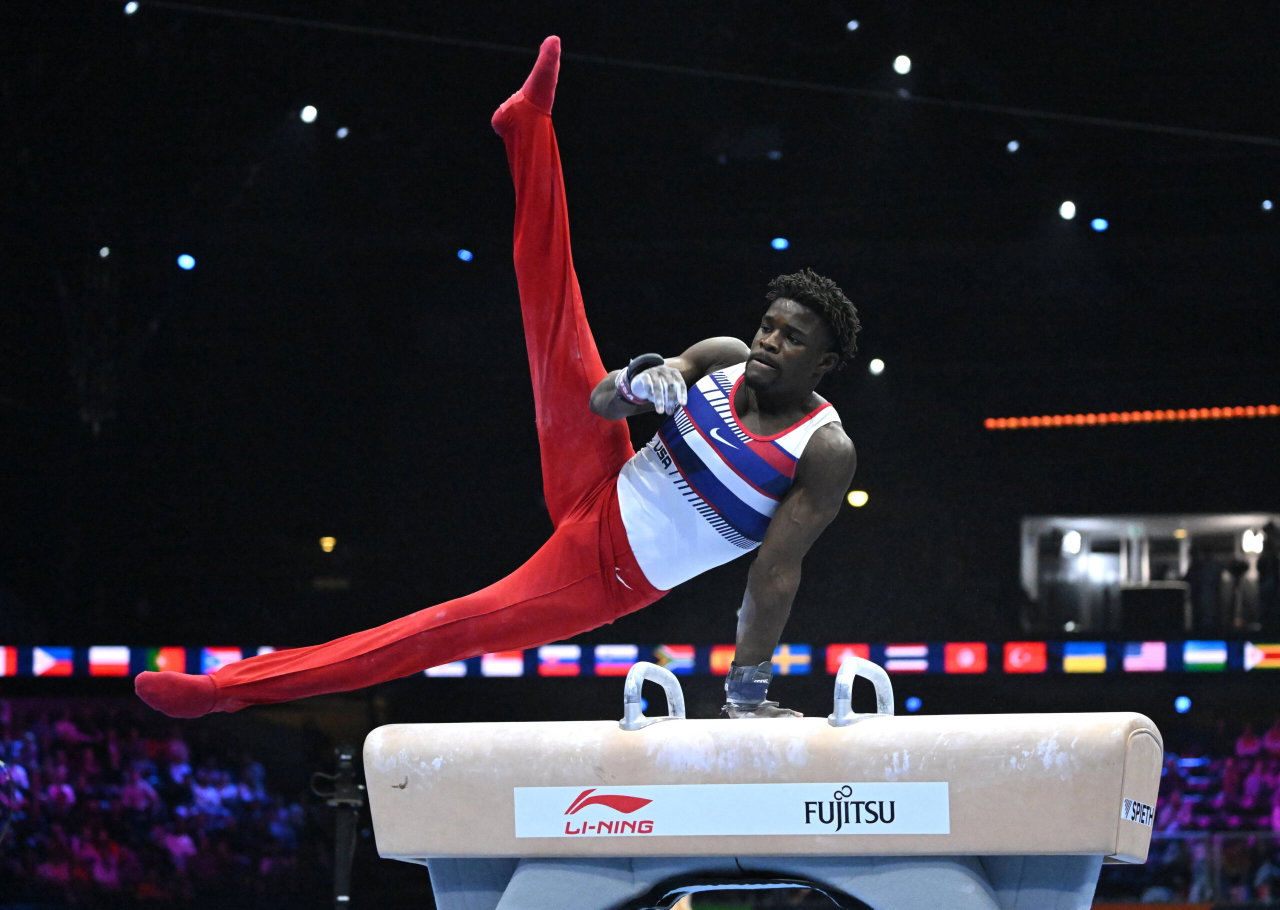
Team USA’s hopes of securing an early men’s gymnastics team berth for the LA 2028 Olympics took a hit after the Americans finished sixth in the team final at the 2026 World Artistic Gymnastics Championships. With a score of 245.161, the U.S. failed to secure one of the three Olympic team qualification places available through the final. The result also marked the country’s worst World Championships team-final finish since 2006, when the Americans placed 13th in qualification. While the setback left the team disappointed, Team USA head coach Syque Caesar believes the result exposed areas that need attention before their next Olympic qualification opportunity.
Watch What’s Trending Now!
Speaking after the competition in an interview with Inside Gymnastics on October 20, Caesar admitted that the team had the ability to finish among the top three and pointed to missed opportunities that proved costly in the final. “I think we’re a top three team. And today we didn’t show,” Caesar said. But the coach also identified another factor that he believes contributed to the disappointing result.
“Inexperience played a factor,” Caesar admitted, acknowledging that some of the gymnasts were still learning how to handle the pressure of a major international competition. Caesar also believed the Americans had left valuable points behind on floor exercise. “I think we lost about four points on the floor,” he said.
With China securing third place on 249.193 points, the United States had little room for error. The Americans finished sixth with 245.161, falling more than four points short of the podium. But beyond the team’s disappointing result, Caesar saw the experience as a learning opportunity, particularly for young gymnast Danila Leykin, whose high-bar routine proved costly.
Leykin scored just 11.466 on high bar after struggling through his routine, dealing another blow to the Americans’ medal hopes. Despite the setback, Caesar remained confident that the young gymnast could grow from the experience. “I think he’s going to get a lot better,” he said. “I think he will never want to feel like this ever again.” Caesar also praised Leykin’s talent and character, calling him “an unbelievable gymnast” and “an amazing person.”
He also stressed that the athlete had completed the preparation expected of him, saying, “I’m confident knowing that he put all the work.” Yet, as Caesar explained, preparation alone cannot guarantee that a gymnast will perform at the same level when the pressure of a World Championships final arrives.
“When you go into the world stage, things change,” Caesar said, explaining why the team needed to find ways to prepare more effectively for high-pressure situations. Asked how the Americans could become more consistent, he offered a direct answer: “We got to train harder and we got to train better.” He also discussed the possibility of introducing more variables into training to help gymnasts adjust to different competition conditions.
The coaching staff already tries to recreate the atmosphere of major events through full practice sessions around the apparatus, using lighting and sound to make the environment feel more realistic. Still, Caesar believes there may be room to do more, particularly when preparing younger athletes who have less experience competing at this level.
“You cannot simulate the world championships,” Caesar said, although he added, “But you can get really close.” Despite the disappointing result, Caesar made it clear that he remained “Extremely proud of every athlete.”
The sixth-place finish means Team USA must wait until the 2027 World Championships in Chengdu, China, for its next and final opportunity to qualify a full men’s team for the LA28 Olympics. However, the Americans’ campaign in Rotterdam is far from over.
Repeated falls expose Team USA’s struggles with consistency
At the 2026 World Artistic Gymnastics Championships, signs of trouble emerged during qualification, when the United States struggled to maintain consistency across all six apparatus. Danila Leykin fell on parallel bars, while Frederick Richard also fell off the apparatus. The problems continued on pommel horse, where both Leykin and Shane Wiskus fell, forcing the team to count costly scores on an event that demands precision. Although the Americans still advanced to the final in fifth place, those early mistakes offered a warning of the challenge ahead.
Floor exercise brought further complications during qualification. Richard received a deduction for repeating an element, while Kameron Nelson nearly lost control of his final tumbling pass and stumbled forward to avoid a fall. Other routines also featured execution deductions, including imperfect landings and body-position errors. Each mistake chipped away at the team’s score, leaving the Americans with less room for error against the world’s strongest contenders.
Unfortunately, the United States could not put those problems behind it in the final. Leykin fell on the high bar, earning just 11.466 points, while Richard fell on pommel horse. Despite strong individual performances from Patrick Hoopes, who scored 14.833 on pommel horse, Wiskus, who earned 14.333 on parallel bars, and Nelson, who posted 14.133 on floor exercise, the team could not make up the lost ground.
Still, there is more to fight for in Rotterdam. Richard and Leykin are scheduled to compete in the men’s all-around final on October 22. The apparatus finals on October 24 will also feature Hoopes on pommel horse and Richard on floor exercise, offering the Americans a chance to leave the championships with individual medals.
The result is a setback for a team that won men’s team bronze at the Paris 2024 Olympics and arrived in Rotterdam hoping to challenge for another major podium finish. Yet the competition is not over, and the experience could prove valuable as the United States looks ahead.