
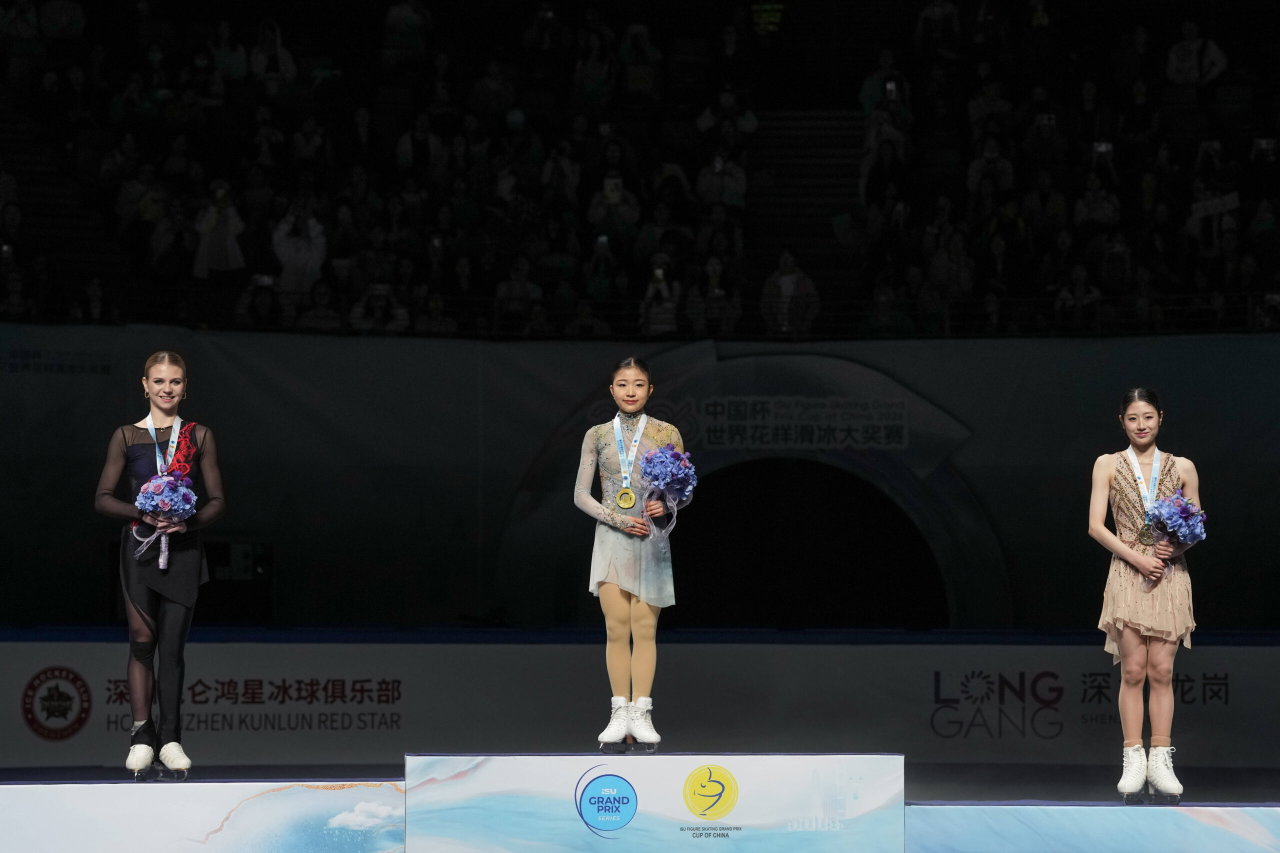
Winning an international title should be the moment an athlete receives the loudest applause. For Japan’s Mone Chiba, however, the celebrations at the Cup of China reportedly turned into an uncomfortable experience. Despite delivering a memorable performance to claim gold, the figure skater faced boos and derogatory chants from sections of the home crowd, with the hostility reportedly continuing online.
Watch What’s Trending Now!
Chiba secured the women’s title in Shenzhen on November 7, finishing with 224.48 points. She edged out Russian star Alexandra Ignatova, formerly known as Alexandra Trusova, who scored 221.27 in the free skate. But the result did not sit well with some spectators, who had clearly backed the returning Olympic silver medalist.
The reaction became particularly uncomfortable during the medal ceremony, when sections of the audience reportedly directed insulting chants at Chiba. Videos circulating online captured the hostility, prompting criticism from figure skating fans who felt the Japanese champion deserved respect regardless of whom she had beaten.
Ignatova’s popularity in China could partly explain the reaction. The Russian skater returned to the Grand Prix circuit after a five-year absence and immediately attracted considerable attention. Having won Olympic silver at Beijing 2022, she already enjoyed a dedicated following. Her comeback after motherhood only added to the excitement surrounding her appearance.
Her performance also gave those supporters plenty to celebrate. Ignatova landed a quadruple Lutz and scored 148.90 in the free skate, narrowly outperforming Chiba’s 148.40. However, Chiba’s advantage from the short program proved decisive, allowing her to take the overall victory.
Some spectators reportedly struggled to accept that outcome. During the medal ceremony, chants included phrases that roughly translated as insults, calling her a fake or undeserving figure and telling her to leave.
There have also been online claims linking the hostility to alleged earlier remarks by Chiba about avoiding meat in China due to possible doping contamination concerns. However, there is no independently verified evidence establishing that she made those remarks or that they triggered the crowd’s reaction. Such claims should not be treated as an established explanation for the abuse.
Whatever the reason behind the hostility, targeting an athlete for winning a competition crosses the boundaries of sporting rivalry.
The incident quickly attracted attention beyond the competition, with fellow skaters and fans expressing disappointment over the treatment Chiba reportedly received.
American figure skater Amber Glenn was among those who showed support. “This breaks my heart; Mone is such a sweet soul and doesn’t deserve hate over something she had no control over,” she wrote. Glenn also reposted a video highlighting the treatment of the Japanese champion, accompanied by the message, “This is how you treat your medalists.”
Glenn’s gesture resonated with fans who felt that sporting achievements should never become an excuse for public humiliation. Chiba had competed, earned her points, and won according to the official results. Her opponent’s popularity should not have changed how spectators treated her.
The backlash also extended to social media, where Chiba reportedly faced a wave of negative comments. Reports indicated that she subsequently restricted or disabled comments on her Instagram account. The incident has consequently raised questions about the responsibility of spectators and event organizers to protect athletes from targeted harassment.
Mone Chiba’s emotional return ends with a Grand Prix title
What makes the treatment particularly disappointing is the effort Chiba put into reaching the podium. The 21-year-old returned to competition after an ankle injury and delivered two strong performances in Shenzhen.
She had already established a lead in Friday’s short program, scoring 76.08 points with her James Bond-themed routine. Ignatova stood third with 72.37, leaving Chiba with an important advantage heading into the decisive free skate.
On Saturday, Chiba took to the ice for Claude Debussy’s “Clair de Lune.” Her composed performance earned 148.40 points, enough to preserve her overall lead despite Ignatova’s higher free-skate score.
Overcome with emotion after completing her routine, Chiba put her hands to her face. She later spoke about the nerves she experienced and how the competition reminded her of her love for skating. “I was very nervous, but I was just reminded of how much I love skating,” she said. “I believed in myself and managed to keep my focus. I was able to reproduce everything I’ve been working on in practice.”
The victory marked her third career Grand Prix title and continued Japan’s impressive start to the women’s Grand Prix season. Nakai Ami and Shimada Mao had already won the opening two events, making Chiba the third consecutive Japanese champion.
Ignatova, meanwhile, also had reason to celebrate. Returning to the Grand Prix podium after becoming a mother, she finished second overall and reflected on how her priorities had changed.
“In the past, finishing first was the most important thing for me. But now, what matters most is skating cleanly and consistently, and that’s what I did,” Ignatova said.
Both athletes had delivered performances worthy of appreciation. Yet, for Chiba, an achievement that should have been remembered for her return from injury and another major title was overshadowed by an entirely different kind of attention.
A gold medal should never come with a price like that. And no matter how passionately spectators support their favorite, basic sportsmanship should never disappear when the results do not go their way.