
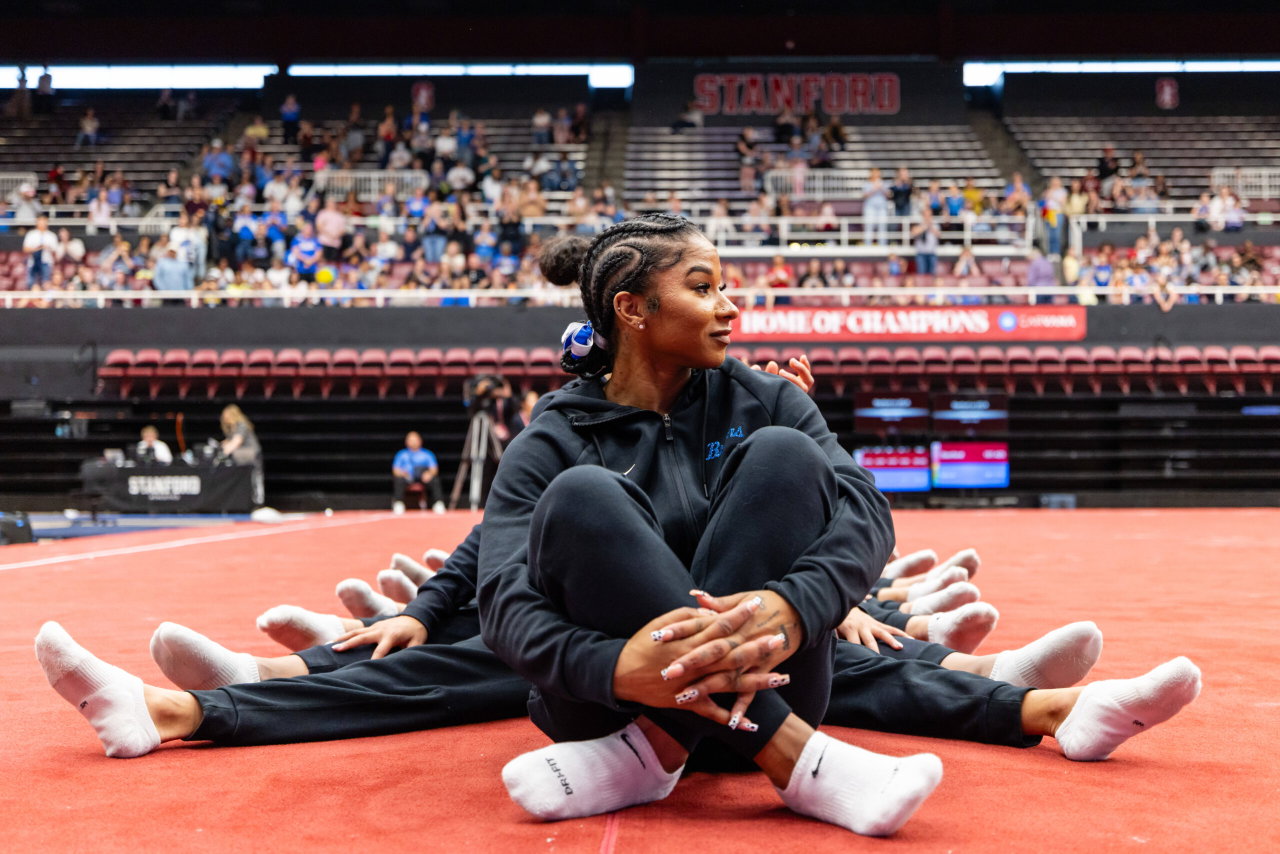
Jordan Chiles didn’t even realize her final vault at the 2026 NCAA Championships was her final vault. She only found it out after UCLA’s April 16 semifinal exit ended her Bruins career. And six days later, she signed off on Instagram with the line that had followed her through Westwood for four years: “THAT GIRL! Is out.” Her goodbye, though, held for barely four months.
Watch What’s Trending Now!
A federal court in Colorado has just reopened the door she thought was shut for good. U.S. District Judge Charlotte N. Sweeney granted a class-wide preliminary injunction on July 31, and unlike two similar rulings issued that same week, hers doesn’t stop at a list of named plaintiffs.
It covers every Division I athlete who falls within the certified class and began competing in the 2022-23 season and had used up four years of eligibility by the end of 2025-26. This is a description that fits Chiles exactly, since she joined UCLA that same season after deferring her college career for the Tokyo Olympics.
The dispute traces back to the NCAA’s new “5-for-5” model, which hands incoming athletes five years to complete five seasons, the clock starting at enrollment or the academic year following their 19th birthday, whichever comes first.
Athletes who’d already exhausted the old four-year limit before that date weren’t covered, that is, until courts started ruling otherwise.
Hamilton County, Ohio judge Christopher Wagner opened the first crack on July 9, granting a preliminary injunction to 24 basketball players and clearing them for the transfer portal. Then, hours before Sweeney’s ruling, a Nashville chancery court granted a similar injunction to 19 basketball players, including Vanderbilt’s Jalen Washington and Ole Miss’s AJ Storr. Sweeney’s was the first to go class-wide.
The NCAA is expected to appeal to the Tenth Circuit, and NCAA president Charlie Baker (who had previously said outgoing seniors wouldn’t be grandfathered into the new rule) pushed instead for Congress to act:
“Without targeted intervention from Congress, college sports cannot set nationwide rules everyone can play by, and without Congress, failed professionals will continue to use college sports as a fallback option—robbing the next class of young athletes of college scholarships.”
He tied the ruling to the pending Protect College Sports Act, calling the chaos around eligibility “exactly why it’s time to pass this bill.”
None of that changes what Chiles did on the floor this year. She won the AAI Award as the nation’s top senior, her fourth individual NCAA title, and spent most of the season ranked No. 1 in the all-around nationally.
Whether she actually returns still depends on UCLA having a roster spot to offer her. It also depends on the Tenth Circuit leaving Sweeney’s ruling standing long enough for the transfer and roster windows tied to it, which the original Colorado filing set for August 3 through 10, to matter.