

It was Week 1 of the 2023 season when the Miami Dolphins were believed to have started an offensive trend that would later be called “speed motion” or “cheat motion.” Under this strategy, offensive players in motion would build momentum and lean toward the line of scrimmage even before the center snapped the ball.
Watch What’s Trending Now!
Wide receiver Tyreek Hill was believed to have used it early on, with the San Francisco 49ers and Los Angeles Rams later utilizing it to their offensive advantage. However, that recently led Tyler DeSena, a freelance contributor for the Dolphins on SI, to claim that NFL offenses could be cheating by using this “potentially illegal” strategy at the time of the snap.
However, DeSena’s commentary prompted former Philadelphia Eagles center Jason Kelce to respond, as he pushed back against the claim and admitted that the move isn’t illegal at all.
“There is nothing illegal about these motions,” Kelce wrote. “He isn’t going forward until the ball is snapped, his shin angles don’t matter, his intent to time the snap and move forward doesn’t matter. All that matters is his body moving forward, which it very clearly isn’t.
“It’s a pretty clear rule, that sometimes gets missed when teams attempt to snap it with timing like this. Neither of these instances are good examples of when they do miss time it and the motion player is moving forward. If you don’t like the rule as it is, what would you change about it?”
In the NFL, a player can move sideways or backward before the snap, but they aren’t allowed to move forward toward the line of scrimmage, a distinction that hinges on rigid timing and mechanics. Under NFL Rule 7, Section 4, Article 2, even legal pre-snap movement carries strict boundaries:
“It is a False Start if the ball has been placed ready for play, and, prior to the snap, an offensive player who has assumed a set position charges or moves in such a way as to simulate the start of a play, or if an offensive player who is in motion makes a sudden movement toward the line of scrimmage. Any quick, abrupt movement by a single offensive player, or by several offensive players in unison, which simulates the start of the snap, is a false start.”
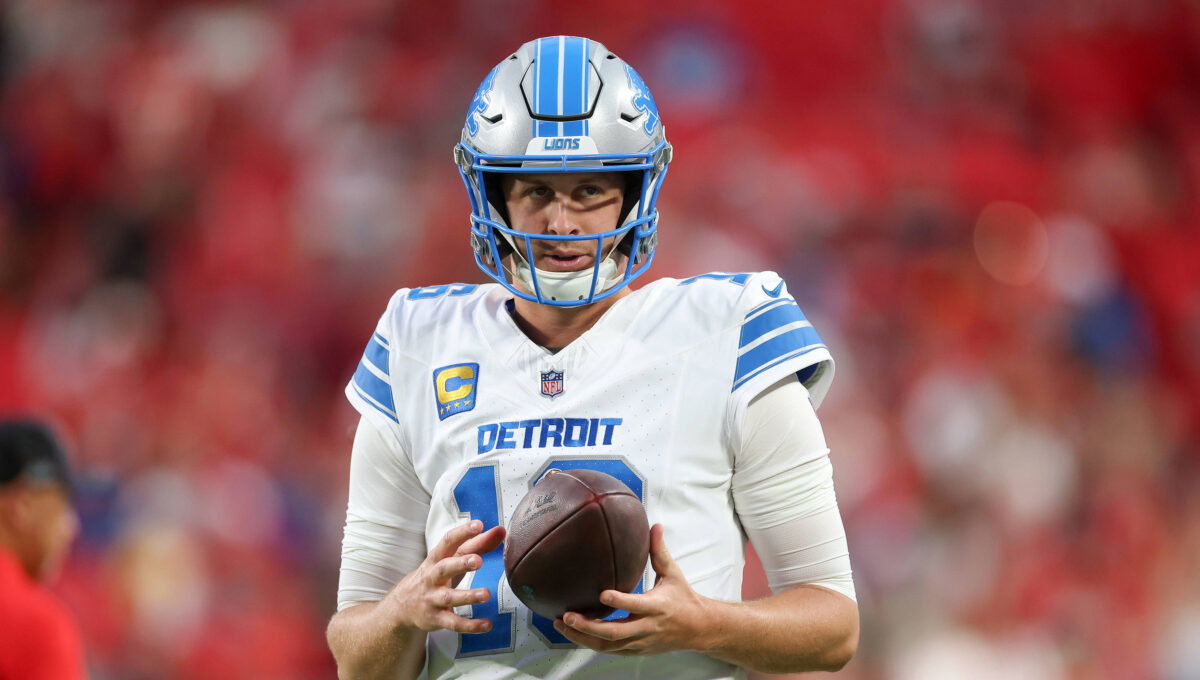
The Detroit Lions learned this the hard way when a Jared Goff touchdown was wiped out against the Kansas City Chiefs last year. On the trick play, Goff shifted out of the T-formation before the snap. But because he failed to pause for at least one full second before the ball was snapped, officials flagged him for illegal motion, costing Detroit five yards and a touchdown.
Imago
October 12, 2025: Detroit Lions quarterback Jared Goff 16 warms up before an NFL, American Football Herren, USA football game against the Kansas City Chiefsat GEHA Field at Arrowhead Stadium in Kansas City, MO. /CSM Kansas City United States of America – ZUMAc04_ 20251012_zma_c04_497 Copyright: xDavidxSmithx
Unlike the NFL’s strict anti-forward limits, the Canadian Football League (CFL) openly embraces full downhill momentum. Under CFL rules, eligible backfield receivers can build up a running start and sprint directly toward the line of scrimmage before the snap, a feature known as the “waggle.” The only constraint? They can’t cross the line of scrimmage until the ball is snapped.
Whether in the NFL or the CFL, this pre-snap movement isn’t just about gaining speed; it’s about gathering intelligence. When a player shifts across the formation, the defense is forced to reveal its hand. If a cornerback trails the moving player across the field, the quarterback immediately knows he’s facing man coverage, giving the offense a critical pre-snap advantage before the play even starts.
In his commentary, DeSena discussed the 49ers fullback Kyle Juszczyk. Before the snap, Juszczyk moves toward the line and appears to be slightly moving downhill/forward. However, that tactic is particularly valuable for the 49ers because Juszczyk can use his pre-snap movement to generate momentum before becoming a lead blocker. At 235 pounds, the veteran fullback can turn that momentum into additional force at the point of contact, helping create space for the running game.
This way, he is gaining an unfair physical advantage by slightly moving forward into his block before the snap. Jason Kelce, however, isn’t on board with this claim. While the viral analysis focused on the fullback’s shin angles and apparent intention to move downhill as evidence that Juszczyk could be moving illegally, Kelce argued that neither factor determines whether a penalty has occurred.
The only question is whether Juszczyk’s body is actually moving toward the line of scrimmage when the ball is snapped, and Kelce believes the footage clearly shows that it isn’t. At the same time, the controversy surrounding Kyle Juszczyk’s pre-snap motion isn’t entirely new.
The league has spent the past few seasons dealing with the rise of so-called “speed motion” or “cheat motion,” in which offensive players attempt to build momentum before the snap. The NFL clarified its motion rules in 2024, allowing backfield players to continue moving before the snap as long as their movement isn’t abrupt or toward the line of scrimmage. Moreover, the real conflict isn’t just defining the rule; it’s officiating it in real time.
When executed perfectly, “cheat motion” happens in a fraction of a second. Down on the field, line judges must track multiple moving parts simultaneously, spotting a player’s forward shift and signaling the penalty before that nanosecond window slams shut. League officials will almost certainly instruct referee crews to monitor downhill momentum more strictly, complete with pre-game warnings to coaching staffs. Yet as long as offensive masterminds keep toeing the razor-thin line between perfect timing and an illegal head start, referees are left trying to police a snap-second grey area at full speed.