
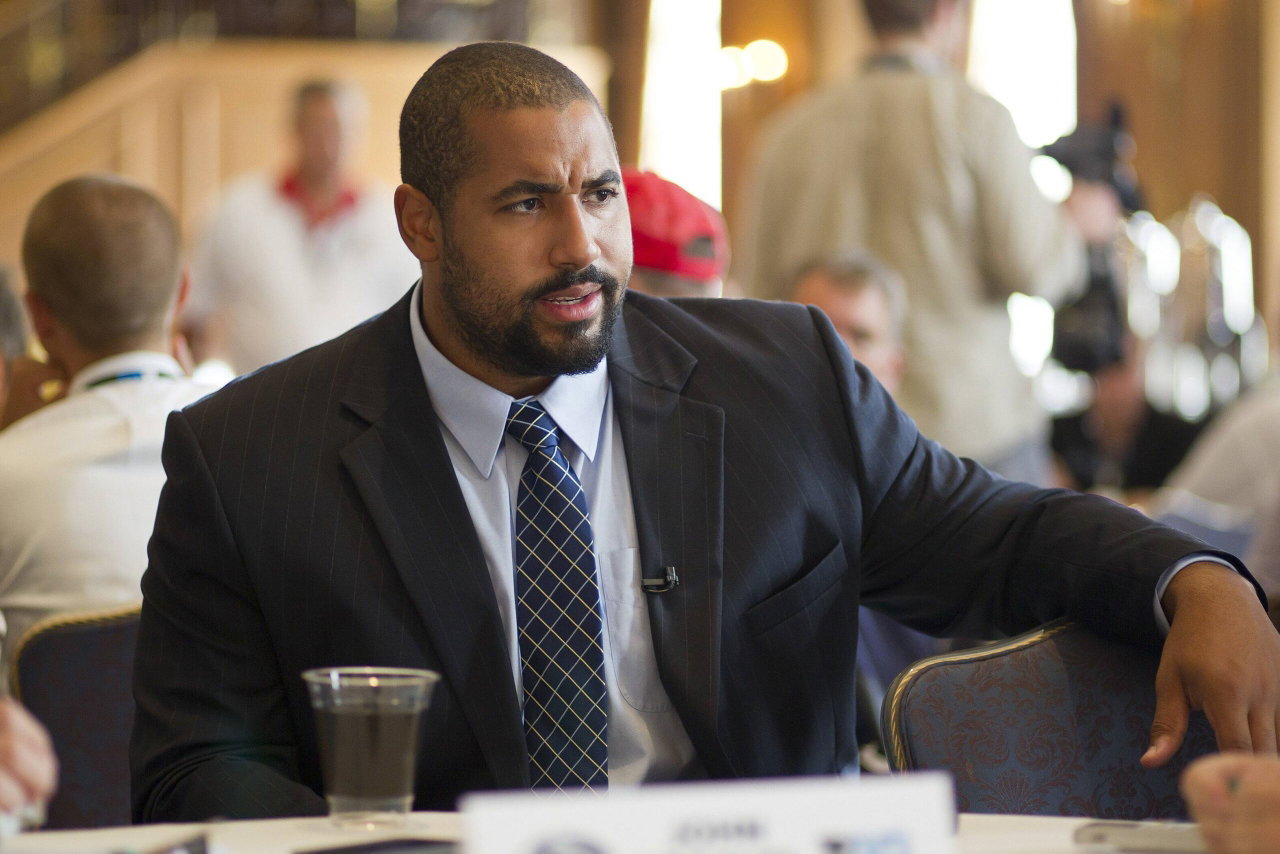
How does a 4.0 GPA mathematics genius end up smashing heads in the NFL? “I love hitting people,” former Baltimore Ravens anchor John Urschel admitted in his essay on Players’ Tribune. The 2013 William V. Campbell Trophy winner had a rare dual identity: a dominant lineman and an elite academic talent. Yet, the math behind brain trauma and Chronic traumatic encephalopathy (CTE) was impossible to ignore. That’s why on July 27, 2017, Urschel made a choice. Set to take over as starting center, the 26-year-old walked into coach John Harbaugh’s office and hung up his cleats forever.
Watch What’s Trending Now!
Now, almost a decade later, the MIT assistant professor of mathematics, who holds a Ph.D. in applied mathematics from the same institute, spoke about his decision on the Better in Person with Stephen Dubner show.
“So this is the last year of my rookie contract. I make a decent amount more, at least a million a year. I’m thinking maybe I do one more, maybe I don’t. And, you know, I’m going back and forth, and I’m just saying, ‘No, I’m not going to, like, come on. I need to.’ And then I say, ‘No, I should.’ You know, sort of going back to high school me, like I have a year left on my contract. I need to see my contract out…
“These contracts are not guaranteed. If you’re hurt you’re done and you know in hindsight why is this such a hard decision like I needed to retire and focus on math and like go like hang out with my kid and the more time I spent at MIT math really sort of went above and then you know this idea of being a parent this is also going above and so now like in hindsight like if football’s the third most important thing to me and it’s a legitimate liability for the first two you know for a long mass not to mention all the hours it’s taking away and the toll it takes on your body. Not even your head, but you know, your entire body to walk.”
You remember when former San Francisco 49ers linebacker Chris Borland’s sudden retirement at age 24 shook the NFL to its core? It hit John Urschel on a deeply personal level. The two had battled years earlier in college, leaving Urschel with a singular impression: “Chris was one of the toughest football players I’ve ever had the pleasure of playing against,” Urschel wrote in his essay.
Borland walked away after months of consulting concussion researchers and studying brain disease. Yet even as Borland’s choice gave him massive perspective, Urschel’s raw passion for the game kept him on the field. Then, the danger stopped being theoretical.
During an open-field practice drill in August 2015, Urschel suffered a brutal helmet-to-helmet collision with Ravens safety Terrence Brooks. The impact knocked him cold. The physical recovery was one thing, but the cognitive aftermath horrified him. For nearly a month, the math prodigy noticed a devastating dip in his mental sharpness; he suddenly couldn’t solve high-level mathematical proofs. It was a terrifying firsthand preview of what a prolonged NFL career could cost his mind.
The final tipping point came in July 2017 with the publication of a landmark JAMA study, revealing CTE in 110 of 111 deceased former NFL players. For a mind wired around applied mathematics and statistical probability, a 99% risk factor was an undeniable math equation. However, walking away meant turning his back on serious financial security. Urschel was set to earn a base salary of $690,000 in 2017, with a lucrative second contract waiting on the horizon. Instead, he chose to walk away from generational wealth to survive on a graduate student stipend at MIT.
But the financial aspect of the decision hardly affected him. Urschel didn’t live like a professional athlete. He famously drove a used hatchback Nissan Versa and survived on less than $25,000 a year. He had zero interest in chasing a $10 million bank account; his biggest expenses were graduate textbooks, a research computer, and a chessboard. Beyond analyzing numerical linear algebra, spectral graph theory, and machine learning, he was an avid chess player driven by a dream of becoming a titled player.
His mother had always pleaded with him to stop playing. His fiancée, Louisa Thomas, wanted him out of the helmet, too. Yet his love for the game kept him anchored to the field, until the overwhelming reality of brain trauma forced a reckoning.
“It was not that this new evidence was extremely overwhelming to change my opinion. It’s more like this really brings something to my attention in a very real way that, quite frankly, I was more or less aware of but attempting to ignore to a degree,” Urschel said.
Two days after that report came out, Urschel walked into Harbaugh’s office. Harbaugh publicly expressed respect for the decision. He acknowledged that while the team was surprised by the timing, they supported Urschel’s desire to pursue his academic passions and protect his future well-being outside of the gridiron.
Subsequently, in spring 2016, he secretly enrolled in MIT’s applied mathematics doctoral program. He juggled MIT coursework during the week with Ravens games on Sundays, staying up late to balance both commitments. Since his early NFL retirement, Urschel completed his PhD in 2021, served as a member at Princeton’s Institute for Advanced Study, and returned to MIT as a tenure-track assistant professor in 2023.