Imago
Via Instagram @sfgiants
Imago
Via Instagram @sfgiants
Essentials Inside The Story
- Montana lasted less than one season in broadcasting,
- 49ers legend had a different lens, thanks to 16 seasons and four Super Bowls
- Montana praised other quarterback turned commentators, highlighting how today’s booth is different.
While the broadcast booth has become a lucrative second act for legends like Tom Brady and Troy Aikman, it was a place Joe Montana couldn’t stomach for more than a single season. Now, he’s finally shed some light on why he quit NBC back in the day.
Watch What’s Trending Now!
“Coming from the other side as a player, so many times, people are making judgments on a player, or on what happened on the field, they have no idea,” he told CNBC’s Alex Sherman. “It would be hard to judge our receivers, our quarterbacks, that played under Bill [Walsh] because our receivers had so many adjustments they could make on a hook, a hook doesn’t always have to be a hook.
The former San Francisco 49ers quarterback stepped into the booth immediately after retiring. He lasted just one season. Montana’s post-field career got off to a brief start. In 1995, he joined NBC as a studio analyst for their pregame show, stepping into the broadcast booth just months after retiring in April. Nine games later, Montana walked away.
“A hook went to a post, it went to an out, it went to a cross. It just depended on the defense,” the former quarterback continued. “So, as someone sitting up in the box, you have no idea what all those are, who misread who, and all that. I just didn’t like making those kinds of judgments on players. I was uncomfortable.”
.png)
.png)
.png)
Montana’s sympathy comes from a decade and a half of experience. Montana spent 16 NFL seasons under center, winning four Super Bowls, three Super Bowl MVPs, and two league MVPs. Diagnosing defenses and mastering playbooks, however, wasn’t the challenge. Evaluating players publicly, without knowing every adjustment or assignment, didn’t sit right with him.


After his final season with the Kansas City Chiefs in 1994, Montana joined NBC’s pregame show. On paper, it looked like the start of another long chapter. Soon, some dismissed him as simply not being good at commentary. Behind the scenes, though, the struggle was more internal than technical.
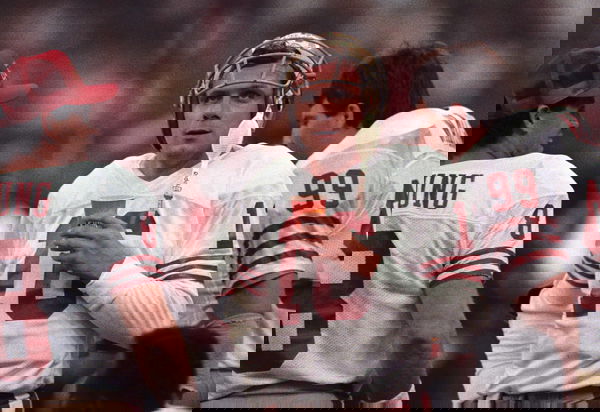
Imago
NFL, American Football Herren, USA Super Bowl XXIV Jan 28, 1990 New Orleans, LA, USA FILE PHOTO San Francisco 49ers quarterback Joe Montana 16 on the sidelines with quarterback Steve Young 8 against the Denver Broncos during Super Bowl XXIV at the Superdome. The 49ers defeated the Broncos 55-10. New Orleans Louisiana UNITED STATES, EDITORIAL USE ONLY PUBLICATIONxINxGERxSUIxAUTxONLY Copyright: xBobxDeutschx 8949027
Montana couldn’t separate his quarterback mindset from the analyst’s chair. He understood how layered every snap was, how one route adjustment or protection call could change everything.
That perspective made it difficult for him to criticize players in a simplified, television-friendly way. Ultimately, even with time left on his NBC contract, he decided he was done after one season.
For broader context, NBC’s final broadcast that year was Super Bowl XXX between the Dallas Cowboys and Pittsburgh Steelers. Montana had already covered nine regular-season games and the playoffs. But by halftime of the Super Bowl, he had made up his mind. Diana Ross was performing that day, and Montana was preparing to walk away.
“At halftime, I called my wife from the phone,” he told the New York Post in 2021. “We all had phones next to us and said, ‘I quit. I’m out of here. I can’t do this.”
So yes, it was one-and-done in broadcasting for the quarterback who led the 49ers dynasty. While there’s no denying some believe he stepped away because he wasn’t strong in the booth, Montana has clarified the real reason was, in fact, that he knew too much.
He believes the pressure was different in his era and suggested that today’s former quarterbacks-turned-commentators operate in a more forgiving environment than he did.
Joe Montana praised Tony Romo and Troy Aikman for their broadcast roles
Back in Joe Montana’s era, color commentary was largely about explaining what had already happened. The job wasn’t centered on forecasting plays or walking viewers through pre-snap reads in real time. Today, though, top former quarterbacks are often celebrated for predicting what’s coming next.
Tony Romo, in particular, has built much of his broadcasting identity around those pre-snap breakdowns. Though he’s been on the receiving end of criticism for his commentary, Montana is all praise for him. The 49ers icon recently praised Romo and Troy Aikman while explaining why the role never felt natural to him.
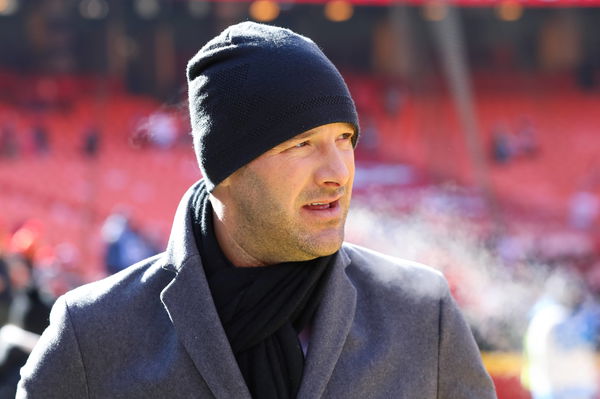
Imago
KANSAS CITY, MO – JANUARY 19: CBS broadcaster Tony Romo before the AFC Championship game between the Tennessee Titans and Kansas City Chiefs on January 19, 2020 at Arrowhead Stadium in Kansas City, MO. Photo by Scott Winters/Icon Sportswire NFL, American Football Herren, USA JAN 19 AFC Championship – Titans at Chiefs Icon2001190127
“I think a couple of the guys do an extremely good job,” he said. “I haven’t seen much of Tom [Brady], but I know Troy [Aikman] and Tony Romo. I think when you look at how they analyze a game, it is a little bit different. They’ll even get into the ‘Well, I’m not sure…’ When I was there, they just wanted you to be definitive, argumentative, and they didn’t care whether you were right or wrong, and I didn’t feel very good about that.”
From Montana’s perspective, today’s analysts are allowed, even encouraged, to acknowledge uncertainty and unpack the layers of a play. That subtle shift changes the tone of the booth.
It creates space for nuance rather than forced certainty. And that’s likely why, more than three decades later, despite his deep football knowledge, Montana has chosen to stay away from returning to it.
Related Newsletters