
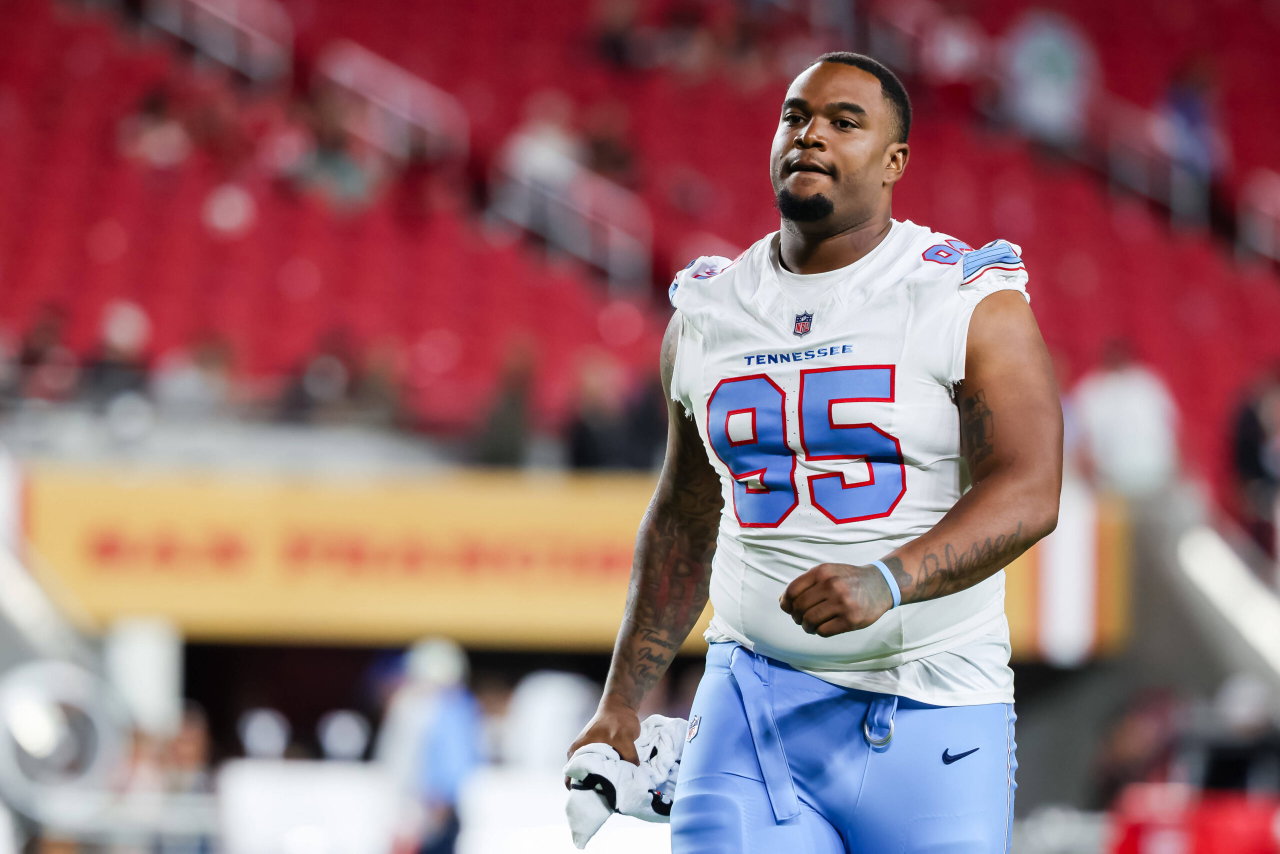
The Tennessee Titans’ statement on Jordan Elliott’s release said very little, and the explanation came a day later. Head coach Robert Saleh used a media session to push back on the rush to judge the defensive tackle, who was released after an incident involving a firearm in a parking lot. Saleh did not dispute that rules were broken, but he urged the public to look beyond the headline and ask a harder question.
Watch What’s Trending Now!
First, Saleh credited the Titans and the NFL for how they handled the situation, and he explained why he thinks they got it right.
“The reason why I think the NFL and the organization did an outstanding job is because this is a man who’s a father, a great husband,” Saleh said. “He’s never committed a crime in his entire life. And he pulled a g*n in the parking lot.”
Now, Saleh didn’t play down what happened, calling it “a terrible lapse in judgment,” and he turned to what he believes is the question being overlooked: not whether Jordan Elliott broke the rules, but what led a player like him to that point.
“And the first question that I think everyone forgets to ask is why would a great man, a great father, a man who shows up on time every day, works his a** off every day, contributes the way he’s supposed to contribute, and is well-liked in the locker room. Why did he go off the rails and grab a g*n? And to me, those are small signs of a cry for help, in terms of, obviously, there’s something greater happening.”
Elliott, 28, followed Saleh to Tennessee from San Francisco and had played five games for the Titans this season. On Thursday, October 15, he got into an altercation on the practice field with offensive tackle JC Latham. The coaches asked him to leave the field. But the dispute reportedly carried into the locker room afterward, and Elliott was seen heading to his car to retrieve a firearm, which, per ESPN’s report, never left his parking spot. Latham, speaking to reporters later, noted that there is no animosity between the two.
“I don’t really have too much to say about it,” Latham said this week. “There ain’t never been no bad blood between us two. We were here on the summer getting treatment. Before that, we hung out whenever we were in the same city together. We actually had never had an argument leading up to it.”
Following the incident, the Titans had immediately informed the league, which placed the matter under review. Meanwhile, that same day the franchise moved to release Elliott from their roster. As for Saleh, he made it clear the team’s priority was to ensure Elliott received the support he needed, and he credited the team and the league with “checking every single box” in that regard.
Saleh then tied his comments to a broader concern, noting that the league has already lost two men to suicide in the past year. In his view, they had been crying out for help and were ignored. While he didn’t name the players, Saleh was careful not to state that Elliott was in that same place. But he did add that “these kids go through a lot.” None of this has changed how he sees Elliott. He weighed his loyalty to the player against the rules.
“Like I said, I thought I will stand on the table for Jordan’s character,” Saleh added. “Unfortunately, rules are rules with regards to guns on property. And sometimes it’s far greater than the knee-jerk reaction of kicking somebody when they’re down.”
Robert Saleh’s final message was aimed at every other team, essentially because Elliott is now out of work.
“My message to 31 other teams would be, if you need a hell of a run-stopping D tackle that can help you on a playoff run, give me a call,” Saleh said. “I’ll tell you everything you need to know about him. He’s a good man.”
Now, it’s uncertain whether Jordan Elliott will land with another team. The league will continue with its review and eventually deliver a verdict on him. But Saleh’s comments have now shifted the conversation toward the question the NFL continues to grapple with: how to recognize struggles in players who seem fine on the outside.