
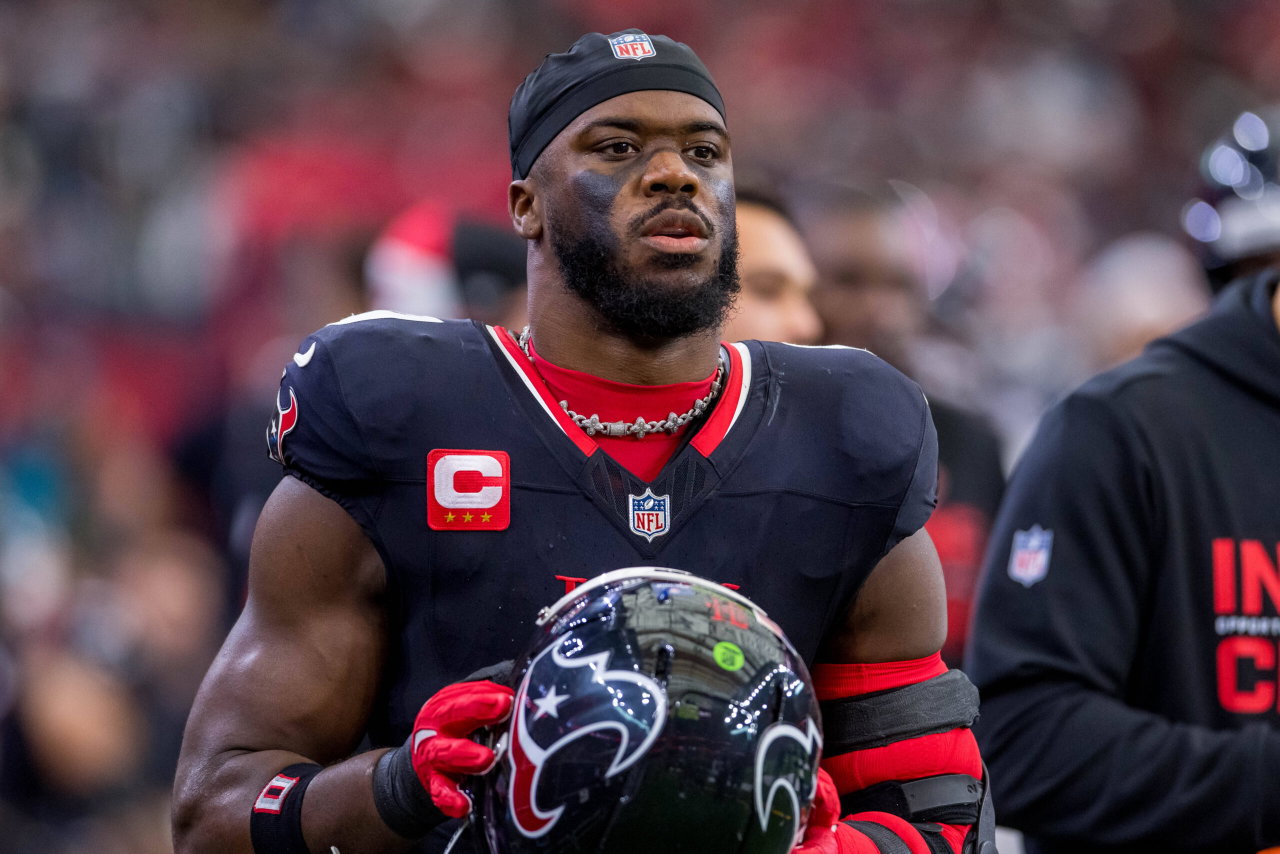
The soccer field wasn’t much of a field at all. It was rocky, rough and tucked inside a desert camp in Jordan. But for Azeez Al-Shaair, it was the children playing on it that mattered. During a July humanitarian trip, the Texans linebacker spent time with families affected by conflict, kicking a ball around with children before visiting an orphanage and a center for children with disabilities.
Watch What’s Trending Now!
The language barrier barely mattered. Al-Shaair had once been fluent in Arabic but had lost much of it over the years. What stayed with him instead were the faces. Weeks later, when he put the name of five-year-old Hind Rajab on his eye black, he explained why: many people might never have known who she was. He wanted them to know her name. A week later, there was another name on his eye black.
And according to The Athletic, an NFL official told Al-Shaair to remove her name during Houston’s Week 2 game against Cincinnati or he would not be allowed to continue playing. As per the report,
“Houston Texans linebacker Azeez Al-Shaair was told by an NFL official to remove the name of Wafaa Akila, an 8-year-old Palestinian girl killed in Gaza, from his eye black during the Texans’ Week 2 game, or he would not be allowed to continue playing,” The Athletic reported on X.
For Al-Shaair, though, the name on his face was only the latest in a months-long effort to make people look twice.
According to Reuters, Wafaa Akila was an 8-year-old Palestinian girl who was killed alongside her father in Gaza by an Israeli airstrike on September 6, 2026—her scheduled first day of school. The Athletic reported that Al-Shaair began the Bengals game with Wafaa’s name written on his eye black before a league official spotted it and told him he would have to remove it or he would not be permitted to continue playing. A league source told the outlet that Al-Shaair was not fined for the Week 2 incident after complying with the instruction.
The league’s intervention was rooted in an existing equipment rule rather than a rule specifically targeting messages about Palestine. NFL Rule 5, Section 4 prohibits players from displaying unauthorized personal messages while they are visible to the stadium and television audience. The rule also provides that, if an equipment violation is discovered while a player is in the game, he can be told to correct it at the next change of possession; if he does not, he cannot return to the game.
That distinction matters. Al-Shaair’s message was treated as an unauthorized personal message, just as the league has treated other non-conforming equipment in the past. In 2019, Odell Beckham Jr. and Jarvis Landry were required to change their cleats at halftime, while A.J. Brown and Maxx Crosby have also spoken about being asked to correct equipment issues during games. The league has even enforced the broader rule when players were trying to honor people: in 2004, Broncos quarterback Jake Plummer was threatened with a fine for continuing to wear a No. 40 decal honoring his friend Pat Tillman after the league-approved window.
But Al-Shaair’s relationship with the issue long predates the latest eye-black confrontation. His activism has also existed within the NFL’s own designated avenues for player causes. Through the league’s My Cause My Cleats initiative, he has worn custom footwear supporting the Palestine Children’s Relief Fund. One pair in 2024 featured the word “FREE” on one side and a Quranic verse on the other: “Surely to Allah we belong and to him we will all return.”
His work away from the field has followed the same thread. Al-Shaair has met with Palestinian families whose children were receiving medical treatment in Houston, and in July he traveled to Jordan with the Human Development Fund.
That humanitarian work is also part of why Al-Shaair was named the Texans’ Walter Payton NFL Man of the Year honoree for the 2025 season. His community work has been a significant part of his identity in Houston, separate from the controversies surrounding his eye black.
Still, the eye black has become a much more direct way for him to put those concerns in front of a football audience.
During the Texans’ 30-6 AFC Wild Card playoff victory against the Pittsburgh Steelers, Al-Shaair wore eye black inscribed with the words “Stop the genocide.” Unlike the names he would use later, the message was a broad statement rather than a tribute to one person. The NFL fined him $11,593 for violating its rule against unauthorized personal messages.
Al-Shaair did not abandon the message after the fine. Before Houston’s AFC Divisional Round game against the New England Patriots the following week, he again wore “Stop the genocide” during warmups. He said he had been told he would be pulled from the game if he kept it on, and he removed the eye black before kickoff.
That episode established something that would become important months later: Al-Shaair knew exactly where the NFL drew the line, and he continued testing the boundary. Then, during the 2026 season opener against the Buffalo Bills on September 13, Al-Shaair shifted from a slogan to a name.
He wrote “Hind Rajab” on his eye black. Hind was a 5-year-old Palestinian girl who was killed in Gaza in 2024 along with six members of her family. Her case had drawn international attention after she was trapped in a vehicle during fighting; in August 2026, the Israel Defense Forces acknowledged that its forces had killed Rajab and her family and said it had opened an investigation into the incident.
The NFL fined Al-Shaair $11,941 for the Week 1 message. He decided not to appeal the penalty, according to KPRC’s Aaron Wilson, but made clear that the fine had not changed why he had written her name.
“What’s a life worth?” Al-Shaair said. “Is a life worth $11,000? I think it’s priceless. So, to sit there and say that, ‘Oh man, the money’ and whatever, that wasn’t relevant to me.
“As human beings, because we all have our own issues and things that we’re going through, [you] can get so lost in your own problems that you can’t have compassion for other people in the world.”
He also connected the gesture to a larger idea of what he believes an athlete’s platform can do. “If my platform can bring even a little hope to families in Palestine, then that is what I want to use it for,” Al-Shaair said last year.
The Week 1 fine also drew support from another high-profile athlete. Dallas Mavericks star Kyrie Irving, who has likewise spoken publicly in support of Palestinians, offered to pay Al-Shaair’s $11,941 fine. Al-Shaair said the two were aligned less by any need to have every answer and more by what he described as a shared concern for humanity.
“We don’t have to have all the answers to everything to know that an innocent man, an innocent woman, an innocent child losing her life is not right,” Al-Shaair said. “I don’t need anybody to gaslight me into saying that, well, you’ve got to ask. I just know that’s not right, whether they’re here in America or somewhere halfway across the world.”
One week later, another name appeared. Wafaa Akila. This time, however, Al-Shaair did not finish the game with it on his face. After a league official spotted the message, he was given a choice: remove it or risk not being allowed to continue playing. He removed the tape and stayed on the field.
The episode therefore marked a subtle shift from the earlier fines. In January and again in Week 1, the NFL’s response came through a financial penalty after the message had been displayed. In Week 2, the league enforced the same principle in real time, using the rule’s provision for correcting an equipment violation while a player is in the game.
For Al-Shaair, the intent behind the names has remained the same: put a person where millions of viewers can see it, even if the league would prefer the space beneath his eyes to remain blank.