
Essentials Inside The Story
- The Steelers have been led by defensive-minded head coaches for decades
- Mike McCarthy becomes the franchise's first offense-first head coach in decades
- McCarthy's systems are heavily influenced by his early work under Paul Hackett
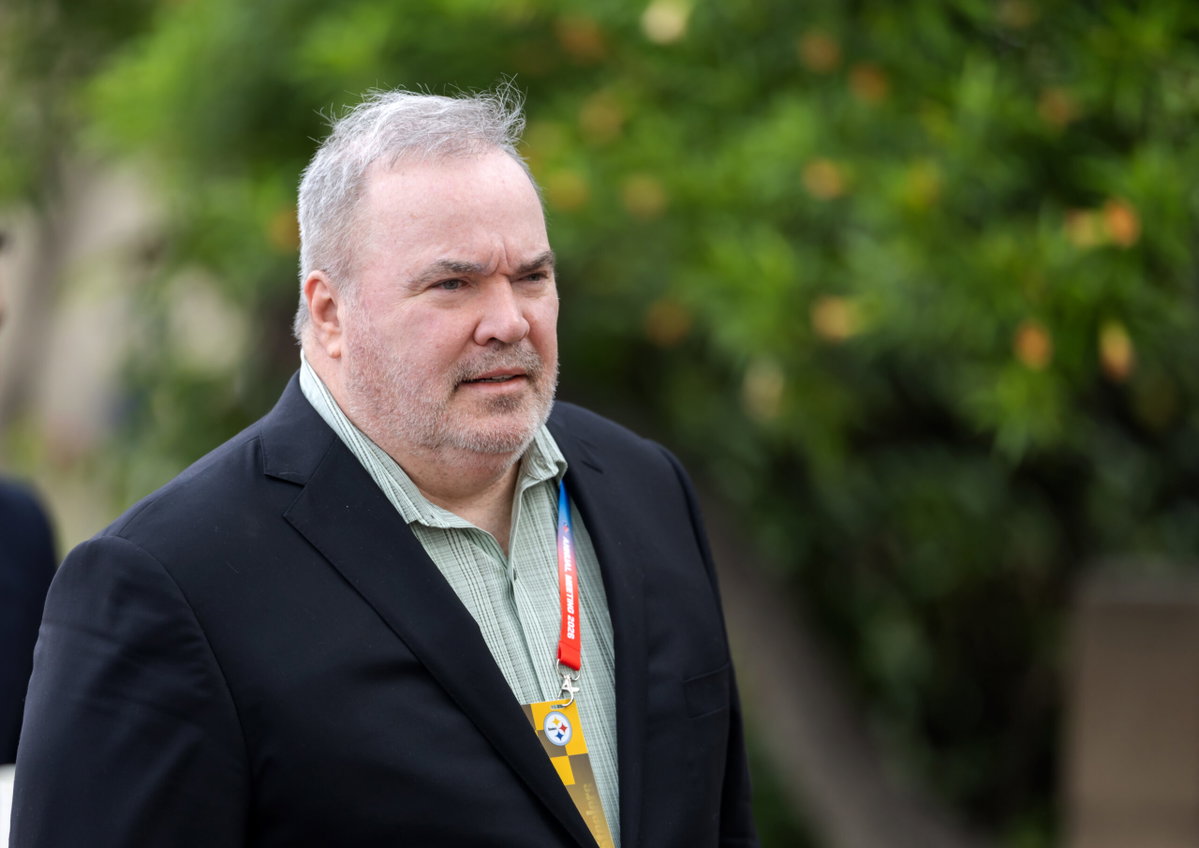
The 2026 season is set to look very different for the Pittsburgh Steelers. For the first time in decades, the Steelers have hired an offense-first head coach in Mike McCarthy after spending more than half a century under defensive-minded leaders like Chuck Noll, Bill Cowher, and Tomlin. And with Pittsburgh currently hosting OTAs, reporter Mark Kaboly says major offensive changes are already noticeable.
Watch What’s Trending Now!
“You could tell the difference offensively just through OTAs and just some of the schemes that they’re installing right now, and they’re still early in the process. He pretty much knows what he’s doing, offensively,” Kaboly said on 93.7 The Fan.
What makes that observation intriguing is that McCarthy has barely spent any time on the field with the roster. But the reasoning behind it is not difficult to understand. McCarthy’s coaching roots trace back to Paul Hackett, a disciple of Bill Walsh, the architect of the West Coast offense. And when Pittsburgh officially named McCarthy as Tomlin’s successor, the new head coach openly acknowledged his belief in that philosophy.
“I’m a believer in the tradition of the West Coast offense,” the head coach said. “And the first thing that always came to mind was the offense needs to be built to make the quarterback successful. As simplistic as it is, that starts with running the football. I mean, you have to run the football, because if you don’t run the football and you don’t tailor your protection schemes and the action-pass game to the run game, obviously it’s not going to affect the defense and have the benefits of what you’re looking for.”
Under Hackett’s guidance, McCarthy worked his way through nearly every offensive coaching role possible, beginning as a receivers coach before becoming a quarterbacks coach, offensive coordinator, and eventually a head coach. During that stretch, he spent time around quarterbacks like Joe Montana and Brett Favre late in their careers before later mentoring Aaron Rodgers and Dak Prescott.
That résumé eventually earned McCarthy the reputation of being a quarterback whisperer. Fast forward to now, and with Rodgers reuniting with McCarthy for the 2026 season, the Steelers are already implementing noticeable offensive adjustments designed around the veteran quarterback, beginning with protecting his blind side.
With Broderick Jones dealing with an ongoing neck injury and Isaac Seumalo leaving for Arizona in free agency, Pittsburgh suddenly had a hole on the left side of the offensive line. To address it, McCarthy shifted Troy Fautanu to left tackle while moving Mason McCormick inside at guard. But according to Kaboly, the changes go beyond just the offensive line.
“Everything that the coaching staff says, it looks like it’s going to be ground and pound, let’s be physical, let’s play AFC North Football, play defense, punting’s not a bad thing,” Kaboly said. “The personnel they got tells me that they’re gonna be, maybe not a run-heavy team, but they’re gonna run the ball more than they have the past couple of seasons.”
Pittsburgh added Rico Dowdle this offseason while already having Jaylen Warren and Kaleb Johnson in the backfield, along with Eli Heidenreich entering the mix. At the same time, the Steelers are not planning to rely solely on the run game either. Pittsburgh already has DK Metcalf as WR1 and further strengthened the receiver room earlier this offseason by adding Michael Pittman Jr..
So when you combine McCarthy’s philosophy, his belief in the West Coast offense, and the structural changes already happening offensively, it becomes fairly clear the Steelers are finally moving away from the blueprint Tomlin was often criticized for over the last several years.
During Tomlin’s tenure, Pittsburgh’s offense was focused on complementary football. The system prioritized protecting the defense, controlling possession, limiting turnovers, managing field position, and winning lower-scoring games.
And while that philosophy survived multiple offensive coordinators in Randy Fichtner, Matt Canada, and Arthur Smith, the overall identity never truly shifted. The Steelers consistently leaned toward conservative passing concepts, heavy rushing commitment, avoiding risky middle-of-the-field throws, and operating at a slower tempo.

Imago
NFL, American Football Herren, USA Pittsburgh Steelers at New York Jets Sep 7, 2025 East Rutherford, New Jersey, USA Pittsburgh Steelers head coach Mike Tomlin reacts during the second half against the New York Jets at MetLife Stadium. East Rutherford MetLife Stadium New Jersey USA, EDITORIAL USE ONLY PUBLICATIONxINxGERxSUIxAUTxONLY Copyright: xVincentxCarchiettax 20250907_kdn_cb6_161
Take Smith’s first season as offensive coordinator back in 2024. When Pittsburgh hired him, many expected the offense to finally become more creative schematically because Smith’s offenses with the Tennessee Titans had previously been built around heavy play-action, outside-zone runs, middle-of-the-field concepts, and explosive efficiency.
“I think we have an idea of what we want the Steeler offense to look like. Start with that. …You can’t completely change your roster overnight, so you kind of have to have a coordinator that feels like they can work with this roster and be successful with it,” Art Rooney II said at the time.
And while Pittsburgh’s offense did improve statistically from ranking 28th with 17.9 points per game in 2023 to ranking 15th with 23.4 points per game, Smith later admitted by 2025 that he never fully ran his preferred system in Pittsburgh.
“I pivoted,” Smith said. “I mean last year we didn’t run as much as true outside zone. And that was due to just some familiarity with some of the players we had. You try to adapt to the strengths of the players, you don’t wanna be rigid. We ran a lot of less wide zone, outside zone, whatever you wanna call it than I had previous couple years.”
That is exactly why many around the league eventually argued the Steelers’ conservative offensive issues extended far beyond just offensive coordinators. But now, with an offensive-minded head coach finally in charge, Pittsburgh’s offense already appears to be embracing this new direction.
DK Metcalf prepares to play under his first offensive-minded HC
The 2026 season will mark the first time DK Metcalf plays under an offensive-minded head coach in Mike McCarthy. And as that storyline started gaining traction this offseason, Metcalf admitted he is genuinely excited about the shift in his NFL career.
“It just excites me just having an offensive-minded head coach,” Metcalf said during the OTAs, addressing McCarthy. “I’ve always had defensive-minded head coaches. So, there’s something different.”
A former second-round pick, Metcalf spent the first six seasons of his career playing under Pete Carroll with the Seattle Seahawks before spending the 2025 season in Pittsburgh under Mike Tomlin. So naturally, the 2026 season represents a completely different experience for the 28-year-old receiver.
Metcalf appeared in 15 games during the 2025 season, recording 59 receptions for 850 yards and six touchdowns. Statistically, Metcalf had the lowest production years of his career in both yardage and targets, with 99, especially considering he served a suspension for the final two weeks of the season. And now, with McCarthy taking over as head coach and Aaron Rodgers returning for another year, Metcalf will clearly be hoping for a much bigger statistical season in 2026.