
In 2017, Forbes profiled Our Generation Speaks, a Boston-based fellowship and business incubator built around an unusual pairing: young Israeli and Palestinian entrepreneurs working on businesses together. They weren’t there simply to discuss peace. They were pitching ventures, looking for investors and trying to turn relationships across a deep divide into something they could build and grow. At one of those gatherings, a young former Israeli soldier spoke about what years of conflict had taught him.
Watch What’s Trending Now!
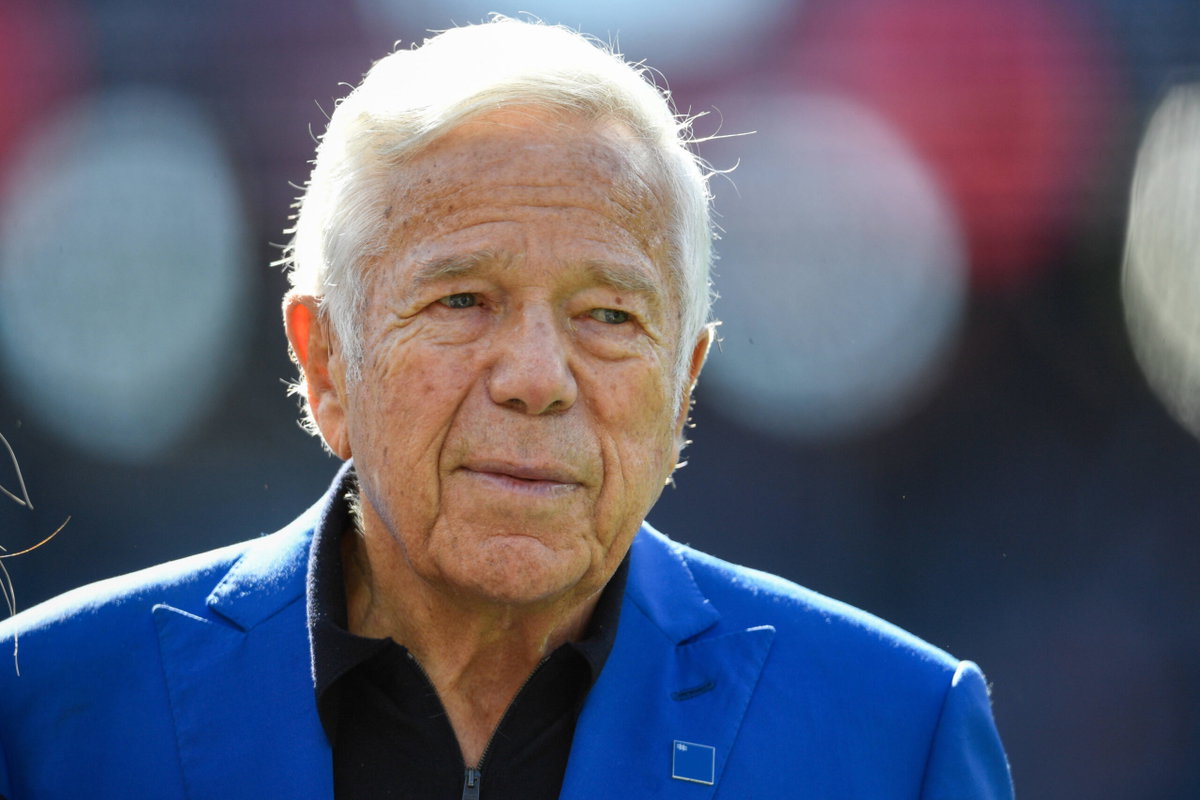
The region, he said, needed an “infrastructure of hope.” Former Massachusetts Gov. Deval Patrick was so struck by the idea that he set aside his prepared remarks and said he wanted to back what the young man was building. Robert Kraft, who was there to introduce Patrick, was listening too. His family would later put $1 million behind the program, backing an idea that treated business, jobs and relationships as another way to bring people on opposite sides of a conflict closer together. That idea has now resurfaced at a very different point of tension.
Kraft’s name has become part of the fallout surrounding Ed Sheeran’s Loop Tour after Macklemore’s pro-Palestinian remarks led to his removal from the remaining U.S. dates and a wider clash over which artists could take the stage at the country’s biggest stadiums. Kraft, who had barred Macklemore from Gillette Stadium, has now pledged $2 million toward humanitarian aid in the region. In a statement, he says that the commitment he says came after Sheeran reached out to him:
“I have dedicated much of my life to building bridges between all people,” he said. “I believe deeply that all lives are worth protecting. Earlier today, before Macklemore challenged me to match his donation, Ed called me and asked me to commit $2 million to match his donation to aid in the region to fight this humanitarian crisis. Ed now plans to reach out to other venue owners and our goal is to continue building bridges.
“In addition, I’d like the people who are speaking in support of the Palestinian people to know that for decades, I have supported efforts that create opportunity for Palestinians and have brought young Palestinians and Israelis together to build businesses, create jobs, and forge relationships.”
The dispute that brought Kraft to this point began onstage in New Jersey, but Macklemore’s position on Palestine was hardly new when he joined Sheeran’s tour. Sheeran said Macklemore had asked to join the Loop Tour last year and that he agreed because he respected him as an artist. He also said Macklemore, like his other support acts, had the freedom to choose his setlist.
At Sheeran’s Sept. 4 and 5 shows at MetLife Stadium, Macklemore used that stage to make Palestine a central part of his set. He called for a “Free Palestine,” said he wanted people in Gaza and the occupied West Bank to know they had not been forgotten, and performed “Hind’s Hall,” his 2024 protest song named for Hind Rajab. He also addressed Jewish members of the audience, saying criticism of Israel and opposition to genocide were not criticism of them.
That distinction became central to the fallout. The Israeli-American Council launched a petition calling for Macklemore’s removal, while Kraft said his decision at Gillette was based on the rapper’s recent actions as well as what he described as a “broader history of antisemitic rhetoric and imagery.” One earlier episode frequently cited in discussions of that history dates to 2014, when Macklemore apologized after wearing a costume that critics said evoked a Jewish caricature. He said then that causing offense was not his intention.
Macklemore said the situation went beyond Gillette, claiming Kraft had rallied other stadium owners and that they collectively pressured Sheeran to remove him. Sheeran later gave a different account of the chain of responsibility, saying he spent the week speaking with venue owners and others in an effort to find a solution, but that the promoter and venues had the final say. Messina Touring Group said it had been notified by venues that they would not allow shows with Macklemore on the lineup, warning that keeping him could force cancellations affecting hundreds of thousands of fans.
The fallout then spread beyond Macklemore. Finneas, Lukas Graham, Aaron Rowe and Sheeran’s backing band Beoga all withdrew from the tour. Rowe and Lukas Graham had been lined up to replace Macklemore on the remaining U.S. dates, while Finneas was scheduled for South American shows. Beoga, meanwhile, had been performing as part of Sheeran’s set rather than serving as a conventional opening act.
Macklemore’s response was to redirect the money he had made from the tour toward Palestinian relief. He said his entire $1 million in net earnings would go to six organizations: the Palestine Children’s Relief Fund, HEAL Palestine, Gaza Soup Kitchen, Medical Aid for Palestinians, the UNRWA U.S.A. National Committee and Anera. He then publicly invited Kraft to match the donation.
There is an important detail in the timing of Kraft’s response, though. The $2 million commitment was not presented by Kraft as a reaction to Macklemore’s challenge. He said Sheeran had contacted him earlier that day, before Macklemore’s post, and asked him to make the larger commitment. Kraft has not publicly identified the organizations that will receive his money. As for Sheeran, he has since tried to separate his own position from the venue decision.
He said Macklemore’s removal “was the promoter’s decision, it was not mine,” adding that Macklemore’s contract was with the promoter rather than with him. He also said he did not want his concerts to become political forums because his audience includes young people, often children, from different backgrounds.
“I am not complicit,” he wrote, adding that he wanted his shows to remain places where people could come together rather than another arena for the conflict.
Kraft’s own framing has also been more specific than simply opposing Macklemore’s support for Palestinians. In his earlier statement, he said the decision was “not about diminishing the suffering of innocent Palestinians or denying anyone the right to advocate on their behalf,” while arguing that Macklemore’s advocacy should not come at the expense of the Jewish community or obscure Hamas’ role.
He also said he would welcome the opportunity to sit down with Macklemore and discuss the facts, arguing that his stated goal was “peace for all people, an end to suffering, and an end to all hate.”