
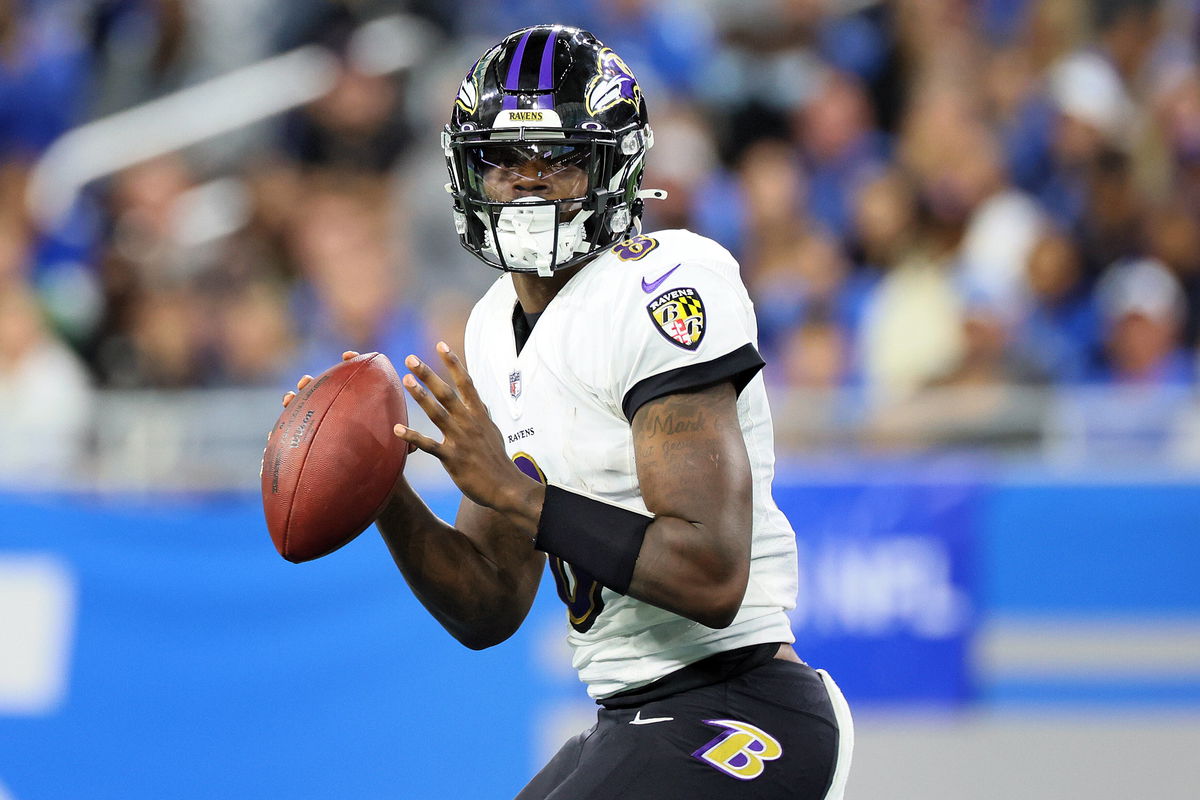
For years, Aaron Rodgers set the standard for elite quarterback play. QB’s like him built careers from the pocket, winning with precision rather than mobility. However, former NFL MVP Cam Newton argues that the league’s definition of greatness has changed. He believes that Baltimore Ravens QB Lamar Jackson has released a blueprint where versatility is no longer optional for the league’s signal callers.
Watch What’s Trending Now!
“It’s Lamar. It’s his style of play,” said Newton on the 4th & 1 podcast. “But his passing percentage is always high. His efficiency is high. It may not look like Payton, it may not look like Tom, it may not look like Drew Brees. Well, brother, times have changed because those quarterbacks who play that type of way have now become the new minorities. Jared Goff is a dinosaur. Respectfully, Aaron Rogers is a dinosaur. Matthew Stafford is a dinosaur. How great those players are that I named. Not a lot of quarterbacks that are coming into this league are just stationary one-dimensional quarterbacks.”
Lamar Jackson’s style of play as a dual-threat quarterback isn’t new. It has been there in the NFL since the 1950s, where Packers’ Tobin Rute stood as an example where the signal callers utilize a heavy blend of designed rushing, run-pass options (RPOs), and explosive off-script athleticism to stress defenses. However, the same cannot be said for the one-dimensional quarterbacks in the league.
Take Aaron Rodgers, for example. He is a classic pocket passer and field general. While Lamar Jackson uses elite athleticism to beat defenses with both his legs and his arm, Rodgers relies on his mind, accuracy, and elite arm talent from within the safety of the pocket. To be precise, they are particularly dependent on throwing the ball into windows with pinpoint precision, making it nearly impossible for defenders to intercept them.
And among the current NFL quarterbacks, Rodgers isn’t alone with this play style. The Bengals Joe Burrow stands as a perfect example. Then, the Rams Matthew Stafford and the Lions Jared Goff also fall into the same category. But according to former Panthers’ QB Cam Newton, the new gen signal callers are more inclined towards being a dual threat.
Playing the high mobility does come with a few perks. For starters, a dual-threat quarterback can execute the Run-Pass Option. They read a specific defensive end on the fly; if that defender chases the running back, the QB keeps the ball and runs into open space. Take the Buffalo Bills’ Josh Allen, for example, who recorded 579 rushing yards and 14 touchdowns last season and impressed many.
Meanwhile, a one-dimensional quarterback cannot freeze defenders this way because defenses know they will never keep the ball. Also, when a one-dimensional QB hands the ball off, they stand still, allowing the defense to ignore them. With a dual-threat quarterback, the defense must assign a player to watch the quarterback on every single play. This eventually eliminates the defense’s mathematical advantage and creates wider running lanes for everyone.
Apart from Lamar Jackson and Josh Allen, Jaxson Dart (Giants), Jayden Daniels (Commanders), and Eagles’ Jalen Hurts are some of the dual-threat signal callers leaving an impact in the NFL. As for the 2026 rookie class, Eagles’ Cole Payton and Browns’ Taylen Green also stand as examples with a similar playing style.