
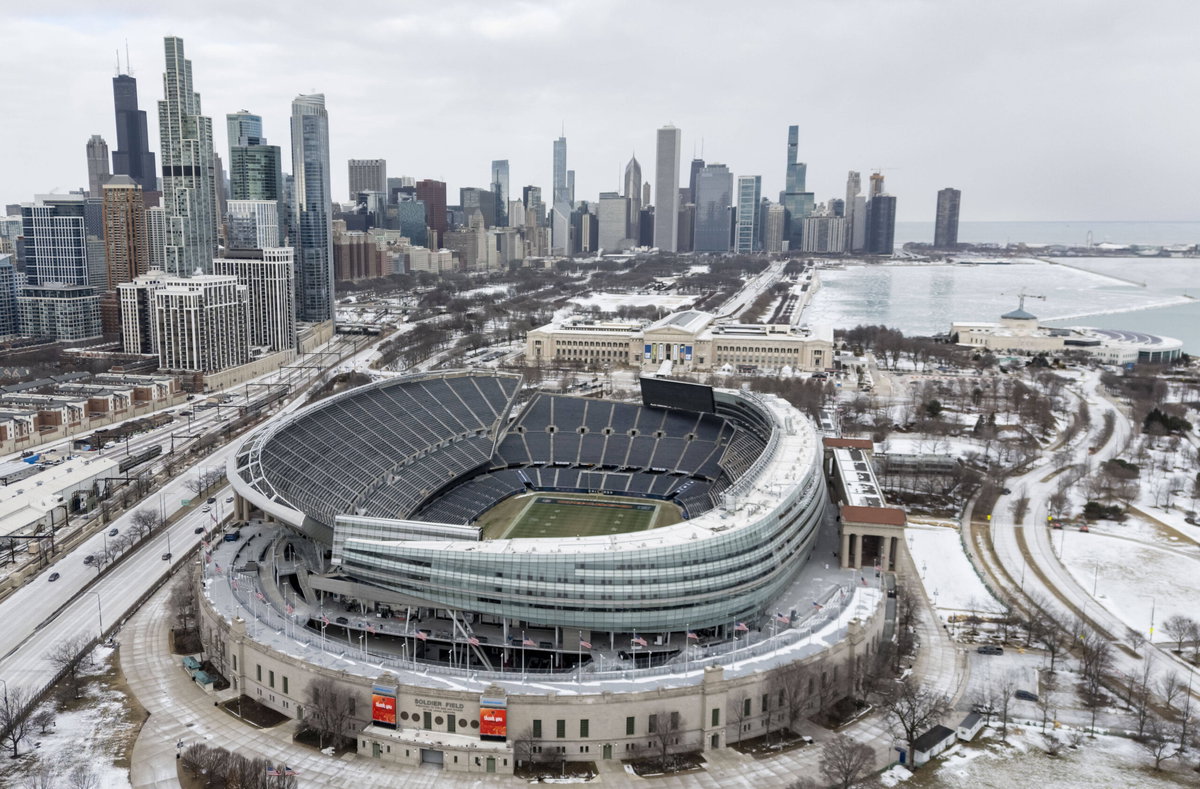
The last time Brian Urlacher watched the Bears at Soldier Field- January 2026, to be precise- the place was shaking. Chicago Bears had just beaten Green Bay in the playoffs, and Urlacher was down on the field as the crowd roared through the fourth quarter. He had played in two NFC Championship Games there, but even after all those years, he admitted he had never seen Soldier Field that loud.
Watch What’s Trending Now!
A few months later, given the circumstances, Urlacher was asked where the Bears should play next. His answer was simple: nowhere but Soldier Field. Even a move to Arlington Heights would bother him, he said, because the new stadium would be a dome. For Urlacher, Chicago’s cold, wind, and snow are not just bad weather but one of the few home-field advantages the Bears have. However, with the Bears advancing their plans for Hammond, Indiana, Urlacher’s frustration has shifted toward Illinois Gov. J.B. Pritzker, and his criticism has become more explosive:
“The worst thing to me is Pritzker gave $2.8 billion to the illegal immigrants and that money could have been set aside for the Bears stadium,” he said on the Sage Steele Show. “If he really wanted to keep them there, he could have set that money aside and quit funding illegal immigrants.”
The immigration issue Urlacher raised sits outside that stadium financing structure. Illinois’ spending on migrants and immigrant healthcare did not directly take money from a Bears stadium fund, and there is no evidence that it caused the Illinois negotiations to fail. Illinois ended its Health Benefits for Immigrant Adults program in July 2025 because of FY2026 budget constraints, while continuing coverage for eligible immigrant seniors. His argument is about priorities: if the state could commit billions to other programs, he believes it could have found a way to make keeping the Bears a bigger priority.
That $2.8 billion figure, however, is Urlacher’s characterization, not a state stadium fund that Illinois could simply have redirected. The real numbers are something else entirely.
The Bears have said they would put more than $2 billion of their own money into the new stadium and have not asked Illinois to fund its construction. Their request centered on infrastructure such as roads, utilities and site improvements, along with a predictable property-tax structure. Moreover, the broader $2.5 billion-$3.2 billion estimate cited in reporting comes from the Illinois Policy Institute and combines spending on migrant services, healthcare and other support between 2022 and the end of 2025. Separately, the Illinois Auditor General found that the state’s Health Benefits for Immigrant Seniors and Adults programs had cost just over $1.6 billion through FY2024.
These discussions come after June 5, when the team announced that its board had voted to advance its stadium project in Hammond, although it did not select a final site. That came after months of stalled negotiations in Illinois, where the Bears had sought property-tax certainty and help with essential infrastructure while pledging to privately fund the stadium itself. The Bears’ preferred Arlington Heights project stalled over tax and infrastructure questions, while Illinois lawmakers did not provide the certainty the team wanted.
In June, the Illinois Senate did pass a stadium-authority bill 37-17, but the House adjourned without voting on it. The proposal would have allowed the Bears to privately fund the roughly $2 billion stadium while creating a different tax structure around the development.
On August 14, Pritzker said that he believed the Bears wanted to stay in Illinois, but argued that the team had not brought the legislature a bill spelling out what it wanted for Arlington Heights.
Bears CEO Kevin Warren responded: “Our sole focus at this point in time is working on a world-class stadium and mixed-use development in Hammond, Indiana.”
Urlacher was particularly critical of how Illinois handled the situation and argued that the state should have done more to keep the Bears from looking elsewhere.
“[Pritzker] dropped the ball. I mean, this should never gone this far. This should have been handled a long time ago.”
That frustration is easier to understand with the Bears now actively evaluating two Hammond locations. The team has completed its review of the Lost Marsh site and deemed it viable, while continuing environmental, geographical and topographical work at the Wolf Lake Terminal site. Warren said the two sites could even potentially be combined.
The potential move also bothers Urlacher on a more personal level. The Bears have played in Chicago for more than a century, and Soldier Field remains a major part of the franchise’s identity. After all, this was Urlacher’s home ground for 13 years. He has since acknowledged, however, that the move makes business sense. Because the Bears do not own Soldier Field, he said, owning their own stadium would allow them to keep more of the revenue generated there.
Indiana has given the Bears something Illinois has struggled to provide: a concrete financing framework. Its package directs more than $1 billion toward the Hammond stadium district and related infrastructure, using tools including a 12% admissions tax on stadium events, a higher Lake County hotel tax and a 1% food-and-beverage tax in Lake and Porter counties. Indiana also struck a deal involving a potential $700 million payment from the Indiana Toll Road’s private operator for infrastructure work. That helps explain why Hammond has become so attractive.
So the Bears’ Illinois problem was ultimately less about finding $2 billion to build a stadium than about agreeing on who would cover the surrounding infrastructure and how the property would be taxed once a multibillion-dollar development was built.
For Urlacher, that is the frustrating part. He can understand why the Bears would follow the better business deal. What he cannot understand is why Illinois allowed that deal to become an option in the first place.
The potential move also bothers Urlacher on a more personal level. The Bears have played in Chicago for more than a century, and Soldier Field remains a major part of the franchise’s identity. After all, this was Urlacher’s home ground for 13 years.
Indiana has put together a package worth up to $1 billion in public incentives, while the Bears have committed about $2 billion of their own money to the project. That financial gap has helped make Hammond an increasingly attractive option as the team weighs its future beyond Illinois. The state support made it a “no-brainer” for the Bears, which Urlacher understood.
For Urlacher, though, the fact that Indiana is now set in stone for the Bears is proof that Illinois failed to act quickly enough. With the Bears continuing their due diligence in Hammond, the pressure is now on Illinois to find a solution before the franchise makes its next major move.