
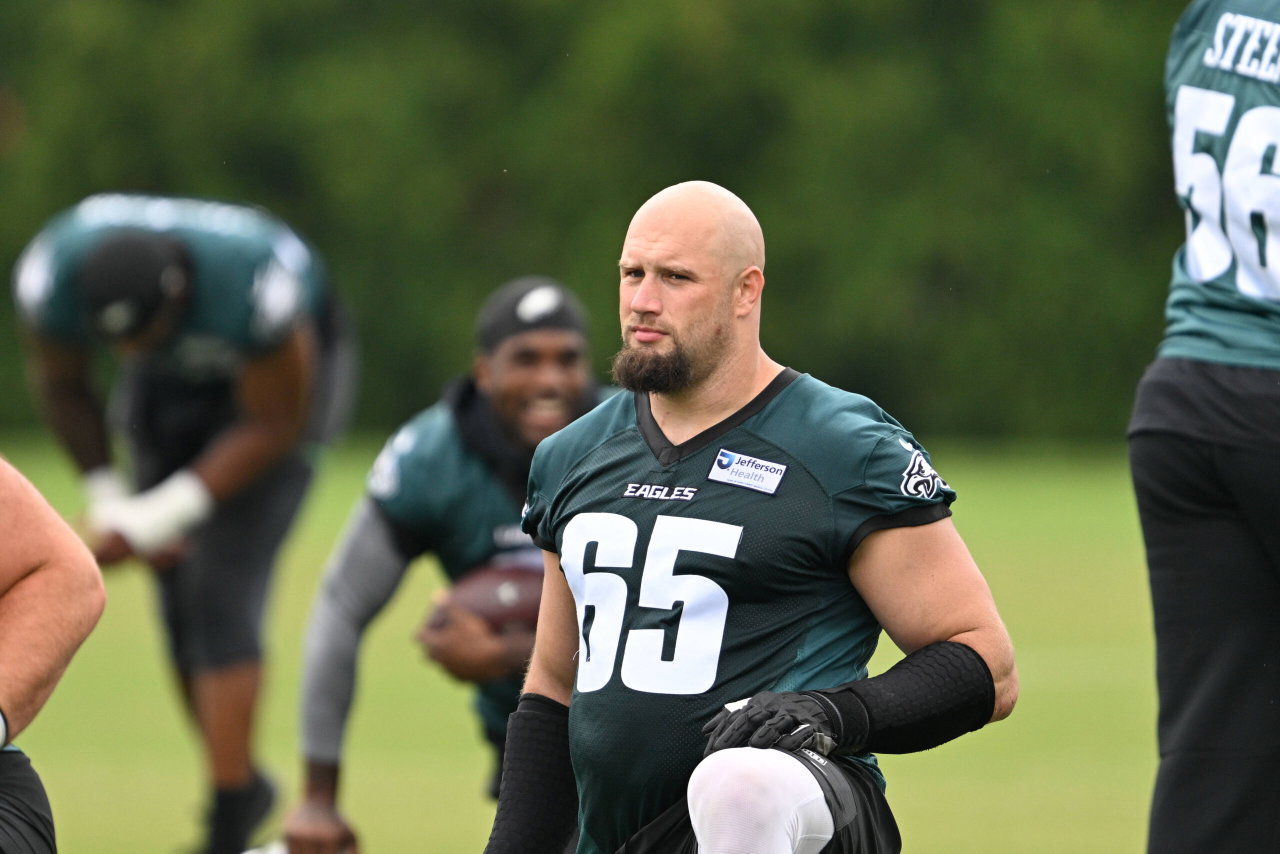
Philadelphia’s season was already beginning to slip from the script the Eagles would have wanted. They had lost 20-24 to the Los Angeles Rams, and Lane Johnson was a late scratch from the game for personal reasons. Just two days later, the 36-year-old right tackle announced his retirement. He had said in August that he wanted to make 2026 his final season, but that meant finishing it with the teammates he had spent 13 years protecting, not walking away just four games into the campaign when the future of the Eagles’ championship core was already becoming a talking point.
Watch What’s Trending Now!
A six-time Pro Bowler who had helped Philadelphia win both of its Super Bowls, he was still among the league’s best pass protectors. Now, rookie Markel Bell must take over at right tackle, a position he filled in against the Rams and struggled in pass protection. For a team already coming off consecutive losses, losing one of its most dependable players only adds to the uncertainty. Yet the Eagles are not ready to clear Johnson’s place on the roster.
“PhillyVoice has learned that the Eagles plan on keeping Johnson on their 53-man roster this season,” reported PhillyVoice staffer Jimmy Kempski. “By doing so, that leaves open the possibility that Johnson could change his mind and come back to play this season, unlikely as that may be. Johnson said in August that this season would be his last in the NFL. Assuming that remains the case — or if he remains retired, as expected — the Eagles would then process his retirement after June 1 in 2027, which would delay salary cap ramifications until 2027 and 2028.
“Or perhaps better stated, Johnson’s salary cap situation would remain as is, as if he hadn’t retired and instead played out the 2026 season as originally planned.”
While the decision could sound strange, keeping Johnson on the roster gives Philadelphia time to manage the financial side of his departure.
The Salary-Cap Calculation Behind Keeping Johnson on the Roster
Johnson entered 2026 with a $20.299 million cap hit, including $1.3 million in base salary and $18.999 million in prorated signing and option bonuses, according to Over the Cap. Although the bonus money had already been paid, the remaining cap charges would not disappear when he retired.
Philadelphia can delay those charges by processing Johnson’s retirement after June 1, 2027, spreading the applicable dead money across the 2027 and 2028 seasons rather than taking a larger hit immediately.
Over The Cap projects $16.6 million in dead money for 2027 and $26.276 million for 2028 under one scenario in which Johnson keeps the relevant bonus money. Processing his retirement immediately could instead mean charges of roughly $18.99 million in 2026 and $42.89 million in 2027, depending on how the option bonus is handled.
The Eagles are not eliminating the financial cost of Johnson’s retirement; they are managing when it hits the cap. The contract had already been structured with the possibility of his departure after 2026 in mind, so the retirement may not significantly change Philadelphia’s overall cap outlook.
There is a trade-off, though. Keeping Johnson on the 53-man roster leaves the Eagles with one fewer spot for a player who can contribute this season.
Lane Johnson’s Absence Puts Eagles’ Offensive Line to the Test
By February 2026, the Eagles had a 110-57-1 record in games Lane Johnson played and an 18-27 record in games he missed. While those numbers do not tell the whole story, they underline how much Philadelphia has relied on its six-time Pro Bowl right tackle.
Johnson helped create opportunities for quarterbacks and running backs alike, giving Jalen Hurts more time in the pocket and helping open lanes for runners such as Saquon Barkley and LeSean McCoy. His consistency was a key part of Philadelphia’s success, including its championship runs.
Now, rookie Markel Bell must step in at right tackle. He filled in against the Rams, but replacing a player with Johnson’s experience is a different challenge. Bell will make his first road start for the Eagles against the Jacksonville Jaguars in London, with Philadelphia still trying to steady an offence that has struggled in recent weeks.
Johnson has already given him a reminder of how to handle the pressure.
“One thing that Lane always said was, ‘You can’t make the game bigger than it is. You gotta go out there and play your best ball, and if you mess up, let that be a tomorrow problem, and go out there and play the next play,’” Bell said.
It’s advice Bell will have to put into practice quickly. Johnson’s experience cannot be replaced overnight, and with the Eagles coming off consecutive losses, his absence leaves another problem for an offensive line already under pressure.
But understanding what Philadelphia has lost on the field also means understanding why Johnson chose to walk away while he was still playing at such a high level.
The Reasons Behind Lane Johnson’s Sudden Retirement
Lane Johnson had considered retirement before. According to The Philadelphia Inquirer, he once discussed ending his career alongside longtime offensive-line coach Jeff Stoutland. When Stoutland left the Eagles in February 2026 following changes to his role, Johnson was reportedly devastated. “I think it’s my sign,” he told confidants.
Johnson returned for 2026 after speaking with head coach Nick Sirianni, offensive coordinator Sean Mannion and new offensive-line coach Chris Kuper. But retirement had never been entirely off the table.
On October 6, Johnson confirmed his decision, citing his mental health and family. “I owe it to my teammates, coaches, the organization, and the fans to have my head and heart 100 percent in the game,” he said in his retirement statement. “And right now my heart is telling me that it’s time to say goodbye to football.”
His decision followed a physically demanding stretch. He missed the final eight games of the 2025 regular season with a Lisfranc foot injury and had previously taken a leave of absence in 2021 while dealing with anxiety and depression. In a 2022 interview with The Inquirer, he described that anxiety as feeling like “Michael Myers always around the bushes.”
Yet Johnson was still playing at an elite level. He had a 97.2% pass-block win rate through his first three games of 2026, the best among NFL tackles at the time. From Week 11 of 2020 through Week 9 of 2023, he also went 1,405 pass-blocking snaps without allowing a sack. During Philadelphia’s Super Bowl LVII season, he postponed surgery to remain on the field, finishing with a 90.1 PFF pass-blocking grade and no sacks or quarterback hits allowed across 651 pass-blocking snaps.
Johnson wanted to finish one more season with his teammates, but ultimately realised he could no longer give football the commitment it demanded. For Philadelphia, that makes his departure all the harder to accept: Johnson is walking away while still playing at an elite level, leaving a gap that cannot easily be filled. And while keeping him on the roster gives the Eagles time to manage the financial implications, it also leaves open the slim possibility that this may not be the final chapter of his career.