
Imago
INDIANAPOLIS, IN – FEBRUARY 26: Ohio State defensive back Caleb Downs answers questions from the media during the NFL, American Football Herren, USA Scouting Combine on February 26, 2026 at the Indiana Convention Center in Indianapolis, IN. Photo by Zach Bolinger/Icon Sportswire NFL: FEB 26 Scouting Combine EDITORIAL USE ONLY Icon2602262375
Imago
INDIANAPOLIS, IN – FEBRUARY 26: Ohio State defensive back Caleb Downs answers questions from the media during the NFL, American Football Herren, USA Scouting Combine on February 26, 2026 at the Indiana Convention Center in Indianapolis, IN. Photo by Zach Bolinger/Icon Sportswire NFL: FEB 26 Scouting Combine EDITORIAL USE ONLY Icon2602262375
Before the NFL Combine and college Pro Days, scouts spend extensive time evaluating game film to assess a prospect’s football ability. The combine and Pro Days then provide a structured environment to measure athletic traits. The process becomes less straightforward, however, when a prospect opts out of on-field drills such as the 40-yard dash.
Watch What’s Trending Now!
In those cases, teams are left with a key question. How do you accurately evaluate speed? Traditionally, that answer comes from film study, in-person scouting, and conversations with college coaches. This year, though, some teams are adding another layer to that process through artificial intelligence.
The shift is not about replacing scouts but supporting them. Through partnerships such as the NFL’s work with Microsoft, teams now have access to tools that can process large datasets and deliver insights in a more accessible format. The distinction is subtle but important. Analytics collects data, while AI helps interpret it.
Top Stories




Widget1
Widget2
Widget3
Widget4
One of the more practical applications comes through computer vision. Unlike NFL players, college athletes do not wear tracking chips, which limits direct data collection. AI can now analyze game film to generate speed-related metrics that resemble outputs from the NFL’s Next Gen Stats system.
This becomes particularly relevant when comparing prospects. Players like Arvell Reese, David Bailey, and Rueben Bain Jr. may appear similar as pass rushers on the surface. AI allows teams to differentiate their usage and efficiency more precisely.
For example, ESPN’s Kevin Seifert reported that Reese dropped into coverage on roughly half of his snaps last season. And even when he rushed, he wasn’t as efficient as the others, as explained by Karim Kassam of Teamworks. So a team might still draft him. But now they have a better understanding of how to utilize him.
“So he might be the best edge player and might be the first one off the board,” Kassam said of Reese. “But he might not be as likely to get to double-digit sacks as a Rueben Bain or David Bailey. That doesn’t mean he can’t be a great football player. He’s someone that you need a plan for.”
Meanwhile, AI also helps contextualize misleading metrics. Take Jaylen Waddle as an example. Tracking data at one point suggested he lacked top-end speed. A deeper AI-driven review showed that his routes often ended before he could reach full speed, which skewed the data. In other words, the raw numbers lacked context, and AI helped fill that gap.
Seifert noted that a similar approach can now be applied to evaluating incoming wide receiver prospects. All of these point to a broader shift. The league is gradually integrating AI into its evaluation process, though it remains in early stages. The tool adds clarity for teams, but it also changes the equation for prospects.
Those who skip measurable drills like the 40-yard dash may find it harder to control their narrative when teams can generate comparable data independently.
The NFL scouts evaluated Caleb Downs’ weakness through AI
Caleb Downs has built a strong profile as one of the top prospects heading into the 2026 NFL Draft. Across three seasons at Alabama and Ohio State, he earned All-America honors twice and won the Jim Thorpe Award as the nation’s top defensive back in his final year.
From a production standpoint, the résumé is clear. Downs recorded 256 tackles, 1.5 sacks, and 6 interceptions over that span, which positioned him firmly among the top defensive prospects. On the surface, that profile aligns with a high draft valuation.
However, his pre-draft process introduced a variable. Downs opted not to participate in the 40-yard dash at both the NFL Combine and his Pro Day, leaving evaluators without a standardized measure of his top-end speed. That absence shifted attention to a more fundamental question. How fast is he in game situations?
Traditionally, that question would be addressed through film study and scouting reports. In this case, teams supplemented that process with AI-based analysis. According to Karim Kassam, those evaluations suggested that Downs’ game speed ranks below that of other top safeties in the class.
“I don’t doubt that he’s a really good football player,” Kassam said of Downs. “He’s just not that fast.”
Imago
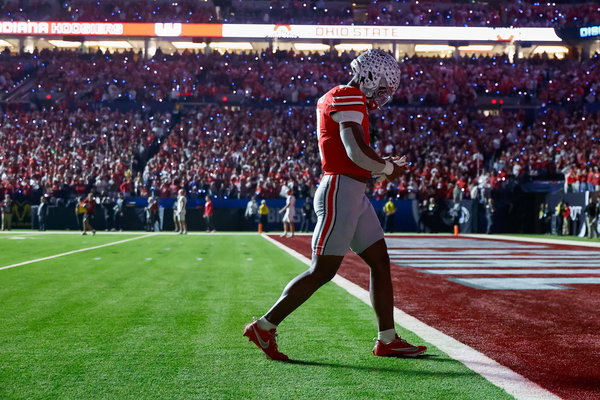
December 6, 2025: Ohio State Buckeyes defensive back Caleb Downs 2 during introductions before the NCAA, College League, USA Big Ten Championship football game between the Ohio State Buckeyes and the Indiana Hoosiers at Lucas Oil Stadium in Indianapolis, Indiana. /CSM. Indianapolis United States of America – ZUMAc04_ 20251206_zma_c04_497 Copyright: xDarrenxLeex
That assessment does not directly change his draft standing. Teams are still likely to value his instincts, production, and overall impact. At the same time, it introduces a layer of role projection rather than outright evaluation.
“They might see that his [particular obstacle] is going to be his athleticism, that he’s not going to be able to run with receivers the way that some other safeties can,” Kassam added. “…Based on the numbers, you might not see him as someone that can flex outside and cover even a premier tight end or be a center-field-safety type that’s going to cover a lot of ground. That might not be his thing. He’s going to be more of a box-slot type of safety.”
That distinction is where AI is currently having the most impact. It is not determining whether a player gets drafted. Instead, it is shaping how teams project and utilize that player within their system, which ultimately influences roster construction and on-field deployment. And Caleb Downs happens to be one of the prospects to be evaluated through AI.
