
The Rams had spent most of the night in control. They led Denver 16-0 at halftime, and when the Broncos finally put together their comeback, Los Angeles still had a chance to end it. With just over a minute left, Bo Nix threw toward Pat Bryant near the goal line. Josh Wallace got to the ball first, came down with the interception and appeared to have stopped Denver with the Rams still holding a four-point lead.
Watch What’s Trending Now!
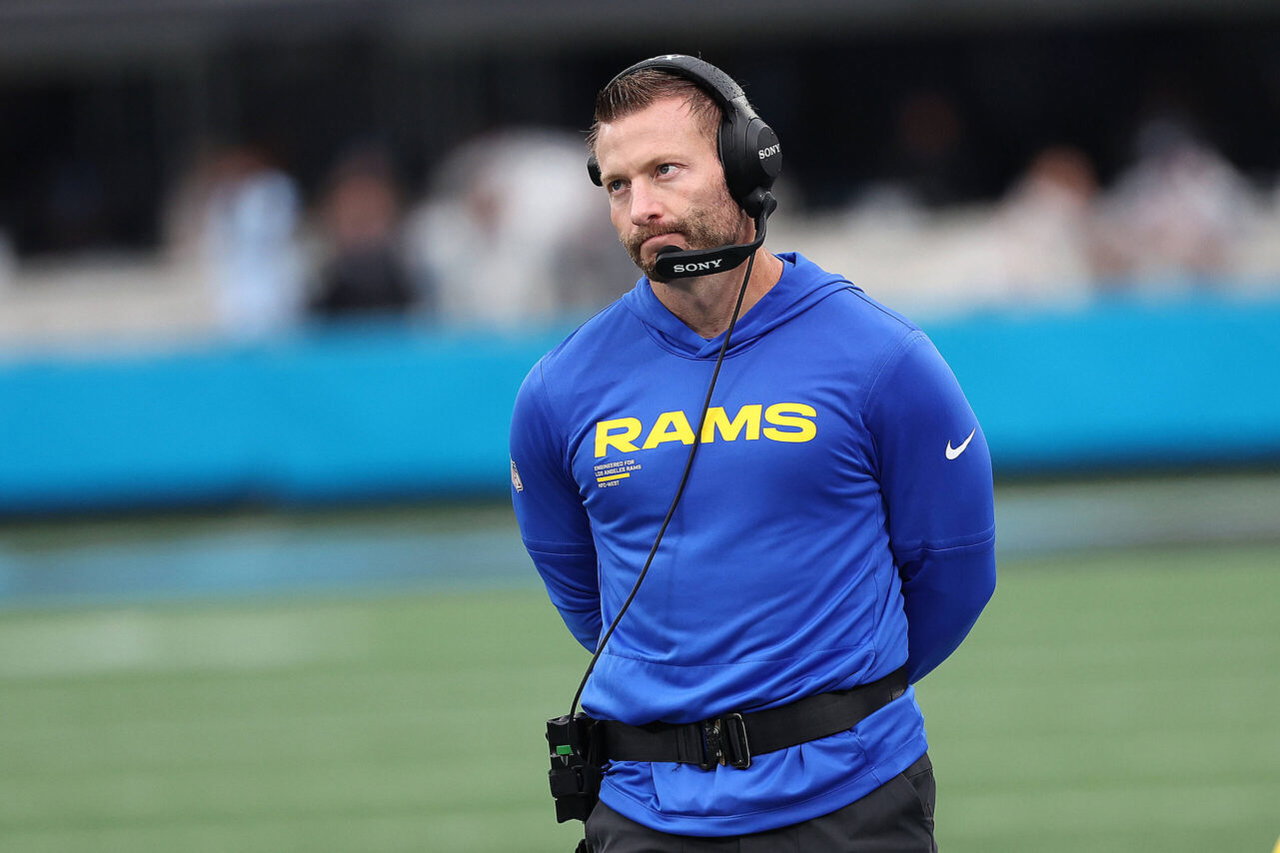
Then the flag came out. Wallace was called for defensive pass interference, wiping out the interception and giving Denver the ball at the Rams’ 7-yard line. A few plays later, the Broncos were in the end zone, and the Rams never got the lead back. McVay left his postgame press conference after answering only a handful of questions, but the story did not end there. In his next press conference, McVay revealed that the NFL had reached out to him and “agreed” that the defensive pass interference on Wallace should not have been called.
“They agreed with me,” McVay said of his phone call with the league and about their conversation around the penalty. “Whether it was or wasn’t right, that wasn’t the point. The call was made, and that was what the call was. What I am interested in is if there’s any sort of feedback that says, this is in alignment with what would be correctly officiated as a DPI. Here’s the coaching points that you want your DBs or your back end guys to be able to have. That’s the only thing that I’m really worried about. That game’s over with.”
And that distinction matters, because the replay does not show a play without contact. It does show a play where the two players were making contact, and the question is whether Wallace’s contact actually crossed the line into DPI.
Why the NFL reportedly believes the flag should not have been thrown
The NFL’s pass-interference rule does not prohibit every bit of contact between a receiver and a defensive back. It says interference occurs when a player more than one yard beyond the line of scrimmage “significantly hinders” an eligible player’s opportunity to catch the ball. The same section also permits incidental contact when both players are competing for the pass and says that, when there is a question over whether contact is incidental, the ruling should be no interference.
That is where Wallace’s play becomes difficult to judge from the flag alone. He had a hand on Bryant, but he was also playing the ball. Bryant was reaching back toward Wallace as the pass arrived, and replays showed the receiver grabbing the cornerback during the sequence. NBC rules analyst Terry McAulay focused on exactly that exchange when he reviewed the play.
“As we get towards the end, we actually see the receiver grab the defender and pull in on him,” McAulay said. “I don’t see the defender do anything that significantly hinders the receiver on this play.”
McAulay also pointed to the earlier part of the play, where Wallace had his hands on Bryant but did not appear to use them to restrict him. That distinction is important under the rule: a defender is allowed to have a hand on a receiver while trying to make a play on the ball, provided that contact does not restrict the receiver’s opportunity to make the catch.
That appears to be the basis for the league’s feedback to McVay. After reviewing the play, the contact apparently was not enough to satisfy the NFL’s “significantly hinders” standard.
Furthermore, there is another detail that changes the picture. Bryant himself acknowledged that he helped sell the contact.
Pat Bryant’s admission makes the play even harder to read
“It was a little pass interference,” Bryant said. “I did sell it just enough to get the flag, but he definitely gave me a little nudge that I felt, and I felt like I couldn’t get the ball. So, it was either the ball or the call, and I couldn’t get the ball, so we ended up getting the call.”
That is a more complicated admission than simply saying Bryant flopped. He maintained that Wallace did give him a nudge and that he felt it affected his attempt at the ball. But he also openly acknowledged exaggerating the contact because he knew it could draw a flag.
And that is precisely why the play can look different depending on which moment of the replay is being watched.
The flag gave Denver more than just another chance
The penalty was called on third-and-6 from the Rams’ 11-yard line. Had Wallace’s interception stood, Los Angeles would have taken over with a 26-23 lead and 1:09 remaining. Denver still had three timeouts, so the interception would not have automatically ended the game, but the Broncos would have needed to get the ball back and mount another scoring drive.
Instead, the DPI gave Denver a first down at the Rams’ 7. Six plays later, Bo Nix reached the end zone to put Denver ahead 30-26 with 47 seconds left.
Even then, Los Angeles had one more opportunity. Stafford moved the Rams quickly down the field, hitting passes for 19, 14 and 20 yards before the drive reached Denver’s red zone. But on the final play, Talanoa Hufanga intercepted Stafford in the end zone, ending the comeback attempt.
That is why it is too simplistic to say the DPI alone “cost” Los Angeles the game. The call changed the Broncos’ possession and directly helped keep their touchdown drive alive, but the Rams also had the ball with a chance to win after Denver scored. Stafford’s interception closed that door. The Wallace call also came during a night when Los Angeles kept putting itself in difficult positions.
The Rams had plenty of other flags to deal with
The Rams were penalized 13 times, compared with five penalties for Denver. Five of Los Angeles’ flags came in the final two minutes, tied for the most by any team in a game since 2000, according to ESPN Research.
The sequence after the DPI made the problem even more obvious. With Denver inside the 5-yard line, Quentin Lake was called for illegal use of the hands, giving the Broncos another first down at the 2. Kobie Turner was then flagged for encroachment with the ball inside the 1, moving Denver even closer before Nix finished the drive.
So while the Wallace penalty became the defining officiating moment, it was not the only reason Denver had opportunities late. That may be the most revealing part of the league’s feedback.
McVay is not changing how he coaches Wallace
McVay said he had asked the NFL for information not simply to argue about the result, but to understand what his defensive backs should be taught from the play. He specifically said he would not change how he was coaching Wallace through that sequence.
For Wallace, that matters. The takeaway is not that he needs to stop playing aggressively when the ball is in the air. If anything, the league’s reported assessment tells the Rams that the technique itself was within the acceptable range and that the flag was the mistake. Wallace, for his part, did not spend much time revisiting the call.
“It’s tough,” he said of the defensive series. “I felt like we stopped them a couple of times. Just got to keep playing at the end of the day.”
Davante Adams took a similar approach.
“Me talking about it, saying my feelings on it is not going to change it,” Adams said. “If it would, I’ll definitely tell you right now. It’s not. My words are not going to influence anything, so we’re just going to leave that one in the past.”
The Wallace penalty also revived an old McVay-Sean Payton connection.
There is one more reason this call feels familiar
Payton was the Saints’ head coach when Los Angeles benefited from the infamous no-call on Nickell Robey-Coleman’s hit on Tommylee Lewis in the 2018 NFC Championship Game. Sunday’s game brought the two coaches together again, this time with McVay’s defense on the wrong side of a disputed pass-interference decision.
There was even a personnel connection to the officiating crew: Bill Vinovich was the referee in both games, while Todd Prukop was the back judge in both matchups, according to ESPN Research. Former Rams tackle Andrew Whitworth noticed the symmetry, joking that Payton had finally gotten his pass-interference call.
Payton, however, did not lean into the history.
“Well, this is years later, so a completely different game, different players,” Payton said. “The longer you get in this thing, the less you discuss penalties. You just got to go out and play.”
That is probably where the Rams have to leave it, too. The NFL can tell McVay the Wallace call should not have been made. It cannot put the interception back on the scoreboard or change the 30-26 result. Los Angeles is 1-2, and Philadelphia is next on October 4.