
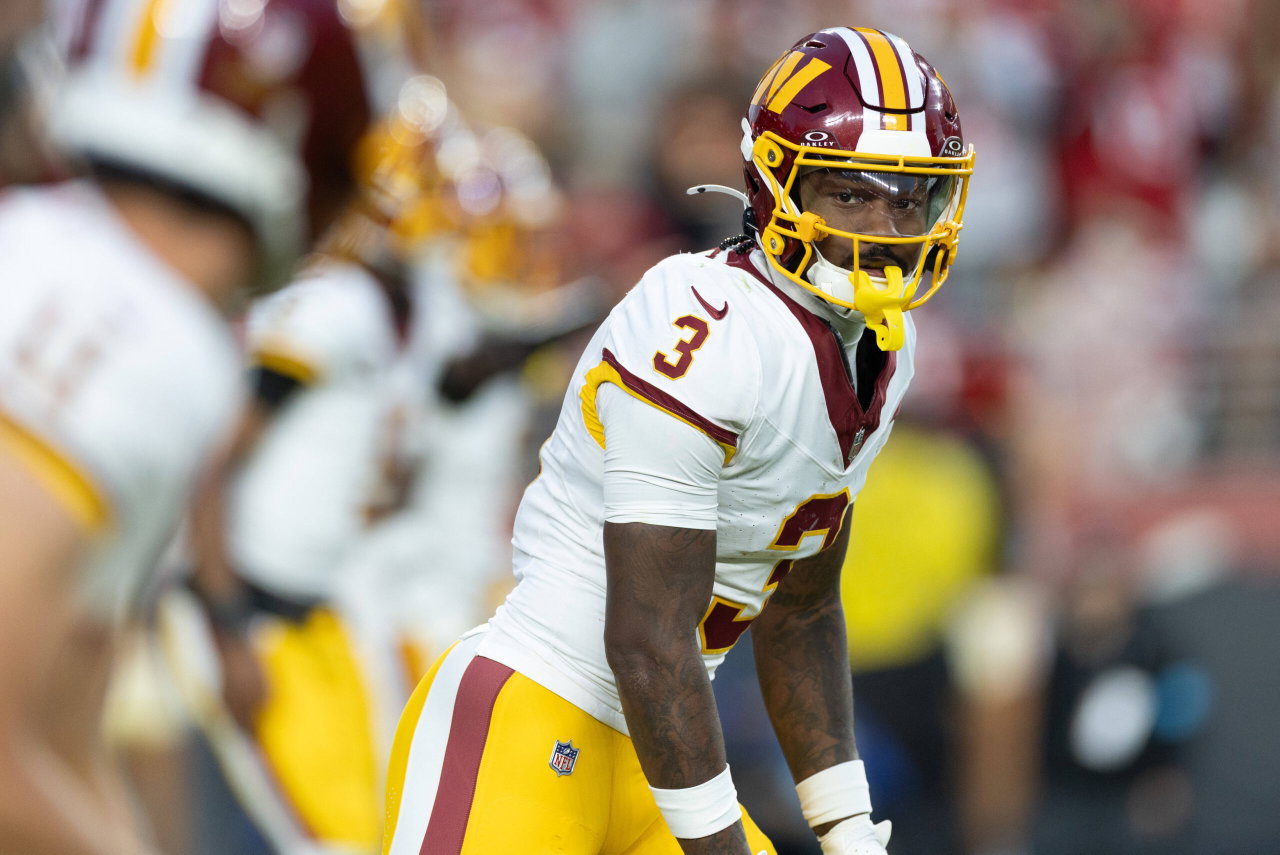
Has anyone ever imagined Stefon Diggs getting so frustrated with the Washington Commanders’ offense that he starts yelling at the sideline, knowing the cameras are rolling? It might seem hard to picture, but that’s exactly what NFL fans witnessed on Monday, November 23, during Monday Night Football against the Cincinnati Bengals. Washington’s offense had gone three-and-out on three of its first four drives, and Stefon Diggs was done waiting.
Watch What’s Trending Now!
And well, even beyond that, the MNF game had no shortage of drama, with several unexpected incidents grabbing attention throughout the night.
Stefon Diggs’ heated moment
A tense moment involving Washington Commanders wide receiver Stefon Diggs quickly became one of the biggest talking points of Monday Night Football.
In the second quarter, with Washington’s offense struggling to get going, ESPN’s broadcast cameras caught Diggs visibly frustrated on the sideline. He appeared to be shouting at the coaching staff and demanding more involvement in the passing game.
According to JM Football’s post, Diggs was heard saying, “Hey! Throw the f____ing ball! Come on, man! Stop with the motherf________ing excuses!”
An assistant coach briefly stepped in as the receiver continued voicing his frustration. While it was unclear exactly who Diggs was addressing, his outburst came during a particularly difficult stretch for Washington’s offense.
Washington had gone three-and-out on three of its first four drives, while quarterback Jayden Daniels struggled to find his rhythm. Diggs had yet to make a catch, and Cincinnati’s defensive pressure was making it difficult for Daniels to establish a passing rhythm.
The Bengals’ defensive front was a major reason for those struggles. Defensive end Boye Mafe had already recorded three sacks on Daniels in the first half alone, marking a career high for a single game. It was also the first time a Cincinnati player had registered three sacks in one half since at least 1994.
The offense eventually found some relief before halftime. Washington scored on a short touchdown run to cut Cincinnati’s lead to 10–7 before the Commanders went on to secure a narrow 22–20 victory.
Diggs joined Washington as a free agent after the New England Patriots released him on March 11, 2026, following his 2025 season in which he recorded 85 receptions for 1,013 yards and four touchdowns. The Commanders signed him on August 7. The move also brought the veteran receiver back to familiar territory: Diggs grew up in Olney, Maryland, and played college football at the University of Maryland.
He entered Monday’s game with 36 receptions for 386 yards and six touchdowns through eight appearances. Despite the sideline frustration, Diggs eventually finished with four catches for 45 yards on six targets.
The sideline footage sparked different reactions. Some commentators and former players viewed it as a sign of growing frustration between Diggs and the offensive coaching staff. Others saw it as a competitor demanding more involvement during a difficult first half, especially after his strong performance against the New York Giants the previous week.
Lights went out in the stadium
The tension surrounding Diggs was not the only unusual moment of the night. The game also experienced an unexpected interruption when the lights at Northwest Stadium in Landover, Maryland, suddenly went out during the third quarter.
Washington was trailing 10–7 and had moved into Cincinnati territory when the incident occurred. The Commanders were preparing for a third-and-14 play near the red zone when the stadium suddenly went dark, forcing officials to halt the game.
It turned out that the blackout was not caused by a major power failure. ESPN’s broadcast revealed that the stadium’s lighting vendor had forgotten to cancel a regularly scheduled weekday maintenance cycle. The system was programmed to automatically shut off the lights at 10 p.m. on weekdays, and it did exactly that in the middle of the game.
The interruption lasted approximately four minutes before the stadium lights came back on and play resumed.
Once the teams returned to action, Daniels threw an incomplete pass on third down, forcing Washington to settle for a field goal. The kick tied the game at 10–10.
The timing was particularly unfortunate for Washington. The Commanders had already worked their way into scoring territory, but the interruption meant Daniels had to return to the field and finish the drive after an unexpected stoppage. The offense ultimately managed to come away with three points rather than a touchdown.
Hit on Joe Burrow went unpunished
While Washington dealt with its offensive struggles and the unexpected blackout, Cincinnati had its own reason to be frustrated with the officiating.
During the first quarter, a controversial sequence involving quarterback Joe Burrow left the Bengals questioning why a late hit went unpunished while their offensive lineman received a 15-yard penalty.
The incident happened on Cincinnati’s second offensive possession. Facing third-and-4, Burrow completed a pass to running back Samaje Perine to move the chains.
However, moments after releasing the ball, Burrow was knocked hard to the ground by Washington linebacker K’Lavon Chaisson, a former LSU teammate of Burrow and Ja’Marr Chase. The contact appeared to come after the quarterback had already released the pass.
Despite being close to the play, the official did not throw a flag for the hit. Burrow, still on the ground, raised his hands in disbelief.
Seeing his quarterback take the hit, Bengals offensive lineman Dylan Fairchild rushed over and shoved Chaisson away. The contact sent Chaisson into a nearby referee, knocking the official to the ground.
The official immediately threw a flag, but it was Fairchild who received the 15-yard unsportsmanlike conduct penalty. Chaisson’s hit on Burrow went unpunished.
The contrast between the two incidents was what made the sequence particularly contentious. Fairchild’s reaction was penalized immediately, while the contact that prompted it did not result in a roughing-the-passer call.
ESPN analyst Troy Aikman acknowledged why Burrow’s teammates reacted the way they did, saying, “You saw the reaction by Joe Burrow.” He added that his teammates were going to respond when they saw their quarterback go down with what they believed was a late and excessive hit.
As a result, Cincinnati lost valuable field position and eventually had to punt instead of getting a fresh set of downs near midfield.
The decision also drew criticism from NFL insiders, including Jordan Schultz, and fans on social media. Many questioned why Chaisson was not penalized for what appeared to be a late hit on the quarterback, while Fairchild was flagged for reacting to the incident.
There was another layer to the matchup, too. Chaisson, who entered the game with 3.5 sacks, had previously played alongside Burrow and Chase at LSU. He was also in his first season with Washington after previous NFL stops with Jacksonville, Las Vegas and New England.
Clock operator error created more controversy
Just when it seemed the game had produced enough talking points, another officiating-related issue emerged in the closing seconds.
A clock operator error during Washington’s game-winning field goal created controversy and potentially denied the Bengals an opportunity to return the ensuing kickoff.
The circumstances leading up to the kick made the finish even more dramatic. Cincinnati had taken a 20–19 lead with just 46 seconds remaining after kicker Evan McPherson converted a 56-yard field goal. It was his seventh successful kick from at least 50 yards that season, tying him for the third-most in the NFL.
With the game hanging in the balance, Daniels led a quick drive in the final moments. He completed two deep passes to rookie wide receiver Antonio Williams, covering 64 yards in the final 39 seconds and putting Washington in position for a potential game-winning field goal.
Rookie kicker Drew Stevens then stepped up and sent the kick through the uprights with approximately four to five seconds remaining. Washington’s sideline erupted in celebration as players congratulated one another.
However, viewers and analysts soon noticed something unusual. The game clock appeared to have time remaining when the ball hit the net, but it continued running down to zero instead of stopping with two seconds left.
The discrepancy became a major talking point during ESPN’s postgame coverage. Play-by-play announcer Joe Buck noted that two seconds remained when the ball hit the net, and ESPN rules analyst Russell Yurk agreed that the clock should have stopped at that point.
Speaking with Buck, Yurk explained that the clock operator should have stopped the clock as soon as the ball hit the net. That would have left enough time for Cincinnati to receive the kickoff.
Yurk clarified that the problem was not necessarily with the officials’ decision to end the game once the clock reached zero. Instead, the mistake happened before that point, when the clock continued running despite the successful field goal.
However, there was little the officials could do once the clock reached zero. Yurk explained that replay officials could not restore the lost time because the next play would have been a kickoff rather than a scrimmage snap. Under NFL rules, the game was therefore considered over despite the clock operator’s mistake.
In other words, Cincinnati was denied the opportunity to receive the kickoff with two seconds remaining, but replay could not simply put those seconds back once the clock had expired. Whether the Bengals could have done anything meaningful with that opportunity remains unknown.
The incident added another layer of controversy to an already eventful night. Washington walked away with a 22–20 victory, but the clock error left Bengals fans wondering whether their team had been denied one final opportunity to respond.
The result also ended Cincinnati’s four-game winning streak, dropping the Bengals to 7–3. Washington, meanwhile, improved to 4–5–1 after securing back-to-back victories.
The Commanders will now turn their attention to their next matchup against the Arizona Cardinals on Sunday, November 29. The Bengals will also be back in action that day, taking on the New Orleans Saints.