
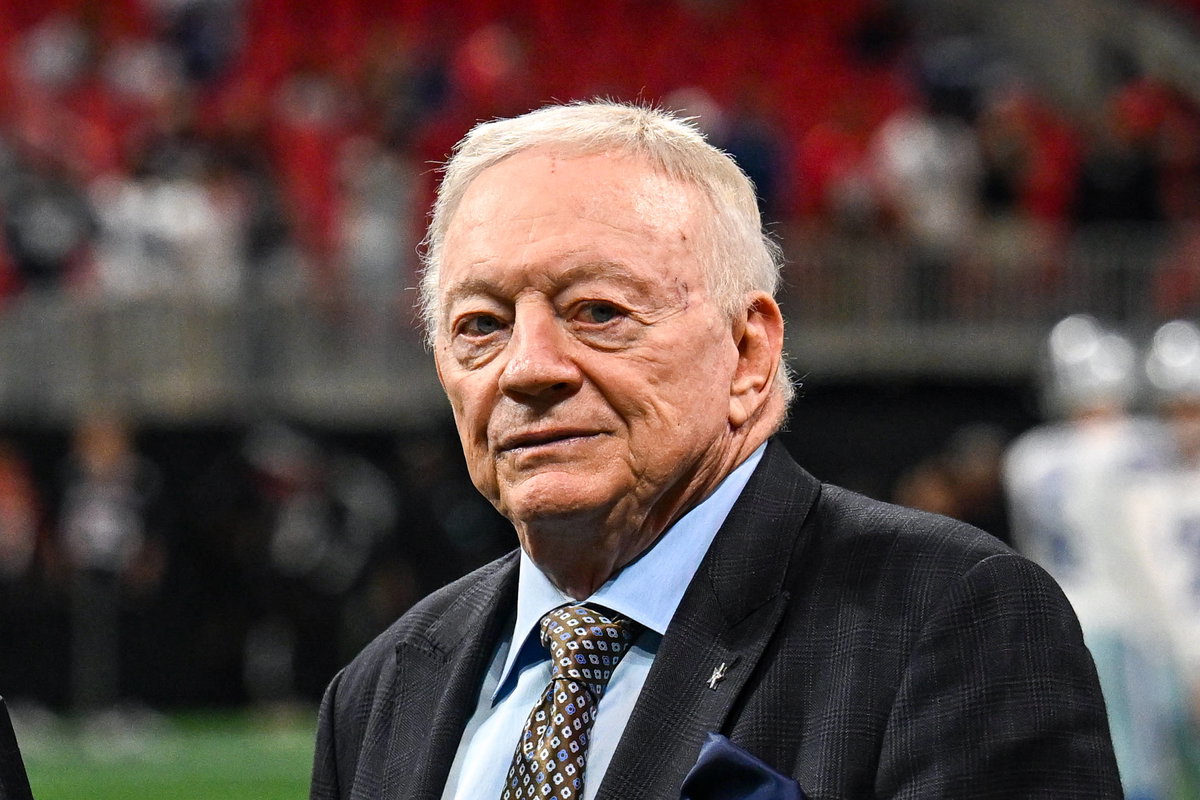
While Jerry Jones finished his decade of success with the Cowboys, another rebuild was already underway in Dallas. Mark Cuban was building the Mavericks from the ground up. And just as Jones once did, Cuban was on the front lines. He sat with the sales staff, working on it less like a sports franchise and more like a business he was desperately trying to save. It was an effort that turned a near $300 million investment into ten times the return.
Watch What’s Trending Now!
That’s why, when Cuban, leading the newly formed $750 million Harbinger fund, announced his interest in purchasing a stake in the Dallas Cowboys last week, he knew he had Jones’ attention. After all, the two have been friends since his Mavericks purchase. However, Jones, true to his nature, turned down the idea. And he did it in a way that will leave Cuban happy about everything he has achieved so far.
While speaking to the media at Oxnard, Jones was asked about a stake being potentially sold to Cuban, to which he responded, “No, I don’t have that on my plate as a possibility at this time. But the question really was, should I ever look at it? Well, he’s the kind of individual that I would want to have as a part of a group.”
For as long as Jones has owned the Cowboys, selling the franchise has never been an option. In fact, Jones was even asked if he would sell the Cowboys and buy a Los Angeles team to help it grow. Yet, he stayed adamant. The one thing he stayed open to was selling a stake in the team. He was one of the biggest proponents of it. And when NFL owners voted in August 2024 to allow private equity firms to purchase up to 10% of a franchise, the Jones family opened their doors to the idea. Cuban could even be a good fit here. And there’s a reason we say that.
His interest in the Cowboys now comes at a very different stage of his sports-ownership career.
When Cuban bought the Mavericks from H. Ross Perot Jr. in 2000, Dallas had missed the playoffs in every season from 1991 through 2000. Cuban paid $285 million for the franchise and quickly became known for treating the organization as both a basketball team and a business. The Mavericks eventually reached the playoffs in 18 of the 23 seasons under his majority ownership and won their first championship in 2011.
But Cuban did not actually turn a $285 million purchase into a $3 billion-plus sale by himself. In 2023, he sold a majority stake to the Adelson and Dumont families at a valuation of roughly $3.5 billion while retaining 27% of the Mavericks and continuing to oversee basketball operations at the time.
That distinction matters now because Cuban is no longer approaching team ownership as the person who needs to control the entire franchise. Through Harbinger Sports Partners, he is pursuing something much more targeted: minority positions in professional teams. The fund’s stated strategy is to pursue stakes generally in the 1% to 5% range, with investments of roughly $50 million to $150 million, rather than taking control of franchises.
And Harbinger is no longer simply a fund looking for its first opportunity. In July, it purchased a minority stake in the Athletics, its first publicly announced team investment. The size and price of that stake were not disclosed, but the deal came as the A’s prepare for their planned move to Las Vegas and a new $2 billion ballpark.
That first deal gives the Cowboys connection more weight. Harbinger has now demonstrated that it is willing to put capital behind the kind of minority ownership model that could theoretically apply to Dallas. Its debut fund had raised more than $450 million by April, while the original target was $750 million.
There is, however, another hurdle that makes Jones’ answer more significant than a simple yes-or-no on Cuban. The NFL’s 2024 private-equity rules permit institutional funds to own a combined maximum of 10% of a franchise, with individual investments subject to league rules and a minimum 3% stake. Those investments are also passive; they do not give the fund voting power or control over football operations.
The NFL initially approved four private-equity fund groups for such transactions, meaning a Harbinger investment in an NFL team would still have to fit within the league’s ownership framework rather than functioning like a normal private-equity purchase. That makes Jones’ willingness to entertain Cuban personally more notable than the existence of Harbinger alone.
These are the qualities Jones sees clearly in Cuban. And for an owner who has kept the Cowboys’ control within his family, his willingness to single Cuban out is telling. Jones didn’t say Cuban was being offered a stake; he said that if the family ever decided to bring someone from outside it into the ownership group, Cuban would be the type of person he’d want.
“In his particular case, because of the experience he’s got and just plain because I know Mark and I really like his human qualities. So candidly, when they brought his name up, I said, ‘Well, that’s the kind of individual if you’re going to go outside our family.’”
That family reference is arguably more revealing than the investment talk itself. Jones has spent decades building the Cowboys into a family-controlled enterprise, and an outside investor would be entering a structure where the Joneses remain firmly in charge. A passive investor such as Harbinger would therefore make considerably more sense than someone looking for an active role in football decisions.
After all, since Cuban arrived in Dallas, he has shared a close relationship with Jones. The two regularly called each other, with Jones mentoring Cuban to an extent. The philosophy they operated their businesses with, one that had a massive focus on marketing and branding, meant their conversations steered towards business and coaching decisions. Their approaches could work well together.
Cuban once even discussed the way the Cowboys are run. “The difference between us is Jerry saw the whole thing as a business… When he talks about running this thing as a business and as a football team, he’s usually right,” Cuban said on Shannon Sharpe’s Club Shay Shay podcast.
Cuban’s comments went further than simply praising Jones’ business instincts. In the same conversation, he argued that winning at the highest level also requires an element neither owner can fully control: luck. “I just think you have to give more credit to luck,” Cuban said, arguing that it can have more impact than anything either owner can do.
That is an interesting distinction for the Cowboys. Jones has already demonstrated that the business side can thrive without a corresponding run of postseason success. Dallas has not reached an NFC Championship Game since the 1995 season, even as the franchise has continued to grow financially.
The numbers show just how separate those two worlds have become. Sportico valued the Cowboys at $15.5 billion on Aug. 12, 2026, up 21% from the previous year. Dallas also generated an estimated $1.3 billion in revenue and $510 million in operating profit, according to the valuation report.
That makes the Cowboys an unusual investment proposition. There is no obvious need for an investor to come in and rescue the business. The franchise is already generating enormous money while remaining the NFL’s most valuable team. What a minority investor would really be buying is exposure to an asset whose value has continued to rise despite the lack of a Super Bowl appearance in nearly three decades.
And that is where Cuban’s Harbinger strategy becomes particularly relevant. The fund is looking for mature sports franchises with durable revenue streams and long-term appreciation potential, rather than teams that need to be rebuilt from the ground up. The Cowboys fit that description almost perfectly.
Cuban’s own Mavericks experience also gives him a perspective few potential investors can match. He knows what it means to inherit a struggling Dallas franchise, build its commercial identity and eventually watch its value multiply. He also knows what it is like to give up control while retaining a minority position, something that could make a Cowboys investment structurally familiar to him.
There is even a twist to Cuban’s current position with the Mavericks. He has remained a 27% owner, but his role in basketball operations has diminished since the Adelson-Dumont family took control. In July, after Harbinger’s Athletics investment, Cuban said his “pivot away from the Mavericks was not my choice.”
That makes Harbinger more than a financial vehicle for Cuban. It gives him another way to remain involved in professional sports ownership without needing to control an entire franchise.
But let’s not be hasty here. While Cuban turned the Mavericks around, they only finished with one championship despite multiple visits to the NBA Finals. What the Cowboys need at the moment isn’t business or a boost to their valuation; it’s consistent performances, especially when it comes to the playoffs.
Still, that may be precisely why Cuban’s potential fit is more intriguing on the business side than the football side. He would not be coming in to fix Dak Prescott’s playoff record, build the roster or tell Brian Schottenheimer how to run the offense. Under the NFL’s private-equity framework, an investor’s role is deliberately limited. The value of someone like Cuban would instead come from his experience building a sports brand, understanding franchise economics and recognizing where a team’s commercial value can grow.
For now, though, none of that amounts to a Cowboys transaction. Jones has explicitly said a stake sale is not on his plate, and there is no announced deal, percentage or valuation involving Cuban and Dallas. What he has done is leave the door open, and put Cuban’s name unusually close to it.
That distinction is important because the Cowboys have become an increasingly expensive asset even by NFL standards. Sportico’s $15.5 billion valuation means a hypothetical 1% stake would represent roughly $155 million, while 5% would be about $775 million at that valuation. Those are not proposed transaction prices, but they show why even a small ownership sale would be a significant financial event.
So the immediate decision from Jones is not really a rejection of Cuban. It is a rejection of the timing. And if the Jones family eventually decides that a small piece of the Cowboys belongs outside the family, Cuban has now been publicly identified by Jerry Jones himself as someone who could belong in that conversation.