

Back in October 2005, when the Arizona Cardinals hosted the San Francisco 49ers in Mexico City, nobody expected the game to become a landmark moment for the NFL. The Cardinals cruised to a 31-14 win against the 49ers’ awful run defense. The product hardly screamed ‘export quality.’ But none of that mattered to a 103,467-full Azteca Stadium. The fans wearing vibrant colors and singing raucous cheers packed the stadium for the first-ever NFL regular-season game played outside America for the biggest regular season crowd in league history.
Watch What’s Trending Now!
Mexican fans understood the sport, embraced the spectacle, and gave the NFL something it had been craving for years: proof that American football could travel.
Two years later, the NFL crossed another border. In October 2007, the Miami Dolphins faced off against the New York Giants in London, marking the league’s first regular-season game in the UK. Wembley Stadium looked more like a swamp than a football field – thanks to nonstop rain. Surprisingly, fans still showed up, wrapped in thermals and raincoats. Tickets sold out within 90 minutes of being put up for sale, and the NFL saw a real opportunity.
Since then, one NFL game has been held in London every year, except in 2020 due to the COVID-19 pandemic. And now, what started as a novelty game in London has become a significant part of the NFL schedule. Last season alone, the NFL staged seven games across Brazil, Germany, Ireland, Spain, and the UK. The NFL’s International Series viewership also reportedly jumped 32% from the 2024 season.
You see, the NFL has squeezed nearly every drop from the American market. The obvious next step is to conquer the rest of the world.
NFL Commissioner Roger Goodell has adamantly declared that the NFL is “serious about being a global sport.” The demand clearly exists overseas, with around 410 million fans across the world. Brazil led as the fastest-growing market for the league with more than 36 million NFL fans. And so the chase began.
During the 2025 season, the Los Angeles Chargers faced off against the Kansas City Chiefs at São Paulo. The Chargers were the designated home team, and they came away with a 27-21 win over the Chiefs. But the real win was the atmosphere in the stadium, which was flooded with Chiefs fans in red and white. Samba performances also filled the arena, and the crowd treated football like a Champions League final. Shortly afterwards, the NFL signed a multiyear agreement to play at least three regular-season games in Rio de Janeiro over five years.
Now the NFL wants more. Much more.


🌍 Here are the confirmed cities and teams for the record-breaking 2026 NFL International Games!


The 2026 NFL schedule will be revealed soon, and the league plans to unveil nine international games during the season. Two of those NFL games have already been announced. The Los Angeles Rams and 49ers will open in Melbourne. The Dallas Cowboys and Baltimore Ravens will head to Rio de Janeiro.
We also know at least one team for the remaining seven NFL games. The Jacksonville Jaguars get two London games, and the Washington Commanders will be playing another game in the same city. The Atlanta Falcons will play in Madrid, the Detroit Lions in Munich, the New Orleans Saints in Paris, and the 49ers in Mexico City.
At this point, the NFL’s international expansion is no longer an experiment. It’s officially part of the league’s policy. But I believe transforming occasional international games into a sustainable global ecosystem may prove far more complicated than the league expects. The NFL already learned that lesson the hard way.
The failures of NFL Europe still linger
Before the International Series came into existence, the NFL tried planting permanent roots overseas through NFL Europe. Originally launched as the World League of American Football in 1991, the league featured teams in London, Frankfurt, and Barcelona alongside franchises in the United States and Canada. The idea looked coherent on paper, as NFL teams could send young players – like Kurt Warner, Jake Delhomme, Adam Vinatieri, and Brad Johnson – overseas for development while introducing football to new audiences.
But there was one glaring issue: overseas fans knew they weren’t watching Super Bowl-level talent.
American football already asks a lot from new viewers – It’s complicated, stop-start nature, loaded with rules, can make cricket look straightforward for Europeans. Add second-tier talent to the mix, and the novelty of American football faded quickly in Europe. So, by 1992, European teams struggled financially, attendance dipped, and the league went on hiatus.
The NFL revived the league later through a financial partnership with FOX, which involved an exchange of broadcast rights in 1994. But even by eliminating several teams and rebranding to become NFL Europa, the problems never disappeared…
The league generated talent for NFL teams, but crowds? It often came for a good pint and a good punt.
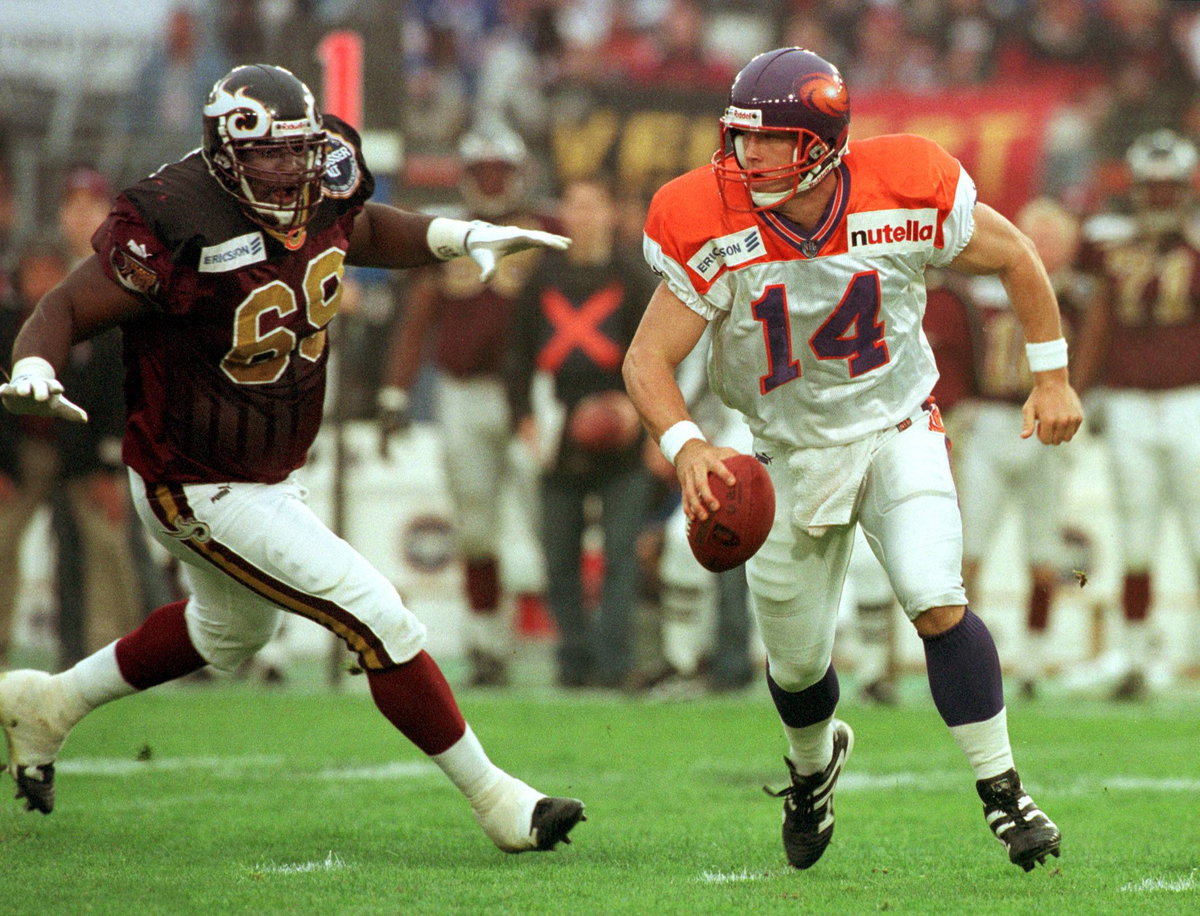
Imago
Bildnummer: 00198698 Datum: 29.04.2000 Copyright: imago/Uwe Kraft
Quarterback Pat Barnes (Frankfurt Galaxy, re.) bedroht durch Ken Anderson (Rhein Fire); quer, Duell, Zweikampf, Ei, Pille NFL Europe League Saison 2000, Düsseldorf RheinFire – Frankfurt Galaxy 31:27 Düsseldorf Rheinstadion American Football Herren Mannschaft Deutschland Gruppenbild Aktion Personen
NFL Europe’s organizers failed to combine enough excitement and off-field entertainment to sustain decent attendance in the league. By 2007, NFL Europe reportedly lost around $30 million annually, mainly due to its inability to garner a live television contract in the European media market. At the same time, the NFL realized that it’s better to shift its global expansion plans towards organizing regular-season games outside the U.S.
The NFL’s global ambitions would’ve looked impossible nearly 20 years ago when the NFL Europe was shut down, but now things have changed.
The NFL dipped its toes in the digital landscape, only to learn it’s not sustainable
The NFL already earns more than $23 billion in revenue annually, and domestic growth is starting to hit a ceiling. Broadcast deals with CBS, NBC, FOX, ESPN, and Amazon run through 2033, with NFL having an opt-out clause after the 2029 season. At the same time, the league is also turning away from traditional broadcasters to negotiate broadcasting rights packages with streaming platforms like Netflix and YouTube to chase a global audience.
In Germany, NFL fans can now watch games for free through standard cable television. Streaming platforms like DAZN have made NFL games more accessible across the world. But there’s a downside in the NFL’s shift to streaming services that’s hiding in plain sight.
The Rams vs. 49ers game in Australia during Week 1 of the 2026 season will be available to stream exclusively on Netflix. That may sound exciting inside league offices, but NFL fans already feel subscription fatigue creeping in like a tax collector. Even the U.S. Department of Justice has launched an investigation into rising streaming costs surrounding NFL broadcasts.
During the 2025 season, you needed to pay the $14.99 monthly fee to Amazon Prime for exclusive access to Thursday night football. Add to this the Sunday Ticket costs, cable subscriptions, and endless ads, and suddenly watching every NFL game this year feels like assembling the Infinity Stones.
The NFL’s digital popularity will not automatically create sustainable football infrastructure. By increasing international games, it will only become much more difficult for the NFL to retain that audience.
Spectacle doesn’t guarantee loyalty in the global market
This week, the Jaguars reportedly protected their 2026 season home game against the Pittsburgh Steelers from being moved overseas. The reason? The Jaguars know that the Steelers fans travel like a touring rock band. They knew keeping the home game at home would be more financially beneficial for them. Three years ago, Cowboys owner Jerry Jones also resisted giving up home games because international matchups mean sacrificing local revenue and home-field advantage.
Meanwhile, the NFL International Series has become a traveling carnival.
Host cities treat these games like mini Super Bowls, complete with celebrity appearances, concerts, fan festivals, and murals. NFL executive Gerrit Meier even described the Dublin game last year as “a real sense of a mini Super Bowl coming to town.”
NFL merchandise stands were open at Croke Park on gameday when the Steelers played against the Minnesota Vikings. But the reality is that while the NFL generates over $3 billion in annual merchandise revenue, its venture into the international market remains relatively low compared to other American leagues like the NBA.
As such, the NFL also continues pushing global marketing through its Global Markets Program, which assigns international territories to teams. All 32 NFL franchises now participate in over 22 global markets. The league’s social media engagement has amplified the effort further, with localized content flooding Instagram, TikTok, and X.
Then there’s the reeling controversy. The Super Bowl LX halftime show featuring Bad Bunny generated more than 125 million YouTube views. But this week, TMZ reported that the Federal Communications Commission (FCC) received over 2,000 complaints about the performance. Some viewers even called the Puerto Rican singer’s act inappropriate, overly sexual, even “anti-American.”

Imago
NFL, American Football Herren, USA Super Bowl LX-Seattle Seahawks at New England Patriots, Feb 8, 2026, Santa Clara, CA, USA. Bad Bunny performs the halftime show in Super Bowl LX between the Seattle Seahawks and the New England Patriots at Levi’s Stadium. Santa Clara Levi’s Stadium, CA, USA. EDITORIAL USE ONLY. PUBLICATIONxINxGERxSUIxAUTxONLY. Copyright: xMarkxJ.xRebilasx 20260208_lbm_su5_167
That reaction revealed that while the NFL wants global culture to help American football grow, parts of its core audience still resist changes. At the same time, even a sold-out stadium once a year in a venue outside the U.S. does not guarantee sustainable loyalty to American football.
International interest may still be tied more to the “NFL experience” than to the teams. It’s easy to cheer an NFL team during a hyped-up international matchup. But I also know that it’s harder to stay emotionally invested in an NFL team through a disappointing 6-11 season. Hey! Go Chiefs, anyone? That’s where true loyalty gets tested, and the NFL might not find that within fans of an overseas franchise.
A permanent international franchise still feels far away
In comparison with other major American leagues, the NFL still has a very small inflow of international players. As such, not many NFL franchises are popular outside the US. The Jaguars are the only NFL franchise to have a decent fanbase in London, but it’s largely because they embraced the market early.
Since 2013, the Jaguars have played annually at Wembley Stadium and kept all revenues from those games. Their matchup against the Rams last season drew more than 86,000 fans. Still, one successful annual event doesn’t magically create a sustainable NFL franchise model. But try telling that to Goodell!
He keeps teasing the possibility of a European franchise or even an overseas division someday. Now, an overseas division would likely require NFL expansion to 36 teams. That opens another can of worms…

Imago
Trump Announces DC Will Host the 2027 NFL Draft Roger Goodell, Commissioner, National Football League (NFL), listens to United States President Donald J. Trump announce DC will host the 2027 NFL draft in the Oval Office of the White House in Washington, DC, USA, 05 May 2025. The move comes after the Washington Commanders announced they planned to return to DC in a new stadium built on the site of Robert F. Kennedy Stadium. Credit: Jim LoScalzo / Pool via CNP/AdMedia, Washington, District of Columbia United States of America EDITORIAL USE ONLY PUBLICATION NOT IN UK/AUS Copyright: xx JJL21646-5370474 CNP/AdMediax admphotostwo930275
More NFL teams could weaken parity, increase tanking, and push the NFL toward an expanded postseason where mediocre teams sneak into January football. I don’t even need to list all the issues. Nobody wants the NFL turning into the NBA’s load-management circus.
Speaking of load-management circus, the NFL schedule! Roger Goodell has been pushing for an 18-game regular-season paired with two preseason games and an extra bye week. New England Patriots owner Robert Kraft even proposed this structure quite elaborately:
“In our new labor agreement, I hope we go to 18 games and two preseason games, and then if we do that, it would allow us to hopefully go to 16 international games, so we would have every team every year play an international game, which would be built mainly through a streaming audience.”
More NFL games mean more inventory and more money. But it also means tougher negotiations with the NFLPA, more player health concerns, complicated tax laws, and relocation headaches. At some point, the NFL needs to realize it doesn’t actually need a permanent international franchise at all. Goodell hinted at that idea himself:
“You can think of expansion as the number of teams, or you can think of expansion as us playing in international markets and reaching in different areas.”
Why anchor one franchise overseas when the entire NFL can rotate globally like a touring concert?
It’s a savvy business plan to push for consistent reach. But these plans still have echoes of the Premier League’s 39th game proposal, which included an extra game week with every team playing overseas. That plan collapsed under cultural resistance as much as logistical strain, and the same can happen with the NFL.
Logistics might be the NFL’s biggest enemy
Let’s be real, the logistics of an overseas NFL franchise sound like a migraine wrapped inside a red-eye flight. For all the excitement surrounding international NFL games, players keep sounding the alarm about travel. And honestly, they have a point.
NFL’s international assignments also don’t fall equally, so the quality of football often suffers overseas. NFL games frequently turn sloppy, low-scoring, and awkward due to jet lag, disrupted routines, and shortened recovery time.
The Chiefs endured brutal scheduling stretches in the 2025 season, including a 12-hour trip to Brazil followed by a long drive to the site on gameday itself. This year, the 49ers face perhaps the nastiest travel schedule imaginable, with nine road games, including two overseas games scheduled in Australia and Mexico City.
So, two months ago, 49ers defensive end Nick Bosa’s mother, Cheryl, took to social media to voice her outrage against the NFL’s scheduling. Later, 49ers fullback Kyle Juszczyk even expressed his displeasure with the schedule:
“That’s not fair. The NFL, I feel, is doing us a disservice. Because if we’re going to talk about health and safety, to do two international games like that is almost like playing three games in 13 days.”
Last season, the Rams faced off against the Jaguars in a London matchup and came away with a 35-7 win. In two other London games last season, the Vikings defeated the Cleveland Browns 21-17, and the Denver Broncos defeated the New York Jets 13-11. While these NFL games were close, none were particularly competitive. The NFL is also aware of these issues.
That’s why league executives started discussing supersonic travel during the 2025 International Series. The league has closely monitored Boom Supersonic, the aerospace startup attempting to revive commercial supersonic flights. If Boom succeeds, transatlantic trips could eventually get sliced nearly in half. But all of this is still a work in progress.
For now, the NFL’s global dream still runs into the same stubborn wall: distance. American football is violent enough without asking players to treat every other week like an international business trip. And that’s the irony at the heart of all this. The NFL might’ve already convinced millions worldwide to watch football. The hard part now is convincing the league itself to evolve enough to sustain that global audience.