Essentials Inside The Story
- Joe Burrow and Brock Purdy frame an injury breakdown explained directly by an NFL orthopedist to EssentiallySports.
- Footwear design, surface grip, and toe mechanics emerge as decisive factors affecting player availability.
- Recovery timelines, not toughness, ultimately dictate outcomes once push-off ability is compromised.
Turf toe: the mere mention of the injury often brings a chuckle, as people wonder how football players who often weigh 300-plus pounds can be sidelined by toes that hurt. High-profile quarterbacks Joe Burrow and Brock Purdy both dealt with turf-toe injuries during the 2025 NFL season, showing how even elite players can be significantly affected by this condition. Yet most people are clueless about turf-toe injuries, what they are exactly, how they come about, and the main culprits that cause the condition. I spoke with Dr. Bob Anderson, an expert in the field who has worked with athletes and professional sports leagues nationwide, to get the answers.
Watch What’s Trending Now!
Dr. Bob Anderson’s experience with professional athletes
Please give us an idea of your background working with professional athletes.
Dr. Anderson: I’ve worked with all the leagues: NHL, NBA, NFL, NASCAR, and the X-Games. I’ve been a consultant with almost all the professional teams. I was the Carolina Panthers team doctor for almost 20 years, and I’ve been with the Green Bay Packers since 2017 as the associate team physician.
.png)
.png)
.png)
In layman’s terms, what exactly is turf toe?
Dr. Anderson: The simplest way to put it is that it’s a sprain of the big toe. A sprain is a ligament injury. There’s a ligament, also known as a plantar plate, on the underside of the great toe (the big toe) that we call the hallux MP joint. When the big toe goes up too far into dorsiflexion, you go beyond the excursion of that plantar plate or ligament; it eventually fails, and you get a rupture. It can be a partial rupture or a complete rupture on either side of the toe.


Sources: Images of Joe Burrow’s turf toe injury are being sent to noted foot specialist, Dr. Robert Anderson, to be reviewed. If surgery is deemed necessary, it would be expected to sideline Burrow three months. Burrow was in a walking boot and on crutches after today’s game. pic.twitter.com/8sz6m3kipx
— Adam Schefter (@AdamSchefter) September 15, 2025
As turf toe was originally described in the mid-1970s on AstroTurf, it was a hyperextension and big-toe injury that occurred on a surface that was unforgiving. Basically, it was described as a hyperextension of the big toe on artificial surfaces. Now we know it can occur on any field surface, and it’s not necessarily a hyperextension. Sometimes it can be [the big toe] moving in different directions and injuring different parts of the joint. There are all kinds of variations for turf toe injuries; some are severe, and some are mild. Some require surgery, some don’t. It’s an injury that, when it’s complete, it’s very difficult for an athlete to push off.
In the NFL, a lot depends on the position. There was a time when you had a lineman with a turf-toe injury, and you’d say, “Just suck it up and wear a bigger shoe, a stiffer shoe, tape it (the big toe), and go back and play,” and you would reserve surgery for the speed guys.
Nowadays, we will consider surgery on any guy at any position that has a complete rupture with changes in the big toe joint.
The impact of Turf Toe on NFL players
Short of a rupture, is it a situation where the pain prevents someone from taking the field? Or is the actual injury that debilitating?
Dr. Anderson: Even a partial turf-toe injury can be very difficult for the running athlete, because every time he’s trying to push off, he’s aggravating the injury. Even if it’s a stable turf-toe injury, it could be painful to push off, which makes it difficult for the player to get back on the field. Some of the non-operative injuries can take 4-6 or even eight weeks for a player to get back on the field.
Our tendency over the years is to offer surgical repair for a complete rupture at an earlier date, for a more predictable outcome.

Imago
NFL, American Football Herren, USA Jacksonville Jaguars at Cincinnati Bengals Sep 14, 2025 Cincinnati, Ohio, USA Cincinnati Bengals quarterback Joe Burrow 9 walks off the field after an injury during the second quarter against the Jacksonville Jaguars at Paycor Stadium. Cincinnati Paycor Stadium Ohio USA, EDITORIAL USE ONLY PUBLICATIONxINxGERxSUIxAUTxONLY Copyright: xCaraxOwsleyx 20250914_jcd_usa_0211
If surgery is required, how long does it take for a player to get back to 100%?
Dr. Anderson: Once you do surgery, you need to figure it’s going to be around 12-16 weeks. The average is about 12 weeks just to get somebody back. It’s different for everybody; some players heal quicker than others.
Common causes
What do you find is the primary culprit of turf toe? Is it contact? Someone getting their foot caught in a pileup? A receiver running routes on a certain type of turf?
Dr. Anderson: The most common mechanism is when a guy has his cleat embedded in the turf, then somebody lands on the back of his heel and drives the forefoot into that hyperextension. It’s what we call an axial load injury.
Nowadays, we know it can happen to a person tackled trying to make a cut, and, more than hyperextension, it could be an injury where the ligament is stretched inside or outside. But typically, it is a contact injury.
I’ve had some older NBA guys that have ruptured an older, worn-out plantar plate, but in football, it’s primarily a contact injury.
In football, we have related it to shoe wear that may be too flexible in the forefoot. We’ve done a lot of research on this through the NFL. We’ve devised a testing device called the FAST machine, which tests for cleat plate flexibility.
We found there were certain shoes that were lightweight and had an excessive amount of flexibility in the front of the cleat plate that may make players more susceptible to turf toe injuries. If you want to avoid turf toe, you’re going to wear the most rigid shoe you can that doesn’t bend and helps prevent hyperextension.
Of course, you’re going to lose some performance when you do that!
Imago
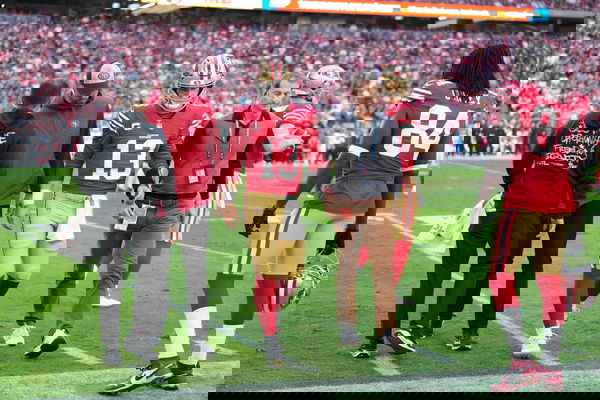
NFL, American Football Herren, USA San Francisco 49ers at Arizona Cardinals Dec 17, 2023 Glendale, Arizona, USA San Francisco 49ers quarterback Brock Purdy 13 leaves the game against the Arizona Cardinals with an injury during the first half at State Farm Stadium. Glendale State Farm Stadium Arizona USA, EDITORIAL USE ONLY PUBLICATIONxINxGERxSUIxAUTxONLY Copyright: xJoexCamporealex 20231217_jca_aa9_023
The skill players probably hate listening to the recommendation of wearing stiffer shoes!
Dr. Anderson: We test all the cleat plates every year before the season, and we try to guide the players into what parameters to look for. You want some flexibility yet not too much flexibility, but we now have the ability to test the cleat plates to ensure they don’t bend too much.
If a cleat plate bends too much, we put out a chart for the player to look at, which says, “You may want to rethink this [shoe] for an artificial surface.”
Are there specific field turfs that make players more susceptible to turf toe?
Dr. Anderson: In theory, you would assume a turf-toe injury would happen more on artificial turf than natural grass, but we haven’t totally proven it yet. The assumption is that there’s a better chance of a cleat releasing on grass; before a cleat gets to maximum bend, the shoe may actually slide out.
On artificial [turf], we believe the studs on the cleat plate get embedded down deep in the cornrows (the seams of the artificial surface), and they just can’t release. So the cleat plate is locked in, and all that force goes through the foot.
Is turf toe a terminal condition, and can a player that’s experienced a turf-toe injury more likely to have it recur?
Dr. Anderson: Yes, there have been a number of well-known players in the NFL who have had subsequent issues with the big toe. Some things that have happened are that you can develop arthritis, you can develop a deformity, or you can develop a bunion, as well as loss of push-off. All of these can happen after a turf toe injury, especially if it’s not recognized, diagnosed, or treated.
BAN TURF FIELDS!!!!!
The injury to #Giants WR Malik Nabers is much worse than originally thought. He has a Torn ACL, Torn Meniscus, partially torn Labrum AND a partially torn turf toe. pic.twitter.com/ukNLPcTV8v
— 49ers & NFL News 24/7 (@49ersSportsTalk) October 5, 2025
If a player comes back too fast from an unstable turf toe and is treated without surgery, he could cause further damage to the joint. He could also cause permanent harm or damage to the joint surface itself.
That’s why we always try to determine who’s stable, who’s not, and who may be better off with surgery right off the bat, to give them the best outcome not only for football but for the rest of their life.
Treatment options
Are there any preventative treatments or exercises a player can participate in to prevent turf toe? It must be tough to tell NFL players expected to lift hundreds of pounds in the weight room, “Wiggle your toes to strengthen your plantar plate!”
Dr. Anderson: (Laughs) Exactly, you can encourage the players to work on their big toe-tendon strength. There’s a tendon called the FHO tendon that rides on the underside of the big toe, and it’s nice to have that tendon strong to help prevent some of the excessive motion and hyperextension, but it’s hard. We find prevention is more about what shoes you wear versus strengthening your big toe.
We have players who sustained turf-toe injuries in the past, and they elect to tape the big toe so it doesn’t happen again. There are other preventive turf-toe measures players take to prevent the injury from recurring, such as wearing turf-toe plates, orthotics, or taping apparatus.
Do turf-toe injuries increase the possibility of plantar fasciitis, or are they separate issues?
Dr. Anderson: They are separate, and turf toe does not increase the incidence of plantar fasciitis.
Related Newsletters