
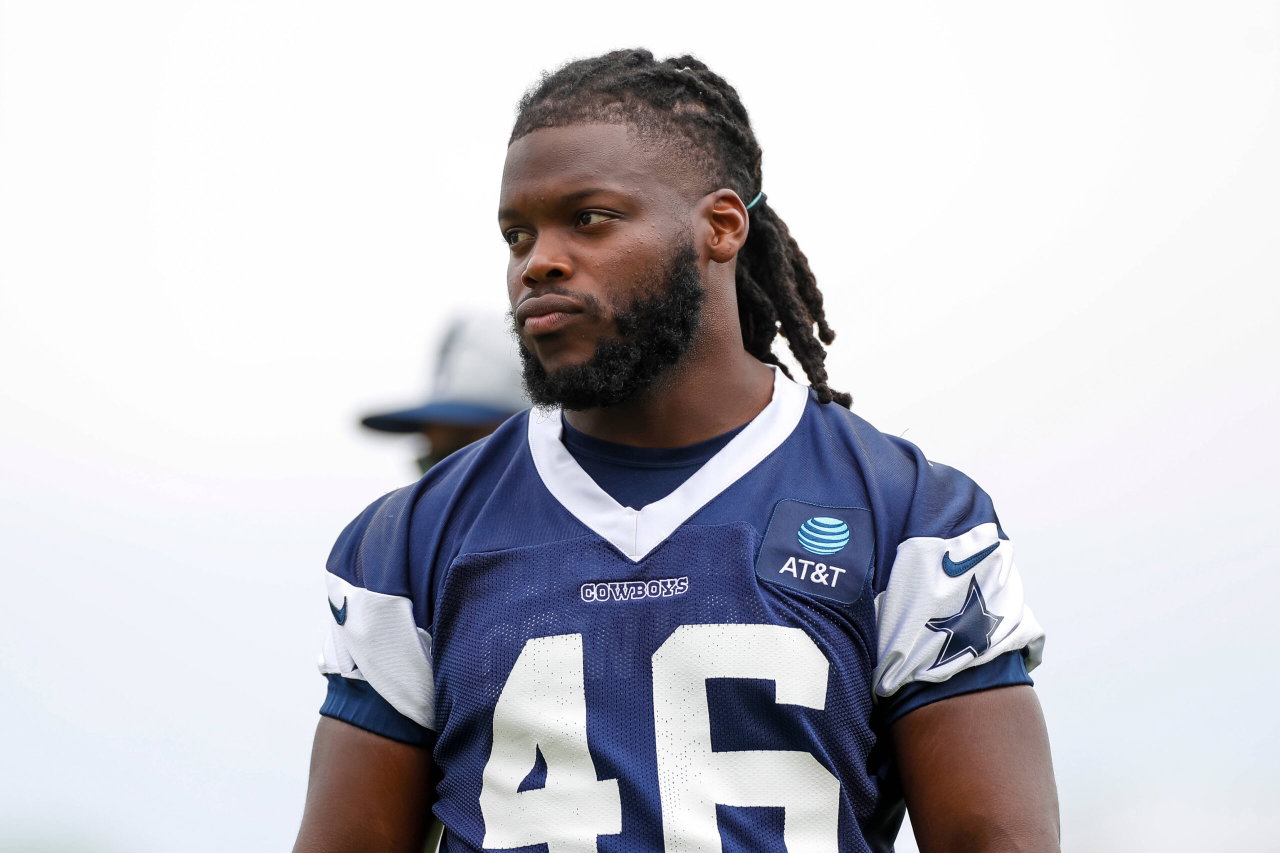
“Yall keep praying for me, please.”
Watch What’s Trending Now!
Two years ago, when Malik Jefferson made a public plea on X, there was a lot of uncertainty around the linebacker. After standout years with the Texas Longhorns, he exited the Dallas Cowboys and was later released by the Detroit Lions with an injury settlement. At just 27, Jefferson was nowhere to be seen.
Now, after years of virtual silence, Jefferson has publicly announced his retirement, and he has explained what caused him to call it quits at 29. More importantly, that same post explained what led the linebacker down a road that saw him underperform across the league, but never kept him from giving back to the city of Dallas.
Posting a lengthy tribute, Jefferson explained that a nerve and neck condition, one he didn’t even know he had for years, had quietly shaped the entire second half of his football life.
“For years, I didn’t know I was battling a nerve/neck issue,” Jefferson wrote on Instagram on September 28. “Constantly getting injuries, always in the training room, or doing extra rehab and mobility work. Towards the end of my career, I kept playing through the pain of my arm going numb on impact. I couldn’t handle the pain anymore; it was 10/10. Fast forward, I discovered my C5-C7 has been damaged. Today I still suffer from those injuries and still struggle with my day to day so I’d really appreciate prayers! It’s not said enough: get pictures of your spine and neck consistently players!!
Now it’s not the first time Jefferson has talked about his injury. Just a few weeks ago, Jefferson was recognized for his Helping Hands Foundation, where had addressed his exit from the sport.
“I’m officially announcing my retirement right now. My retirement is done because of medical issues. I have a C-spine injury, C5 through C7, and I also have thoracic outlet syndrome where my upper rib is compressed on the left side of my body. So when I used to tackle, my arm would go numb. I have double hips that need to be replaced in the future.”
The C5 to C7 nerves are crucial when it comes to the arms and fingers movement:
- C5 controls the shoulder movement and the upper arm.
- C6 deals with wrist extension and helps rotate the forearm.
- C7 controls the triceps as well as specific wrist and finger movements.
In hindsight, when we look back at his exit from the Detroit Lions, it came due to a finger injury. The same one could have been part of a bigger problem the linebacker may have faced at the time. Interestingly, this might have been the same problem that held Jefferson back from truly standing out in the NFL.
You see, he arrived at the Longhorns and delivered on the promise he showed in high school. 33 games across three seasons in Austin, was named a Freshman All-American in 2015, and capped his final season by winning Big 12 Co-Defensive Player of the Year and earning second-team All-American honors in 2017, finishing his Longhorns career with 233 tackles and 12 sacks before declaring early for the draft.
The Cincinnati Bengals selected him 78th overall in the 2018 NFL Draft, making him the first Texas linebacker taken that high since Jordan Hicks in 2015. Before the draft, NFL Draft analyst Lance Zierlein had already pointed to a concern that would follow Jefferson into his NFL career.
“Jefferson has the desired combination of height, weight, speed that teams covet and draft, but his career production never matched his athletic traits,” Zierlein wrote.
The gap between Jefferson’s potential and production followed him throughout his NFL career. Across parts of seven seasons with the Bengals, Browns, Chargers, Titans, Colts, Cowboys, and Lions, he finished with just 19 total tackles in the league, a strikingly thin stat line for a player once considered one of the most complete linebacker prospects in the country.
With this week’s announcement, that gap finally has a medical explanation attached to it. But looking back at his career in the sport, Jefferson isn’t feeling regret. Rather, he thanked his teammates and organizations that had been part of his journey, reflecting on the people he met along the way and the role they played in shaping him throughout his career.
For Jefferson, the focus is now giving back to the community that helped turn him into the football player that he grew up to be. In his time spent away from the NFL, Jefferson returned to his home in Mesquite, Texas, to serve his community.
He established the Helping Hands Community, a non-profit organization meant to uplift communities in Mesquite and Dallas. From helping families during holidays to school supply drives, Jefferson is trying to support his neighborhood and his city. And that’s his biggest takeaway, even when he was forced to retire early.
“It doesn’t matter what we do in our lives. It’s not going to change whether you be the biggest person with the most money or the poorest person. It’s about you being a human. And I’m super thankful. I know the ladies and gentlemen that served us today; they don’t understand it. To be able to serve somebody is huge. Serve first. So, super thankful.”