
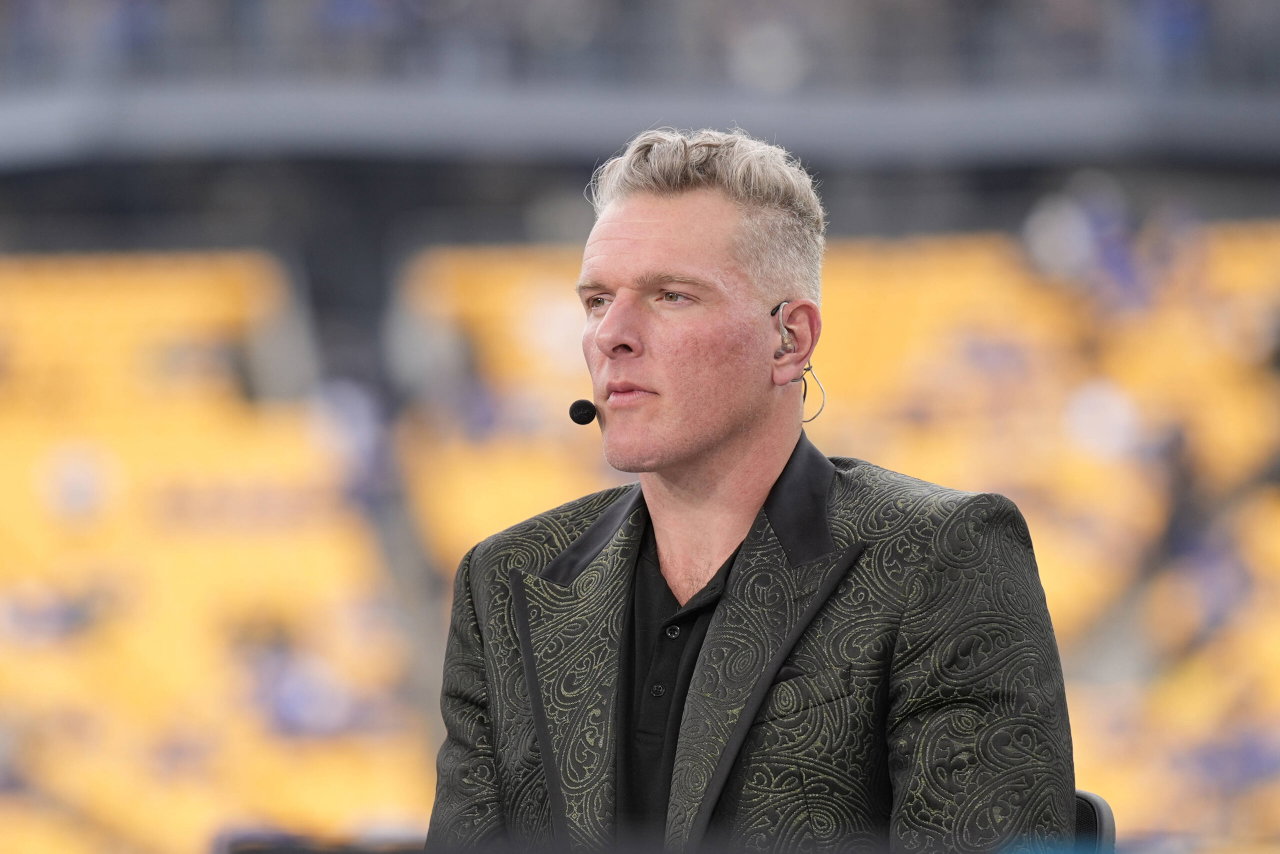
Dan Le Batard is back at it again. Just a week after arguing that NFL broadcasting jobs were going disproportionately to white men even though the league’s players are “disproportionately black,” Le Batard isn’t backing away. This time, his complaints have shifted from who gets the job to who gets the big money.
Watch What’s Trending Now!
On The Dan Le Batard Show, Le Batard pointed to several big names in sports media as examples of white personalities who get major contracts.
“They’re [ESPN analysts] all white and male except for Jonathan Vilma and a couple of others,” Le Batard said. “Since George Floyd, the company of ESPN and the country of the United States were promising some sort of change over the last five years. But what has happened with the NFL Network and ESPN, having put a whole bunch of white people in charge of how to select the next evolution of ESPN? This is what’s happened.
“I like almost all of the people that I’m about to mention here. I know many of them, and I respect all of the ones that I know a great deal. So I mean this as no insult. I’m just asking everybody listening to this: have you noticed that the people at ESPN who are getting the chances and the big money as things grow at ESPN are Joe Buck, Pat McAfee, Josh Pate, Rich Eisen, the Golics, Jason Kelce, Peter Schrager, and the Mannings? I’m legitimately asking the question, as I know that Stephen A. Smith has also gotten the money.”
Le Batard then took his argument a step further, tying those names to what he sees as a broader shift in ESPN’s direction.
“But as the money flows in from Disney and ESPN to fund the great spectacle that is the Worldwide Leader in sports that is now sitting out the political discussion to become the worldwide follower of sports, that it’s a whole lot of white people hiring a whole lot of white people and giving all of the money to a whole lot of white people. I have no issue with those people getting that money. But it’s only those people getting that money,” Le Batard further added.
Now, Joe Buck perhaps gives the clearest example of the kind of deal Le Batard was referring to. ESPN recently agreed to a six -year, $108 million extension with Buck, keeping him as the network’s lead Monday Night Football play-by-play announcer. The deal increased his annual salary from $15 million to around $18 million. As far as McAfee’s deal goes, the arrangement is a little different.
McAfee’s show operates under a licensing deal, reportedly worth around $60 million to $65 million per year for his broader ecosystem. Given his arrangement, Stephen A. Smith is technically the network’s highest-paid traditional employee after he signed a five-year, $100 million extension. And he isn’t the only Black talent ESPN has continued to invest in.
In June, ESPN announced a new multiyear agreement with former NFL safety Jason McCourty, who has continued to appear across NFL Live, Get Up, First Take and SportsCenter. He is also part of a broader group of Black analysts like Marcus Spears, Chris Canty, Louis Riddick, Sam Acho and Booger McFarland.
OutKick’s Bobby Burack also pointed to ESPN’s recent promotions involving Black talent, including Ryan Clark, David Dennis Jr., Monica McNutt, Elle Duncan, Clinton Yates, Chiney Ogwumike, Mina Kimes and Malika Andrews. He noted that Mike Golic and Mike Golic Jr. did return to the network, but only for a radio-only program. He also pointed out that the Mannings, like Shaquille O’Neal and Charles Barkley, have licensing deals with ESPN.
Stephen A. Smith himself didn’t seem to agree with Le Batard, even though many netizens did. According to Smith, McAfee got a good deal out of the network only because he deserved it.
Stephen A. Smith believes Pat McAfee earned his way to the top at ESPN
“First of all, I’m happy for him. He’s earned it, and I truly mean that,” Smith said. “I do believe, even though it makes people uncomfortable, as a Black man, that I don’t believe that’s an opportunity that would ever come to us first. In our society, we can say that’s fortunate or unfortunate. But the reality is that there usually has to be a precedent set before somebody is in a position to capitalize off of that.
“Make no mistake. I will be. But I definitely think along those lines, business is business. He’s earned it with a multitude of things that he has done. I’ve been incredibly successful in linear. He’s incredibly successful in streaming. The future is there, and I think that’s incredibly important.”
According to Smith, the story is bigger than a paycheck. Barrett Media’s John Mamola believed that it’s a cultural benchmark that conveys the message that entities can expect to make such money out of their contracts with ESPN.
Ultimately, ESPN’s megadeals keep fueling an intense debate between industry diversity and raw commercial value.