
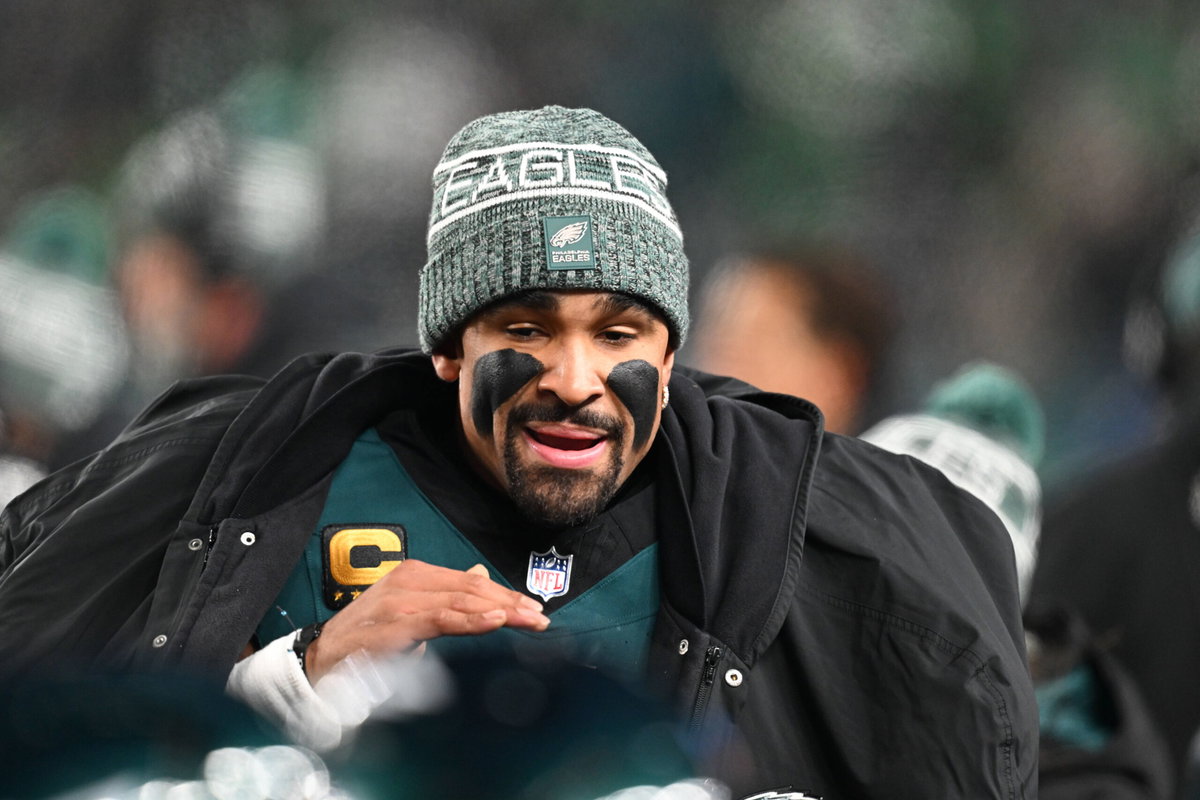
Week 3, Chicago. Jalen Hurts is in the blue medical tent, being checked for a concussion, and Andy Dalton, 38, a three-time Pro Bowler, trots on for four snaps. One of them is a pass. It’s picked off in the end zone. It’s the only throw he makes as an Eagle. Less than two weeks later, on Friday, Oct. 9, in London, they cut him. They needed the roster spot.
Watch What’s Trending Now!
Spots were scarce. Lane Johnson had retired without warning. Cam Jurgens had been traded to Baltimore. Saquon Barkley and DeVonta Smith were nursing hamstrings. Jordan Mailata called it a “week from hell.” Then came London, and five more Eagles got hurt against the Jaguars: Jonathan Greenard, Jalyx Hunt, Michael Carter, Will Shipley and Quinyon Mitchell. By Thursday, Mailata was admitting he’d spoken too soon. He had. Jalen Hurts has a superficial blood clot in his calf and is out indefinitely. Putting him on injured reserve would free a roster spot. But….
“The Philadelphia Eagles are not planning to place quarterback Jalen Hurts on injured reserve, sources told @RapSheet and me, even as he remains sidelined indefinitely because of a superficial blood clot,” ESPN insider Adam Schefter wrote on X.
The decision is less about predicting when Hurts will return than giving Philadelphia time to establish how long he could be out. The team is still gathering medical information and seeking additional opinions before committing to a minimum four-game absence.
That distinction matters because the treatment plan could determine whether Hurts misses a handful of games or a considerably longer stretch. The Eagles have not announced a return date, and keeping him off injured reserve should not be mistaken for an indication that he will be back soon.
The medical timeline began on October 8, when Hurts sought treatment after being cleated in the calf during Philadelphia’s October 4 loss to the Los Angeles Rams. He had practiced in full on Wednesday and Thursday before reporting the problem. An ultrasound conducted on Saturday, October 10, after the team’s flight to London, revealed the superficial blood clot.
According to the Eagles’ official statement, the team’s medical staff and doctors in London reviewed the results and concluded that activity and mobility were important and that Hurts could safely play against the Jacksonville Jaguars on October 11. They recommended another ultrasound within 72 hours of the game and the return flight to Philadelphia. Hurts played without limitation against Jacksonville and continued practicing in full the following week.
The situation changed on Wednesday night, October 14, when the follow-up ultrasound revealed movement in the clot. Philadelphia ruled him out for its October 18 game against the Carolina Panthers while determining the appropriate treatment. The team subsequently stressed that Hurts’ health and safety remained its highest priority.
Why the treatment plan could determine Hurts’ absence
A superficial blood clot develops in a vein close to the skin’s surface, but its location, size and potential to extend into deeper veins can affect the risks and treatment required. The Eagles have confirmed that the clot moved; they have not said that it travelled into a deep vein or caused an additional complication.
According to the reporting from Schefter and Rapoport, doctors are considering the appropriate course of treatment, with anticoagulants, commonly known as blood thinners, among the possibilities. Some minor clots may be managed differently, depending on the medical evaluation. The treatment decision is therefore central to the timeline, rather than simply how quickly the calf injury itself heals.
The ESPN report cited doctors around the league who had not examined Hurts but believed the condition could sideline him for several weeks. One team’s doctor estimated that the absence could last six weeks, while another offered a similar assessment. These were outside medical opinions, not a prognosis issued by Hurts’ own doctors.
The distinction is especially important for a contact-sport athlete. Anticoagulants can increase bleeding risk, and the ESPN reporting said a player cannot play while taking blood thinners. The report noted that a moderate dose could require a minimum treatment period of around six weeks, although the actual course would depend on the clot and the medical team’s assessment. A more serious development could require a longer course of treatment.
None of those possibilities establishes Hurts’ eventual recovery timeline. The Eagles have said they are still evaluating the appropriate treatment, and the decision about when he can return belongs to his medical team.
Why the Eagles can afford to wait on an IR decision
Under NFL rules, a player placed on injured reserve during the regular season must miss at least four games before returning. For Philadelphia, making that move now would commit Hurts to that minimum absence before the team has a complete picture of his prognosis.
Jonathan Jones of The Athletic offered another explanation for the delay, writing that the Eagles could keep Hurts on the active roster while they assess the full scope of his condition. With roster space available and several injuries already affecting the team, Philadelphia has some room to wait before making a decision that would create an additional roster spot.
The timing also matters because the Eagles have their Week 10 bye after their November 8 game against the New York Giants. If Hurts were placed on IR now, he would have to miss Weeks 6 through 9 and the Week 10 bye before becoming eligible to return. If the team waits until the following week to make that move, the mandatory absence would shift accordingly, potentially keeping him out through Week 11.
That is why the Eagles’ decision should not be framed as a declaration that Hurts will return before the bye. Avoiding IR preserves that possibility, but the medical information may ultimately point to a longer absence. Philadelphia has also left open the possibility of placing him on IR later if the treatment plan warrants it.
There is a football consideration, too. Philadelphia entered Week 6 at 2-3 after losing three consecutive games, including a 19-17 defeat to Jacksonville in London. Another loss against Carolina, combined with wins by NFC East rivals Dallas and New York, could further complicate the Eagles’ position in the division. That does not mean the team will make Hurts’ medical status contingent on its record, but the broader outlook could affect how it manages roster spots and the remainder of its season.
The immediate priority, however, is establishing how long Hurts needs to recover. Philadelphia is not required to make that roster decision before it has enough information to do so.
Tanner McKee takes over as Eagles add quarterback depth
With Hurts ruled out against Carolina, Tanner McKee is expected to start at quarterback. The Eagles also promoted rookie Cole Payton to the backup role and signed Joe Milton III from the Dallas Cowboys’ practice squad to reinforce the position.
The Milton move carries a roster commitment. Under the NFL’s practice-squad rules, a player signed to another team’s active roster from its practice squad must count against the acquiring team’s 53-man roster for three games, with a bye week counting as a game for this purpose. Philadelphia cannot simply treat Milton as a short-term practice-squad addition and immediately move him off the active roster without the applicable consequences.
Milton arrives with limited regular-season experience but showed promise during the 2026 preseason. Across three exhibition games, he completed 29 of 43 passes (67.4%) for 378 yards, three touchdowns and no interceptions. Those numbers provide context for the signing, although preseason production alone does not establish where he will fit in Philadelphia’s offense.
For now, McKee is the starter, Payton is the backup and Milton provides another option as the team works through Hurts’ absence. His signing strengthens the quarterback room, but it does not change the central uncertainty facing Philadelphia: how long its franchise quarterback will remain unavailable.
The Eagles have made a deliberate choice not to commit Hurts to injured reserve while they continue gathering medical information. That decision preserves flexibility, not a guaranteed early return. If the eventual treatment plan requires an extended absence, IR remains an option; until then, Philadelphia is waiting for a clearer answer from the people responsible for his care.