
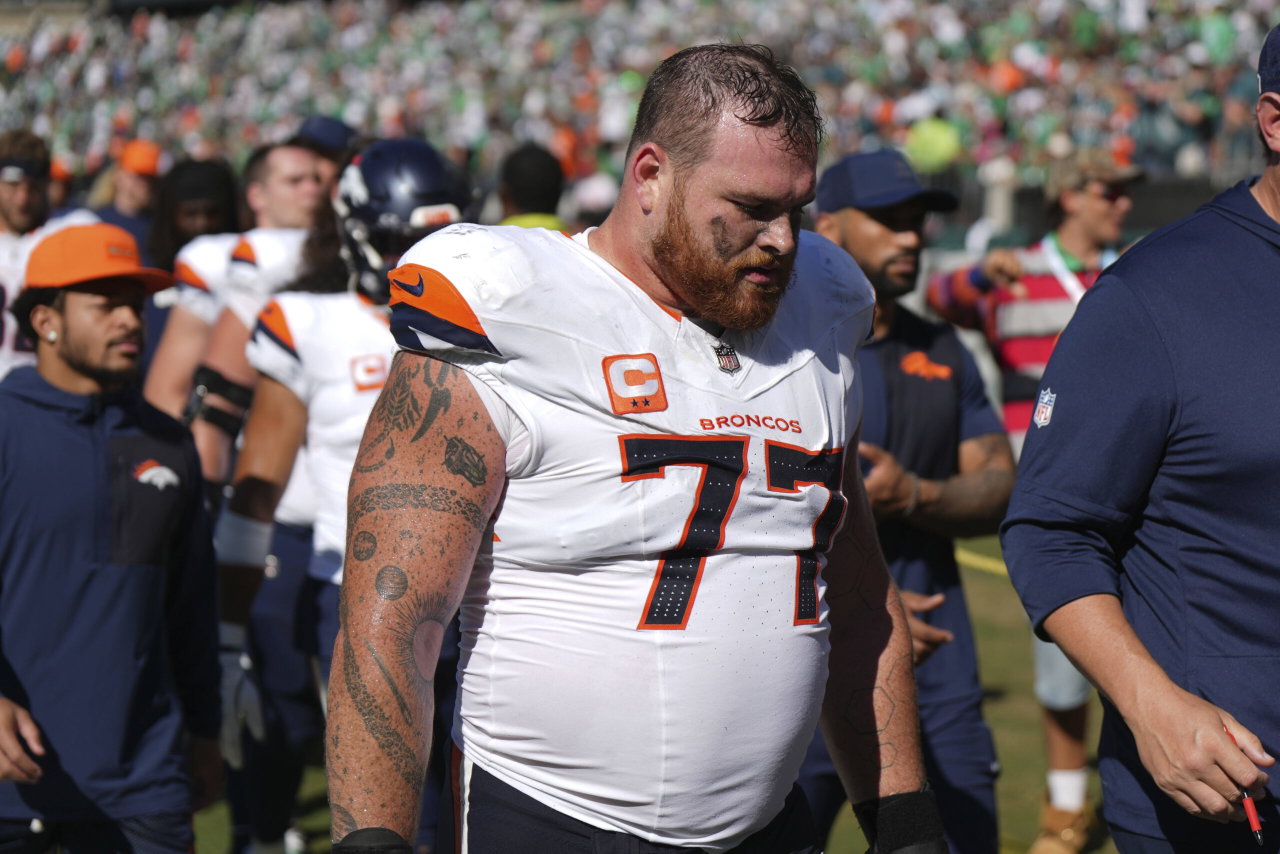
Aaron Donald may not even have been trying to beat Quinn Meinerz on that play during the Denver Broncos – Los Angeles Rams game. According to a Next Gen Stats breakdown, Meinerz allowed zero pressures across 35 pass-blocking snaps, including 11 reps against Donald, eight of them one-on-one. Donald appeared to be executing a defensive stunt, occupying the guard to open a lane for a teammate looping around the line. If so, his fall wasn’t necessarily the result of Meinerz overpowering him in a straight-up battle.
Watch What’s Trending Now!
But that didn’t stop fans from marvelling at the sight of Donald off balance and on the turf. The clip became a talking point about Meinerz’s strength, which led to a drug test. The Broncos guard found humour in the timing of it all, but the NFL had little appetite for that kind of joke. The NFL had dealt with players sharing such notifications on social media before, and Meinerz just became another use case for them.
“Per sources, #Broncos RG Quinn Meinerz drew a fine of around $15k for posting the image of his drug test notification on social media after Denver’s win against the Los Angeles Rams,” Parker Gabriel, a DenverPost journalist, shared on his X account.
This was bound to happen, considering there is a rule prohibiting publicly releasing such information.
It reads: “Any recording or photography of any stage of the collection process via any media (audio or visual), including but not limited to screen shots of testing notifications, video of the collectors or the collection of a specimen, and sharing such information via any social media is not permitted.
“A player found in violation of the rule prohibiting unauthorized recording of the collection process and sharing such information on social media will be subject to a fine of $15,000.”
Despite this rule’s existence, Meinerz had shared a screenshot of the message/notification he was sent by the league after the Broncos defeated the Rams.
“Quinn this is Christian on behalf of the NFL and Drug Free Sport,” the message read. “You have been selected to complete a Performance Enhancing Substance (PES) test today. You must complete your test prior to the start of afternoon team activities. Please bring your government issued ID or team ID.”
As per reports, the star offensive lineman will appeal the new fine. But why would the league be suspicious of Meinerz’s strength?
Well, it’s not every day that a lineman pancake blocks Aaron Donald. When offensive lines usually decide to double-team or triple-team Donald, Meinerz took Donald down single-handedly.
Per PFF, Meinerz has allowed just six total pressures in pass protection so far, one quarterback hit, and zero sacks. He is ranked 4th among 73 qualified offensive guards with an overall PFF grade of 86.2. His run-blocking grade of 91.9 is ranked 1st at his position.
The NFL aptly captioned the elite matchup: Definition of unstoppable force meets immovable object.
“I passed it,’’ Meinerz said of the drug test earlier this month. “That was one of the funnier text messages I’ve got. The first thing I woke up, looked at the phone, got a text message I’ve got to come in and get a drug test. It was funny. They say it’s random, but sometimes it doesn’t necessarily feel random.”
That said, while Meinerz hinted at specifically being chosen for drug testing, the NFL is known for randomly testing players throughout the year. In fact, in the past there have been several players who believed they were specifically targeted by the NFL for PED testing (for example: Odell Beckham Jr. in 2019), but the league has maintained its stance that players are randomly picked.
The NFL has also been quite clear about confidentiality surrounding drug testing.
The issue has surfaced before, although the circumstances have differed. In 2013, information about Tampa Bay Buccaneers quarterback Josh Freeman’s status in the NFL’s substance-abuse program became public. Freeman said the program involvement was related to a prescription for ADHD medication. The NFL planned to investigate the leak, and the NFLPA formally sought a joint investigation into how the information had reached the media.
That case concerned the disclosure of a player’s program status by others, rather than a player posting his own testing notification. But it illustrates why confidentiality around the league’s drug policies has long been a sensitive issue. NFL.com reported on the investigation in 2013.
But coming back to Meinerz, after being named a first-team All-Pro in each of the last two seasons, the player is making a strong case for a third straight selection with his performances this season. However, the league also decided to punish him for his behavior during the Rams game.
Quinn Meinerz was also fined for unsportsmanlike conduct
Meinerz was flagged for unsportsmanlike conduct over an illegal celebration after a Broncos touchdown. Following a two-point conversion on that score, Meinerz celebrated by pretending to roll a dice.
“I got fined,” Meinerz told Mike Klis of 9News. “We were playing Yahtzee. They didn’t like we were playing Yahtzee.”
Under the NFL’s fine structure, an unsportsmanlike conduct violation carries a $14,926 fine for the first offense and $20,897 for the second. And Meinerz’s name slipped into that list, and he was handed a $14,926 fine.
Waddle was fined the same $14,926 for the dice-roll celebration. The NFL classified the conduct as “illegal celebrations and vulgar acts.” The pair were not alone in drawing scrutiny for their celebrations that season, but their fines were separate from Meinerz’s $15,000 penalty for posting the drug-test notification. NBC Sports reported Waddle’s fine on October 3.
Meinerz had appealed this fine, too.
Klis reported recently that appeals officers have been rescinding many fines on celebrations. But there is no word on whether Meinerz has had his fine dropped.
The NFL’s handling of celebration appeals has since shifted. On October 7, the league and NFLPA clarified that celebrations mimicking drinking a beverage would no longer be treated as violations, following backlash over fines issued to other players. That change does not automatically resolve Meinerz’s separate dice-roll appeal, and no confirmed decision on his appeal was available in the reporting cited here. The NFL’s joint statement with the NFLPA explains the revised guidance.
We will have to wait and watch what becomes of his appeal against the recent fine.