
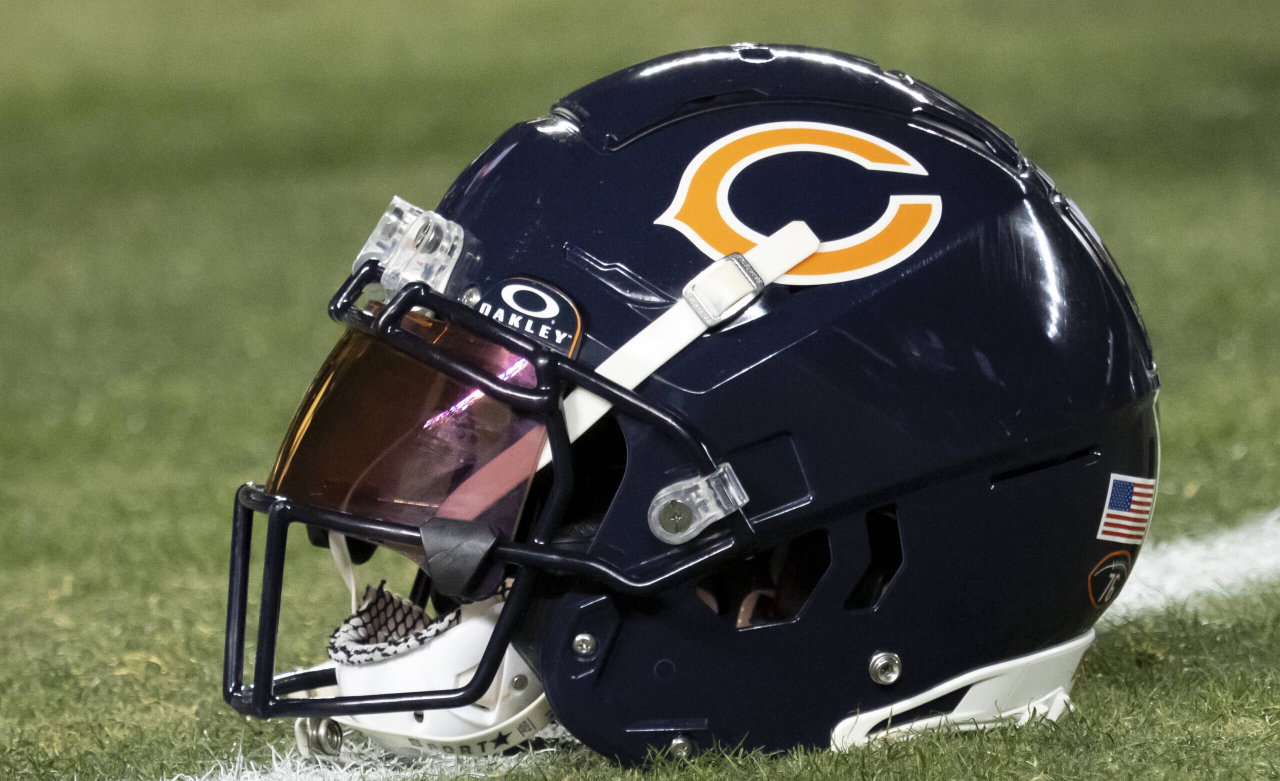
The Chicago Bears didn’t start out as the Bears… or even in Chicago. In 1921, cornstarch businessman Augustus Eugene Staley owned a 25-man team in Illinois with former Illinois star George Halas coaching and the players working at his plant. But when the economy turned south, Staley needed them off his payroll. He handed Halas $5,000 to take the team to Chicago, asking only that they keep the Staleys name for one season.
Watch What’s Trending Now!
Halas honored the deal, then spotted a better name the next year while playing at Cubs Park, now Wrigley Field. Baseball already had the Cubs. So, Halas went with the Bears. It fit the sport. And it seems like the name will not change anytime soon.
“No. We will be the Chicago Bears whether we’re in Arlington [Heights, Illinois] or whether we’re in Hammond,” chairman George H. McCaskey said on Thursday at the training camp.
“Our focus is on Hammond, that’s where we’re advancing our efforts, and that’s where the bulk of our time, attention and resources are being devoted.”
With the stadium standoff dragging on for weeks, speculation grew that a move across state lines could come with a new name. George McCaskey shut that down. As the Bears move closer to a possible stadium deal in Hammond, Indiana, the Chicago Bears name is not going anywhere.
And this is not some last-minute bluff. The team confirmed in June that Hammond was a real option, and Warren reinforced that again Thursday.
“We don’t have an offer from the state of Illinois,” Warren said. “And our focus now is on Indiana. And obviously, as I said, there have been occasional meetings that have taken place. But right now our focus is on Hammond, Indiana, to make sure that we bring that to life.”
With that said, the Bears’ recent actions and the legislative landscape support Warren’s assessment.
- First, Illinois still has not given the Bears the legislative certainty they want. The franchise has repeatedly pointed to property taxes and infrastructure as sticking points, and by May 2026 it said it had “exhausted every opportunity” to stay in Chicago. At that point, the message was hard to miss. The Bears were done waiting and had narrowed the stadium fight to Arlington Heights or Hammond.
- Second, Indiana, meanwhile, has already started building the runway. Senate Bill 27 created a Northwest Indiana stadium authority with powers to acquire and finance stadium facilities, and Hammond was specifically named in the plan. FOX 32 also reported that the state had put roughly $1 billion in tax revenue on the table for stadium-district infrastructure.
- Third, Indiana is not just being used as leverage. The Bears are already spending time and money there. Warren said the team is moving ahead with studies, land acquisition and financing work in Hammond, with due diligence completed at one possible site and continuing at another.
The team has already completed topographical, geographical and environmental due diligence at the Lost Marsh site and found the land viable for a stadium. It is also studying a second option at Wolf Lake Terminal, where more environmental and site work is underway.
Warren has even discussed the possibility of tying both areas into a larger development. The Bears have moved beyond casual talks into land, financing and development work, while communication with Illinois officials has been “minimal.” Warren, meanwhile, has praised Indiana officials as productive partners.
“We’ve had extremely productive meetings there and feel really good about what’s going on with the state of Indiana, specifically Hammond,” Warren said on Thursday. “Not only are we building a world-class stadium, but we’re building a world-class mixed-use development, and we want to make sure that we get this right.”
Still, Illinois has not been completely ruled out. Governor JB Pritzker said the state is still talking with the Bears, though he made it clear the team needs to spell out exactly what it would take, legislatively, to get an Arlington Heights deal done.
“They’ve got to figure out how they can get the legislature, both sides, around the same bill, and I would be happy to call a special session,” Pritzker said in June. “There were a number of issues. Some of them were self-created by the Bears. Some of them just in trying to get the two houses, the House and Senate, to work together.”
Pritzker’s biggest problem is that Illinois still cannot agree on what a Bears stadium deal should even look like. The House backed House Bill 2789, the “megaprojects” bill, which would have frozen the Bears’ property-tax assessment at Arlington Heights and opened the door to a payment-in-lieu-of-taxes deal lasting up to 40 years.
The Senate was not sold, with lawmakers worried about lost local tax revenue and about helping the Bears leave Chicago. Senators later approved a different stadium-authority plan 37-17 that could have let a public entity own and finance the stadium, shielding the facility itself from property taxes while keeping surrounding development taxable. Then the House adjourned without taking it up.
Add in the fact that Chicago taxpayers are still on the hook for more than $500 million in Soldier Field renovation debt, and the political resistance becomes obvious. Illinois is not short on stadium ideas. It is short on lawmakers willing to back the same one.
Their lease at Soldier Field runs through 2033, but as the stadium search shifts toward Hammond, they will still be the Chicago Bears.
Keeping the Chicago name is the easy part. Getting fans comfortable with an Indiana home is the harder sell.
Bears Know Hammond Will Be an Emotional Adjustment
For generations, Bears fans have connected the franchise to Chicago, Illinois, and Soldier Field, which is why a move to Hammond would feel bigger than just changing stadiums. It would mean watching a 100-year-old franchise cross the state line and asking fans to accept that Bears football can still feel like Bears football in Indiana.
That is the emotional hurdle McCaskey is trying to clear. His bet is that once fans see a modern stadium with better amenities, a stronger game-day experience and a venue built for the future, the location will matter less. The Bears may change locations, but the identity stays the same.
“We feel that anxiety,” McCaskey said. “We feel that stress. We talked about this in March. It’s going to require an adjustment. But when I’ve driven that route, other than a sign telling me so, I wouldn’t know that I’ve just crossed the state border.
“And as Kevin said, once people see the building, once they get in there, once they understand that our top priority from day one was a world-class stadium experience, we think we’ll make that adjustment. We think Bears fans are up for that.”
Warren also pointed out that fans deserve better than what Soldier Field currently offers on game day.
“I think everyone will be pleased, one, once we make the final decision, and two, once we break ground, and three, once we open up,” Warren said.
The stadium plans are still coming together, but the direction is clear.