
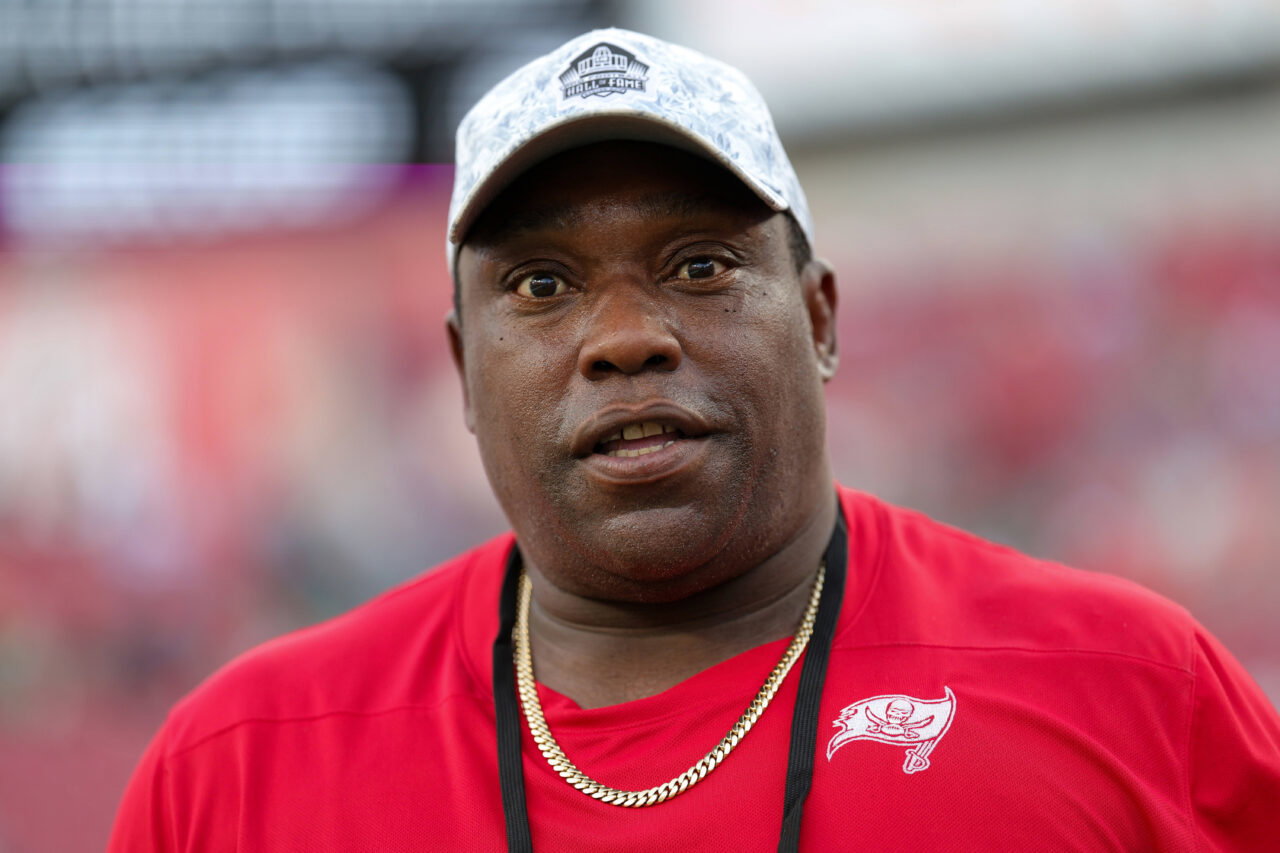
Warren Sapp used to call himself an “elephant in the room.” He never forgot anything. But years after his 13-year NFL career ended, the Hall of Fame defensive tackle found himself reaching for his phone just to get through the day. Appointments, errands, everyday tasks- he needed reminders for things he once would have remembered without thinking. “I need help,” Sapp admitted in a video for The Players’ Tribune back in 2017.
Watch What’s Trending Now!
For a player who spent his career in a football culture built around taking part in the Oklahoma drill and enduring punishing practices once treated as routine, the change was unsettling. But Sapp wasn’t only thinking about what those years might have done to him; he was thinking about the countless NFL players who could be facing the same struggles. At 44, he decided to donate his brain to the Concussion Legacy Foundation for research. Now, he looks back at that version of football with everything he knows today.
“It was crazy, it was insane,” Sapp told the Concussion & CTE Foundation. All that goes away because we know better. When we know better, we do better. And that’s my whole thing. It’s a game of skill now more than it was, because it was just brute force. It was a brute force game, and it shouldn’t be that way.
“The information that Dr. McKee and Boston and Chris (Nowinski) can give me, that I can actually get to [Derrick] Brooks, [John] Lynch, Ronde [Barber], Simeon [Rice], all my guys… That’s the key. This is: Can we make this game better? And the knowledge we gain from us is going to push everything forward.”
For Sapp, that change is not simply about removing football’s physicality. It is about changing what the sport rewards. The Oklahoma drill, an old-school full-contact exercise built around players overpowering one another in a confined space, became a symbol of that mentality. The NFL moved away from it in 2019 as part of a broader effort to eliminate high-impact practice drills. The concern is not that one drill causes CTE, but that repeated head impacts, and the cumulative force of those impacts, are associated with long-term brain changes and CTE.
In 2023, researchers at Boston University’s UNITE Brain Bank found CTE in 345 of 376 former NFL players whose donated brains were examined. The figure is striking, but it should not be read as meaning 92% of all former NFL players have CTE, since the brains were donated for research and were not a random sample of the NFL population.
A separate study of 631 former football players also found that the cumulative force of head impacts was associated with the likelihood and severity of CTE pathology, adding weight to the argument that reducing both the number and force of head impacts matters.
Sapp has since taken that thinking beyond the NFL. At the 2026 Global CTE Summit in San Francisco, he said he would not even watch young children play tackle football, telling reporters that he would wait until they were around 14. “There’s nothing wrong with the game,” Sapp said. “It’s just the age we give it to our children.”
His concern comes as researchers continue to investigate the effects of repetitive head impacts in younger athletes. A 2023 study led by CTE researcher Dr. Ann McKee examined 152 donated brains from people who had died before age 30 and had a history of repetitive head impacts from contact sports; more than 40% had mild CTE.
Sapp also remains unsure what his own brain will ultimately show. He said he is under a doctor’s care because of recurring short-term memory problems and has developed a simple checklist for himself: “keys, wallet, phone.” He even jokes to himself when he feels his pace slipping: “Slow down, fat boy.” Behind the humor, however, is the same concern that prompted him to donate his brain in the first place.
That concern is shared by a growing body of research. A 2026 study from Mass General Brigham, Boston University and the Concussion & CTE Foundation found that former NFL players had nearly four times the mortality rate from neurodegenerative diseases compared with the general population. The study also found higher mortality from dementia and Parkinson’s disease, with longer NFL careers associated with greater neurodegenerative mortality.
The findings do not establish that all of those deaths were caused by CTE, but they add to the growing evidence surrounding the long-term neurological risks associated with professional football. Even Troy Aikman has recently spoken about the lasting effects of his playing career, including the memory issues that followed his concussions.
Aikman has said that leaving football without knowing whether his memory and mental faculties would remain intact was difficult. He suffered multiple concussions during his career, including one during the 1993 NFC Championship Game that left him unable to remember the game itself. However, CTE cannot currently be definitively diagnosed or ruled out in a living person, so his past evaluations should not be described as having “cleared” him of CTE.
The same player who once spent his career in a “macho league” now wants his former teammates to have better information than his generation did, and wants younger players to enter the sport with a better understanding of what repeated head impacts can cost them.
“I want to make the game better for the next generation,” Sapp said. “I love football. It took me off a dirt road with no cable television and no air conditioning. I wouldn’t trade it for anything.”