
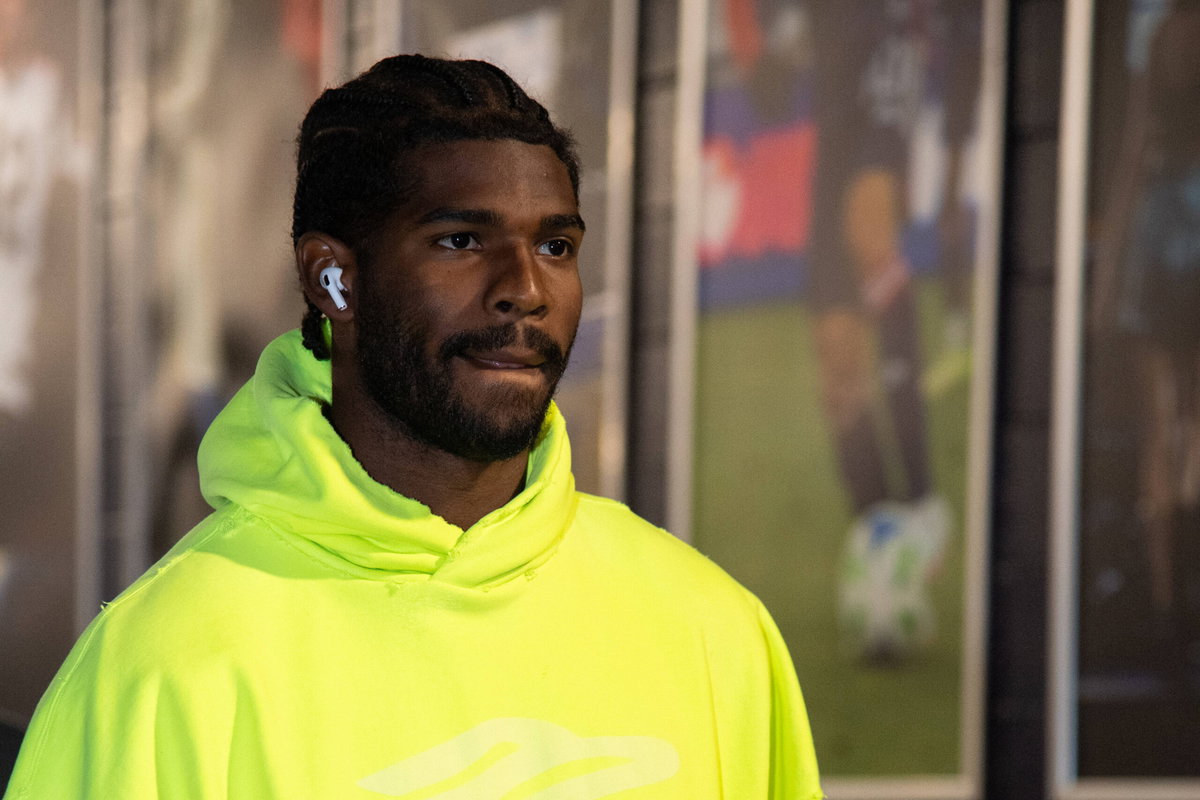
Shedeur and Shilo Sanders were looking at a Fort Lauderdale apartment. The place cost roughly $8,900 a month but had plenty going for it: a 10-minute walk to downtown, a 30-minute drive to Miami, scenic views, a pool, a gym, and enough polished amenities to justify calling it luxury. And while Shilo was more concerned about how big or small the apartments were at that price, Shedeur had another concern entirely.
Watch What’s Trending Now!
Perhaps remembering the burglary at his home that cost him $200K while he was away playing his first NFL game, Shedeur asked, “How safe is Fort Lauderdale?” The agent showing the Sanders brothers around did offer some reassurance. But Shilo immediately brought up his own concern: “Even though I live in a gated community right now, I still be thinking, ‘Bro, I don’t want to go on vacation and just come back, all my stuff be gone like him.’” The conversation hit closer to home than it should have. But Shedeur shared his preparedness for the next time football takes him away:
“I’ll be having security in my house when I play,” Shedeur replied.
Shedeur wasn’t speaking from theory. He knew exactly what could happen in his absence. It had already happened once on November 16, 2025.
While the rookie quarterback was making his NFL debut against the Baltimore Ravens, three masked suspects were at his Granger Township home in Ohio. According to surveillance footage released by the Medina County Sheriff’s Office, they emerged from a tree line and entered the house through an unlocked door at 6:46 p.m. They moved through the home before leaving the same way they came, carrying bags and other items at 6:58 p.m. The entire break-in lasted just 12 minutes, but the loss was estimated at roughly $200,000. But the more investigators pieced together, the less it looked like a random break-in.
The men had allegedly come from the Atlanta area in a stolen rental car, driven all the way to Ohio, and checked into a Red Roof Inn in Medina Township on November 15, the night before Sanders’ home was hit. The next evening, while Sanders was at the Browns’ game against Baltimore, they allegedly made their way to his house.
That trail gave investigators several pieces to work with. Cameras at Sanders’ home captured the suspects. A neighbor’s security camera picked them up as well. Then Flock license-plate readers helped investigators trace the stolen rental car, while footage from the Red Roof Inn helped connect the group to the trip to Ohio. It was a chain of cameras that eventually turned a 12-minute burglary into a case stretching from Ohio back to Georgia.
The first arrests came surprisingly quickly once investigators had their leads. Jarvet Myrick was arrested on November 26, followed by Deandrez Jackson on December 16 and Maurice Exavier Taylor on December 29. All three face second-degree felony burglary charges in Ohio. Carlos DeAnthony Morris, identified as the fourth suspect and allegedly the third person who entered the home, remained at large when the Medina County Sheriff’s Office laid out the case in January.
Morris was eventually arrested in February in DeKalb County, Georgia, after police located him at an apartment on Glenwood Road. The operation involved the Gang Unit, SWAT, aerial support, and a K9 unit. Police said multiple firearms were found inside the apartment, including two they classified as machine guns. Morris was then held in DeKalb County on the Ohio burglary warrant. With his arrest, all four people accused in the Sanders case were in custody.
But the investigation revealed something more important than simply who had entered Sanders’ home.
Detective Rodney Rees said the group appeared to be targeting wealthy, high-profile people because they knew when those homes would be empty.
“Unfortunately, right now, they’re just targets,” Rees said. “They’re taking advantage of them being some type of stature in the community and they’re hitting them when they’re away from home and they know they’re away from home.”
That was not the only piece of the case that pointed to a larger pattern.
Rees said the suspects were believed to have been involved in other burglaries and had allegedly struck a home in Brookhaven, an Atlanta suburb, after returning from Ohio on November 17.
He also said investigators believed there could be a ringleader directing people toward high-profile targets, although that had not been proven. The stolen property from Sanders’ home, meanwhile, had not been recovered.
In other words, the game was not simply the reason Sanders happened to be away. His game was part of the information that could make his absence predictable. The Sanders burglary also landed in the middle of a wider problem that had already caught the attention of the NFL and federal investigators.
In late 2024, homes belonging to Patrick Mahomes, Travis Kelce and Joe Burrow were among those targeted, while Luka Dončić and other professional athletes were also victims. The FBI subsequently warned sports leagues that organized theft groups were targeting athletes’ homes, in part because players’ public schedules made it easier to know when they would be away.
The FBI’s warning was about that earlier wave of burglaries, not a finding that the same group was responsible for Sanders’ case. But the vulnerability it identified was strikingly similar: an athlete’s schedule can tell someone more than where he will be on a given night. It can also tell them where he won’t be. The bureau said the homes were attractive targets because of the perceived presence of designer bags, jewelry, watches and cash, and noted that some theft groups used surveillance and publicly available information to plan their moves.
For Shedeur, though, the incident initially seemed easier to brush aside than the headlines suggested. When he spoke about it days later, he smiled while admitting that his house had been “caught slipping.” What seemed to matter more to him was that the thieves hadn’t taken his jewelry.
“I know this is a trending topic that my house got broken into,” Shedeur said. “But I’m in a mental space now to where there’s not too much that can faze me, honestly.”
He even repeated the one detail he seemed relieved about: “None of my jewelry got took anyway.”
By now, the burglary may be behind him, but Shedeur clearly hasn’t forgotten it. The next time he leaves home to play, he won’t be leaving it unguarded.