
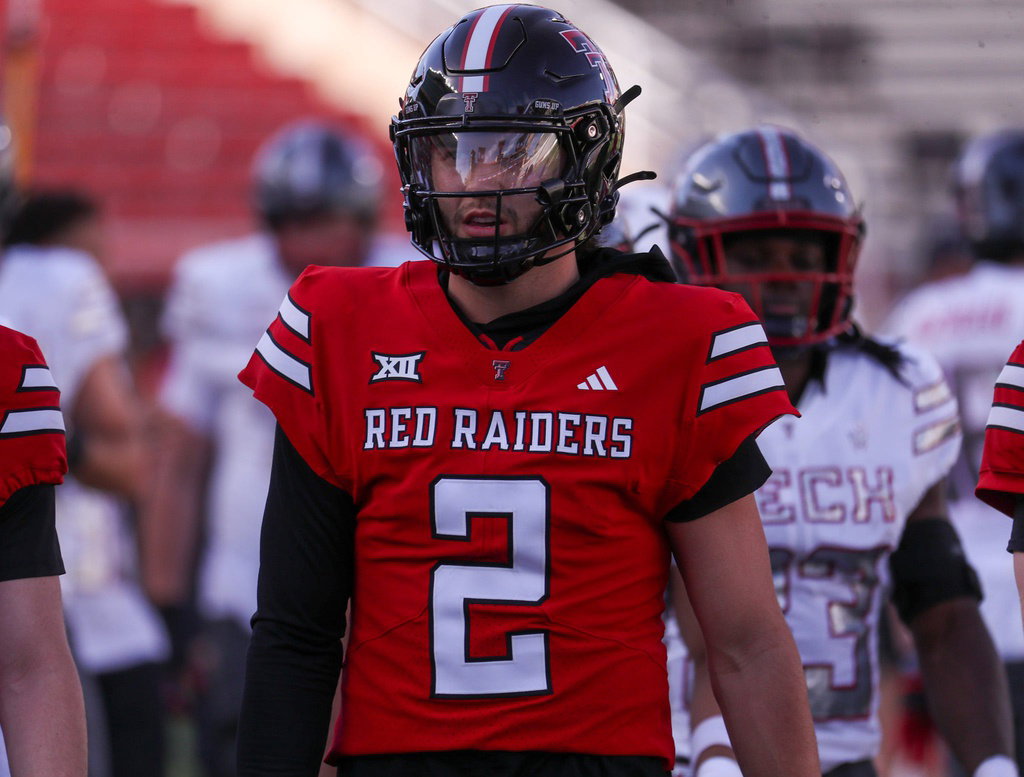
The fallout from Brendan Sorsby’s eligibility ruling reached Georgia almost immediately. After a Texas judge granted the Texas Tech quarterback an injunction allowing him to play in 2026, Bulldogs athletic director Josh Brooks moved quickly, announcing that Georgia would no longer schedule the Red Raiders in any sport until the situation is resolved. Today, Brooks hopped onto David Pollack’s podcast, doubled down on his stance, and explained why he felt it was necessary.
Watch What’s Trending Now!
“I’ve already made a statement to our department that we will not schedule any contests with Texas Tech in any sport moving forward until this is resolved,” Brooks said on the See Ball, Get Ball podcast. “Again, this isn’t personal [at] Texas Tech, but we have to draw a line in the sand somewhere. And there may be some contests that are on the books right now. We’re going to look at what our options are, but I’ve got to be able to look my young men and women and say that we’re playing under a fair set of standard rules that we’ve all agreed to. I owe it to the young men and women in their locker rooms to do that. So, that’s my responsibility, and I hope others do the same.”
The very first thing he did was tell all of Georgia’s coaching staff to review their future schedules and stop any ongoing talks with Texas Tech officials. Georgia and Texas Tech rarely face each other in football, with their last meeting coming nearly 30 years ago in 1996. But this decision could still affect several other sports between the two schools.
According to a memo obtained by multiple outlets, Georgia coaches were instructed to review both current and future scheduling arrangements involving Texas Tech. Brooks’ office also indicated that any existing matchups would be evaluated on a case-by-case basis rather than automatically canceled.
Brooks has been one of the most outspoken administrators on the issue, arguing that the ruling extends beyond one player or one school. The Georgia athletic director, who also serves on the NCAA Football Oversight Committee, said that schools must protect the integrity of competition rather than rely on courts to determine eligibility standards.
Fair assessment, if you ask. Suiting up after placing 9,000 bets, including betting on your own team, is diabolical. He made it pretty clear that he wasn’t going to sit back and watch this happen. He explained that this isn’t a personal grudge against Sorsby or Texas Tech, but a stand for basic fairness.
In Brooks’ view, college sports start to lose their foundation if one school can simply go to a local courtroom and bypass major rules violations while every other program is expected to follow the same standards.
Brooks said he cannot, in good conscience, ask Georgia’s athletes to train hard, stay disciplined, and follow strict compliance rules, only to have them compete against an opponent that he believes received a free pass. It creates an uneven playing field that hurts the kids who are doing things the right way. Since the NCAA’s hands are legally tied by the court’s injunction, Brooks decided that the universities themselves have to step up and enforce consequences.
Georgia’s aggressive stance has quickly triggered a massive domino effect across the college sports world. Within hours of his comments, Nebraska Athletic Director Troy Dannen followed Brooks’ lead and banned Texas Tech from their schedules too, and the Big Ten Conference is now talking about a league-wide ban.
Well, a Big Ten conference-wide ban might feel a bit too far-fetched. However, there’s a good possibility that the ruling could be overturned.
The odds might not be in Sorbsy’s favour
The NCAA has filed an accelerated emergency appeal to the Court of Appeals for the Seventh District of Texas to strike down the injunction. Legal experts and sports analysts believe the NCAA has a strong chance of winning for a few reasons.
Sorsby’s initial victory happened in a local Lubbock County district court. However, the appellate court overseeing the appeal is located in Amarillo. A funny twist: all four justices on that appellate court are graduates of the Texas Tech University School of Law. While that sounds like an advantage for the school, higher court judges are under massive pressure not to look biased or let “hometown favoritism” destroy the national rulebook.
The injunction itself was unusual. Along with restoring Sorsby’s eligibility, Judge Ken Curry attached a two-game suspension as a condition of the ruling, despite suspensions traditionally being handed down by governing bodies, conferences, or schools rather than courts.
The biggest reason the NCAA will probably win is that the original judge, Ken Curry’s decision was incredibly weak. He only wrote a tiny, three-page order that didn’t provide any real legal reasoning for why a player who bet on his own games should get a pass.
Then again, the courts have repeatedly beaten the NCAA on money issues (like NIL and transfer rules), and gambling has always been treated as a strict red line. Just last year, Alabama basketball player Charles Bediako won a very similar temporary restraining order in a local court to keep playing. Just two weeks later, the higher courts stepped in, denied his permanent injunction, and completely shut down his season.
The clock’s running short because a final decision needs to happen by June 22. That is the hard deadline for the quarterback to enter the NFL Supplemental Draft (if he’s given a green light) if his college eligibility gets officially snatched away. And if the appeals court acts fast and strikes down the ruling before that date, he will be kicked out of college football for once and for all.