
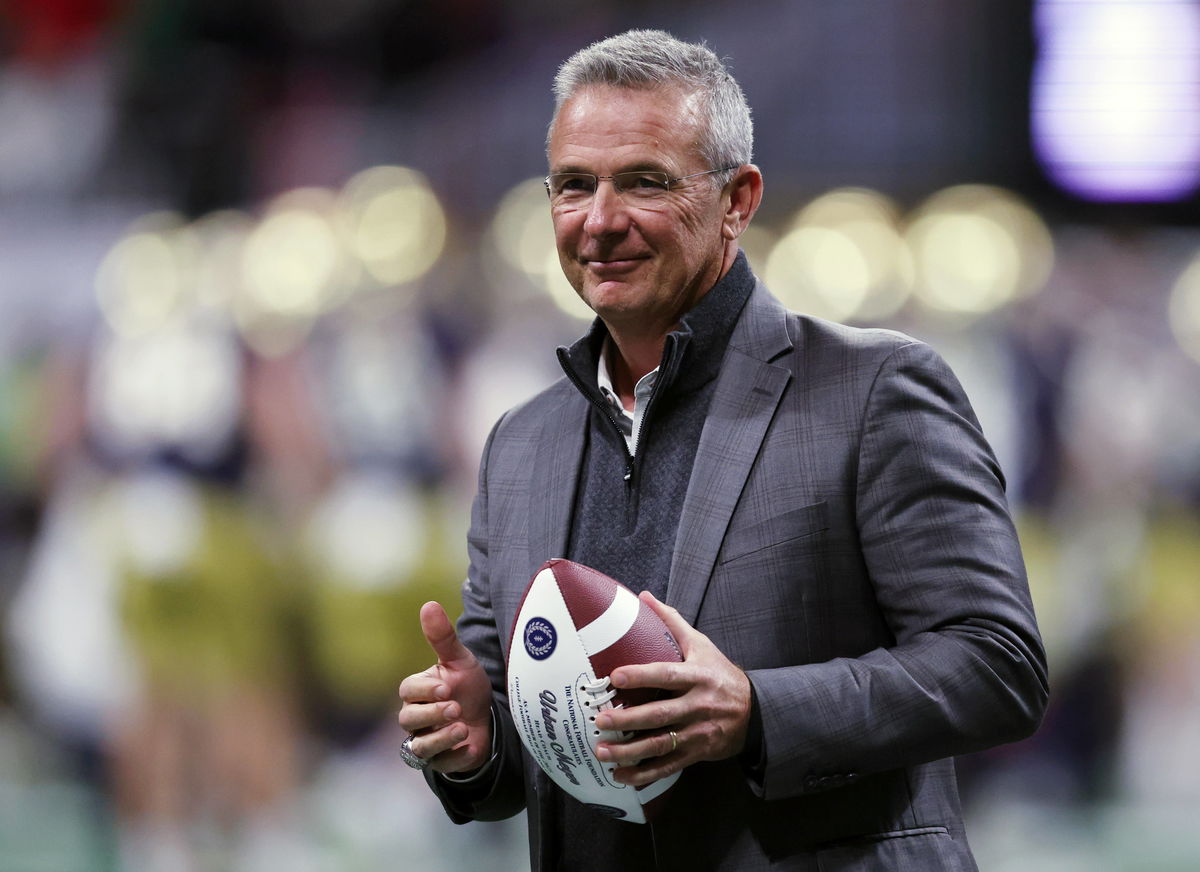
Former Florida head coach Urban Meyer has never been shy about explaining what he believes makes a championship team work. His latest comments focused on one area he considers impossible to fake: defensive talent and coaching. Interestingly, he learned that in his very first year in Florida.
Watch What’s Trending Now!
“If you look historically when coaches fail, it’s because one side of the ball is struggling,” Meyer said on August 11 on Hightop Sports’ podcast. “A lot of times it’s like I’m an offensive coach. It’d be the last thing in the world for me to go over there and try to explain defense to guys like Charlie Strong and Greg Mattison. So, you better hire someone that’s really good.”
That philosophy was not theoretical during Meyer’s time at Florida. Meyer retained Charlie Strong as his DC when he took over the Gators in 2005. Strong had already spent years coaching defense at major programs, including Notre Dame, South Carolina and Florida. Greg Mattison, meanwhile, was also part of Meyer’s defensive staff during that era. Meyer has previously described Strong and Mattison as two of the coaches he trusted heavily when building his staff.
The results help explain why Meyer remains so firm on the subject. Florida won two national championships during his six-year tenure, including the 2006 and 2008 seasons. The 2006 Gators finished 13-1 and held Ohio State to 82 total yards in the national championship game. Two years later, Florida finished 13-1 again and beat Oklahoma 24-14 for the national title. His approach was not simply about finding good defensive coaches. He wanted defensive players capable of physically changing games.
“And I would always say whatever salary pool I have, a big majority of that’s going to go to defense cause first of all, we better be good,” Meyer outlined. “I want every year was I said, just give me the top 10 D-linemen in America, and I’m personally recruiting them.”
The SEC’s biggest games were often decided by defensive fronts capable of disrupting quarterbacks without needing constant blitz pressure. Meyer wanted players who could create that disruption themselves. His Florida teams produced plenty of them.
Players such as Derrick Harvey, Carlos Dunlap, and Brandon Spikes became major pieces of Meyer’s championship teams. Dunlap recorded 9.5 sacks in 2008, while Florida’s defense ranked among the nation’s best and helped the Gators finish No. 1 in the final polls. Meyer later carried that philosophy to Ohio State.
Meyer’s recruiting philosophy also produced enormous NFL numbers at Ohio State. In total, he had produced 40 NFL draft picks over the previous six years before his departure, including 12 first-round selections. Meyer did exactly that during his most successful years.
He trusted Strong and other defensive coaches to run their side, then spent considerable energy finding players who could execute the plan. And his message to the next generation of coaches like Jon Sumrall is unmistakable: if the defense is bad, everything else eventually starts to wobble. The new Florida head coach has tried to do just that by hiring Brad White as DC. Sumrall also retained 63% of the Gators’ defensive snap production from 2025.