
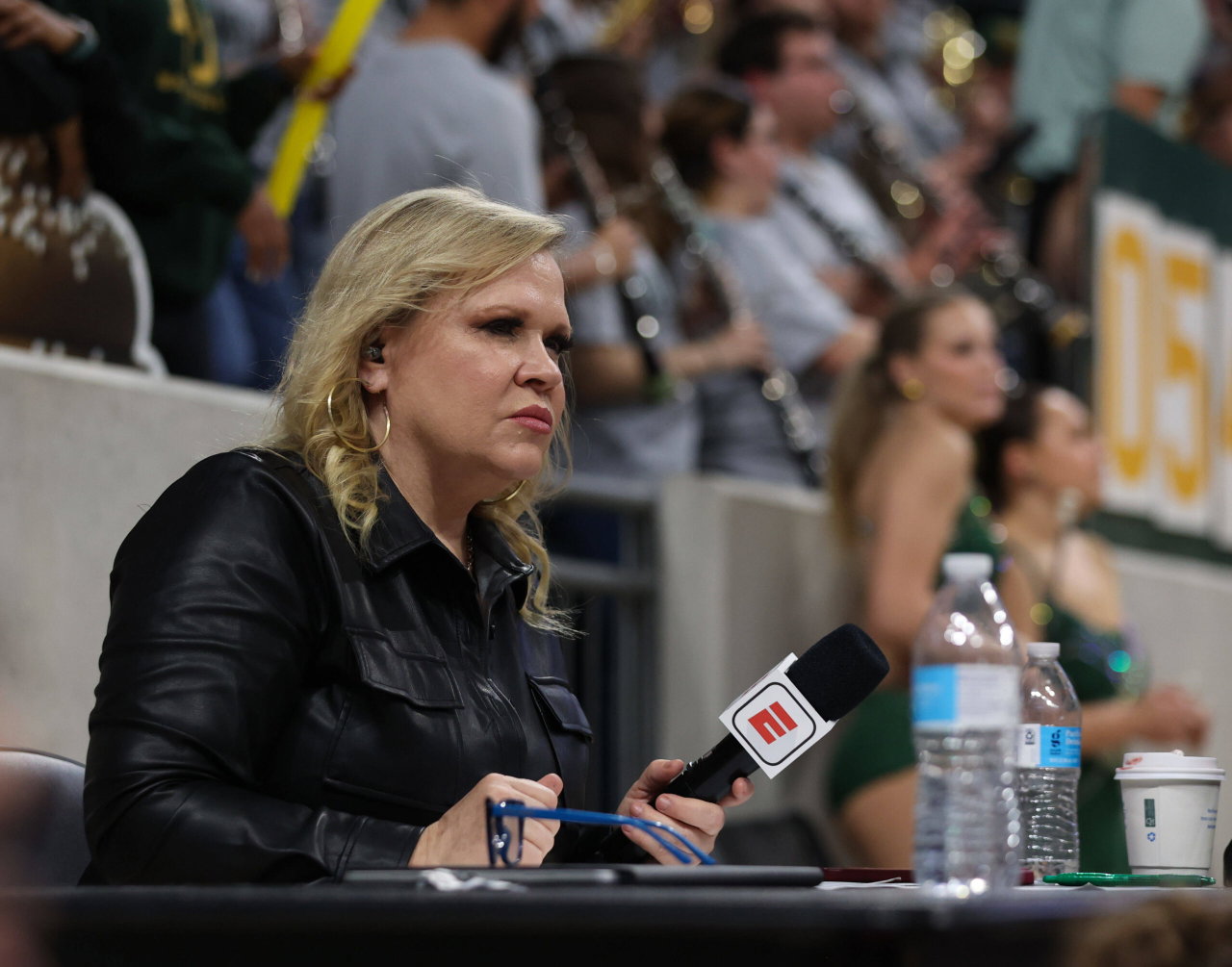
The pink shoes on Dabo Swinney’s feet, his pink tie, and his pink blazer were impossible to miss a day before Clemson’s game against Miami. Holly Rowe made sure that everyone knew about the cause Swinney’s attire was connected to.
Watch What’s Trending Now!
Clemson has designated its Week 5 game as its annual Breast Cancer Awareness Game, but this was not just another October theme for Swinney. His family has lived with the disease.
“My sister-in-law Lisa passed away at 49, and so I’ve lived through that personally,” Swinney told Holly Rowe. “And my wife has the BRCA gene. It’s just something we’ve been really passionate about and creating a lot of awareness.”
Lisa Lamb, his wife’s older sister, was first diagnosed with breast cancer in 2003. She underwent a double mastectomy and chemotherapy, and for a while, it looked like the cancer was behind her.
Doctors later discovered that she carried a genetic mutation (BRCA) linked to breast cancer. That information changed the Swinney family. Lamb urged her sisters, Kathleen Swinney and Ann, to get tested.
Kathleen initially hesitated. She had three young boys and felt healthy. But watching what happened to Lisa eventually pushed her to get the test. She was 34 when she learned she carried the BRCA mutation.
The news hit hard. Dabo later recalled the conversation with the doctor. Kathleen was told her lifetime risk of developing breast cancer was extremely high. She went home and quickly decided on a preventive double mastectomy.
Those decisions came directly from Lisa’s experience. Kathleen once explained that refusing to act after watching her sister fight the disease would have felt like ignoring the warning Lisa had given them.
Lisa had gained information that her sisters could use, and Kathleen believed she had an obligation to use it. For Dabo, that has made the cancer fight painfully personal. And he aims to spread awareness through his All In Team Foundation.
“We’re on our way to 16 million dollars,” Swinney told Rowe. “We’re over $15 million, and part of that has gone toward helping to create these three mobile mammography buses.
“It’s really cool and gives free mammograms to women who maybe otherwise would not get one. And because the statistics show that if you get early detection, you have a great chance of beating this.”
Lisa’s cancer eventually returned. In 2012, after doctors had taken her off medication because she was doing well. She underwent brain surgery, but the cancer in her lungs left the family with few options.
Dabo and Kathleen spent as much time with her as they could. They traveled to Birmingham, where Lisa lived, and tried to preserve normal family moments. Lisa made it home for Thanksgiving and Christmas in 2013.
The family also took a beach trip together the previous summer. By January 2014, Lisa was hospitalized for the final time. Dabo’s last visit came on Easter Sunday. He knew he was seeing her for the final time.
“I told Kath when we left, I think it was the first time I had seen her peaceful,” Swinney recalled. Lisa died two days later. Because of those experiences, it became important for Swinney to do something himself for the people who fought the same disease.
The first “Big Pink” mobile mammography coach started serving Oconee, Pickens, Anderson, and Greenville counties through a partnership between the All In Team Foundation, Bon Secours St. Francis Foundation, and Pearlie Harris Center for Breast Health.
“October is Breast Health Awareness month and Clemson and Dabo Swinney are such great advocates! Thank you Coach,” Rowe wrote on X.
Rowe understands the personal side of the conversation, too. In May 2015, she learned she had desmoplastic melanoma, a rare form of skin cancer. A second tumor forced another surgery in February 2016, when doctors removed a tumor from beneath her armpit along with 29 lymph nodes.
The surgery left her with a 15-inch scar. The strange part was what happened next. Rowe went back to work.
Less than a month after that second surgery, she was back covering college basketball. During the NCAA tournaments, she worked with plastic tubes stitched into her incision and a drainage bag hidden underneath her blouse.
She was reporting on athletes while quietly dealing with something much more personal. “I was used to reporting the news, not being the news,” Rowe said after ESPN publicly announced her diagnosis.
In April and May 2016, Rowe underwent four weeks of high-dose interferon treatment. She went to the Huntsman Cancer Institute five days a week. The treatment left her extremely sick.
“I was deathly ill,” Rowe recalled. “I couldn’t eat. I could barely walk.” Yet she still went to work.
In July 2016, doctors discovered that the cancer had spread to her lungs. Rowe joined a clinical trial at UCLA testing an immunotherapy approach. From August 2016 through August 2018, she flew to Los Angeles every 21 days for intravenous treatment.
Within three months, the tumors in her lung had begun shrinking. One tumor eventually went from 21 millimeters to 3 millimeters. Even during that period, the sideline remained part of her life.
She continued working for ESPN throughout much of that period, successfully battled the illness, and has since become an advocate for cancer research and prevention. That personal experience made the exchange with Swinney carry a little more weight than a standard sideline interview.