
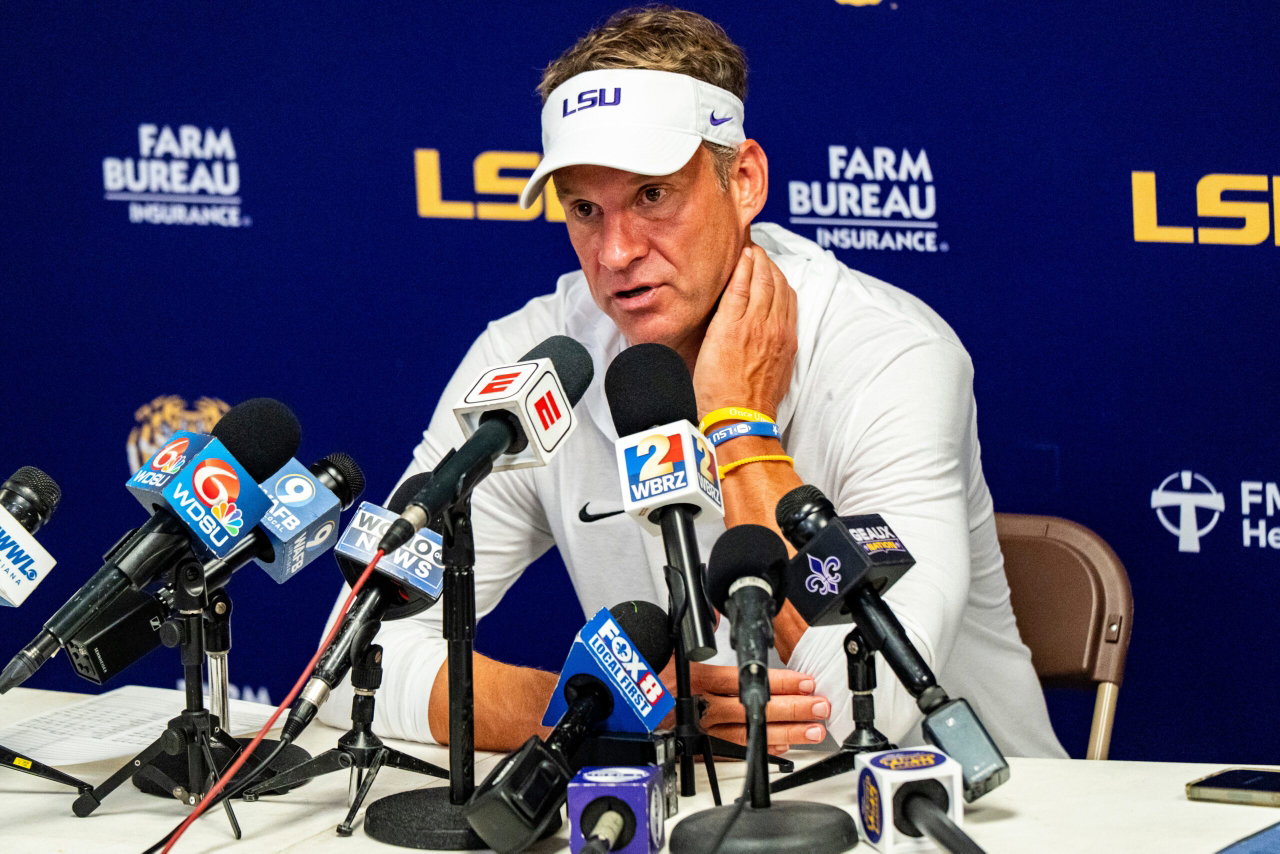
LSU had two spots left to fill on its 105-man roster. By Tuesday night, those spots had names on them: Aidan Anding and Gabriel Reliford. Neither was Dae’Quan Wright or Zxavian Harris, the two former NFL players at the center of the Tigers’ fight with the SEC. By Thursday, the temperature had dropped.
Watch What’s Trending Now!
The SEC presidents and chancellors met without taking action against LSU, and the threat of an expulsion vote was no longer hanging over the Tigers in the same way it had days earlier. What had looked like a confrontation headed for a breaking point suddenly had room to breathe.
Then, on Friday, LSU and Louisiana Attorney General Liz Murrill went back to federal court, asking a judge to dismiss the SEC’s lawsuit altogether, a move that didn’t sit well with the conference because the two sides had been trying to reach a resolution. In a statement, the SEC said:
“The Southeastern Conference is aware of the motion filed Friday by LSU officials and the Louisiana Attorney General seeking dismissal of the conference’s federal lawsuit. We are deeply disappointed that this filing came amid efforts to reach a resolution with LSU that would address our other member universities’ concerns about LSU’s commitment to the conference’s rules and shared governance responsibilities.”
It all kicked off when Lane Kiffin tried to aggressively recruit tight end Dae’Quan Wright and defensive lineman Zxavian Harris, two former Ole Miss players who had just spent their summer in NFL training camps. The SEC has an ironclad rule that strictly bans any athletes who have signed professional sports contracts from returning to college sports. And with that one roster decision, what had been a fight over two players had already grown into a much bigger battle over who gets to make the rules inside the SEC. Now, however, LSU and Louisiana are asking the federal court to end the fight on a much broader basis.
Murrill, who is herself one of the defendants in the case, filed the motion in the U.S. District Court for the Northern District of Alabama seeking dismissal “with prejudice” and asking that the SEC bear the costs.
The central argument is that the dispute the SEC rushed to court over no longer exists in the form it originally feared. Wright and Harris were never added to LSU’s roster. The Tigers’ 105-man roster is now closed for the 2026-27 season, and the Sept. 10 SEC meeting that the conference had sought to protect has already happened without interference.
“The players in question were not, in fact, rostered, and LSU’s football roster is full and closed for the 2026-27 football season,” Murrill wrote. “The September 10 meeting, moreover, came and went without a problem.”
That led Murrill to make the argument at the heart of the filing: the SEC now has no “imminent, concrete harm” that would give the federal court a live controversy to resolve. In her view, the lawsuit was unwarranted when it was filed and remains unwarranted now.
But the filing did not come in isolation. LSU and SEC lawyers had been negotiating this week over a possible resolution, according to Yahoo Sports’ Ross Dellenger, making Friday’s decision to seek a court-ordered dismissal particularly significant. No settlement had been reached when LSU and Murrill filed.
Murrill acknowledged those discussions while arguing that Louisiana still had a reason to act. “The SEC has not moved to end the federal lawsuit against LSU or me as attorney general,” she told Yahoo Sports. “It is therefore appropriate for me to act in the sovereign interests of the State of Louisiana and move for its dismissal.”
The motion also attacks the legal foundation of the SEC’s case. Murrill argues that the conference cannot claim it is being “forced” to associate with LSU when its own Constitution and Bylaws give the SEC’s presidents the power to terminate a member’s membership. “No one is forcing the SEC to associate with LSU,” the filing states.
That argument goes directly after one of the SEC’s central claims. The conference has framed its lawsuit partly around a First Amendment right to control the terms of its association with its members. Louisiana counters that the SEC itself has acknowledged it can expel LSU through its own governance process, making the alleged “forced association” a problem of the conference’s own making.
Murrill is also challenging the case on jurisdictional grounds. The motion argues that the Alabama federal court lacks personal jurisdiction over the defendants and that the conduct at issue, including LSU’s recruiting efforts and the Louisiana litigation, largely occurred outside Alabama.
There is another obstacle Louisiana says the SEC has not overcome: sovereign immunity. Because Rousse, Ausberry, Kiffin, the LSU Board members and Murrill were sued in their official capacities, Murrill argues that they are protected as state officials unless the SEC can establish a recognized exception. Her filing says the conference has not done so.
That is the immediate legal fight. But to understand why Friday’s motion matters, it helps to go back to the two players whose names once sat at the center of all of this.
Wright and Harris were among 42 athletes involved in a separate Louisiana eligibility lawsuit challenging restrictions on athletes returning from professional sports. Both had been at Ole Miss under Kiffin before entering the NFL system as undrafted free agents. Wright signed with the Philadelphia Eagles before later being waived by the Cleveland Browns, while Harris signed with the New Orleans Saints. Neither played in an NFL regular-season game, but both had spent time in NFL training camps before trying to return to college football.
On Sept. 3, Louisiana district court Judge William Jorden granted a preliminary injunction protecting the athletes from enforcement of the disputed eligibility restrictions. The order became the legal opening around which LSU’s plans for Wright and Harris were built, while the SEC maintained that its own conference rules still prevented its member schools from rostering former professional players.
The distinction mattered because this was not simply an NCAA eligibility dispute anymore. The SEC had separately adopted a policy barring its members from placing former professional football players on their rosters. LSU President Wade Rousse had voted for a broader conference statement reaffirming that policy but abstained from a later vote authorizing specific penalties for violations.
The SEC then took the dispute to federal court on Sept. 3, naming LSU, Rousse, Athletic Director Verge Ausberry and Kiffin. The conference argued that LSU’s conduct violated its rules and interfered with what it described as its First Amendment right to determine the terms of its association with its members.
The case escalated further on Sept. 8, when the SEC amended its complaint and sought to protect a Sept. 10 meeting at which the conference’s presidents and chancellors could consider terminating LSU’s membership. Under Section 3.1.5 of the SEC Constitution and Bylaws, at least two-thirds of the conference’s 16 CEOs would be needed to remove a member.
The conference also had other penalties available under its rules, including a coach suspension and a fine of up to half of a sports program’s budget. That is a significant distinction from saying LSU was guaranteed to lose 50% of its football budget, as the potential penalty was framed more broadly in the conference’s rules. Then LSU made the decision that changed the trajectory of the entire dispute.
The Tigers used their final two roster spots on Anding and Reliford, both returning LSU players who had initially been left off the 105-man roster after spring injuries. That closed the roster for the season and meant Wright and Harris would not be joining LSU in 2026.
Rousse subsequently wrote to SEC Commissioner Greg Sankey that the roster was locked and LSU had complied with the conference’s rules. “The roster is now locked for the season,” Rousse wrote. “LSU complied with SEC rules. This issue is moot.”
The threatened Sept. 10 confrontation then failed to materialize. The SEC presidents and chancellors held their meeting by videoconference, but did not impose sanctions or vote to remove LSU. The meeting that had helped drive the SEC’s request for federal intervention came and went without the interference the conference had feared.
The dispute had also produced one of the stranger details in college football’s legal battles this season. ESPN reported that Kiffin sometimes sent screenshots of ChatGPT responses to his attorney Tom Mars when he disagreed with Mars’ legal assessment. Mars said the AI responses were “almost always wrong.”
With Wright and Harris off the roster and the SEC meeting behind them, the immediate confrontation appeared to have cooled. The lawsuit, however, remained pending, and that left the two sides with a much larger question than whether the two players would take the field.
Could they actually settle the dispute, or would the federal case continue over the SEC’s broader claims about its rules, governance and right to determine its membership?
That was the issue LSU and the SEC were reportedly discussing this week. Friday’s motion changed the posture again. Instead of waiting for the negotiations to produce a resolution, LSU and Louisiana asked the federal court to end the case itself.
The SEC now says that move does not resolve the underlying disagreement. Its statement stressed that its concerns about LSU’s “commitment to the Conference’s rules and shared governance responsibilities” remain unresolved and that it is preparing a response in court.
So the two former NFL players are no longer on LSU’s roster, the Sept. 10 expulsion meeting passed without sanctions, and the immediate threat that sent the SEC into federal court has receded. What remains is a fight over whether those developments ended the controversy, or merely removed the original trigger while leaving the SEC’s broader claims against LSU alive.