
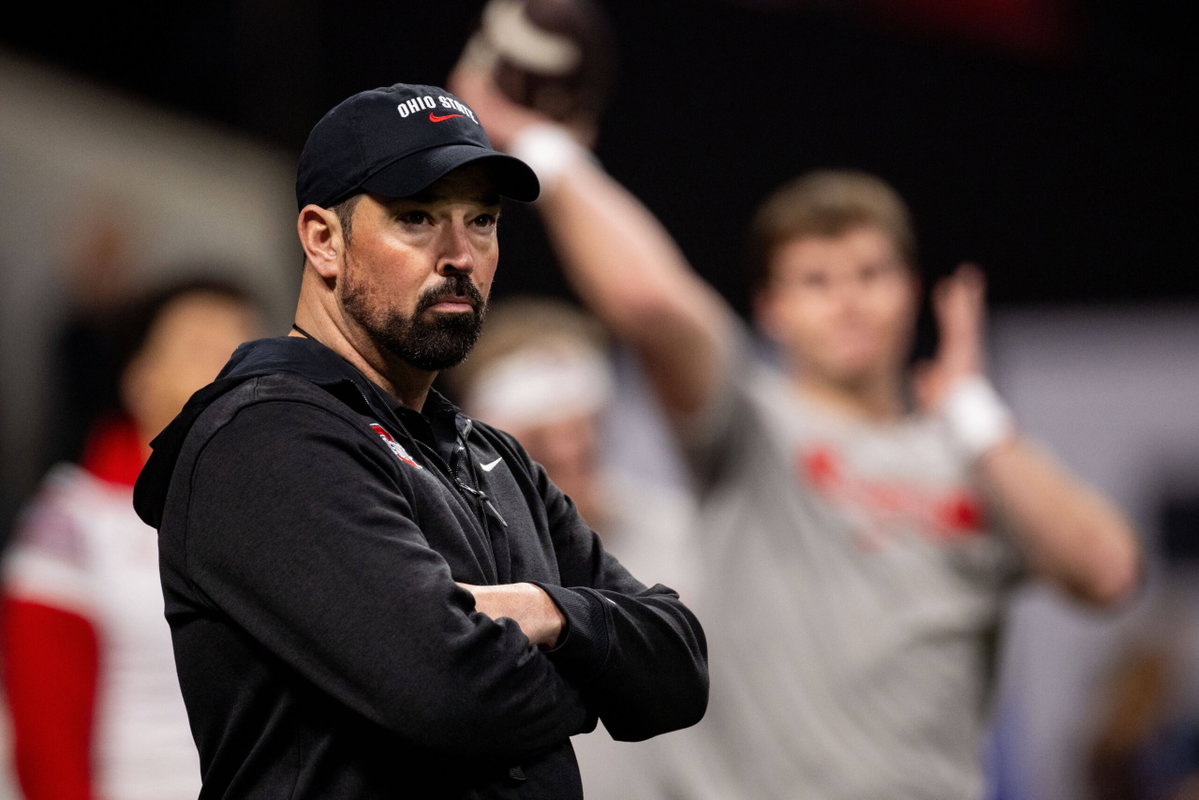
Ohio State’s shocking 24-23 loss to Texas on Saturday night did more than break a 197-game winning streak when leading by 20-plus points in the fourth quarter. It handed head coach Ryan Day his worst reality check yet. Up 23-3 in the final frame, the Buckeyes looked fully in control. But as the game slipped away, familiar questions resurfaced about how a top-tier roster collapses when the pressure mounts.
Watch What’s Trending Now!
Looking back, one of the biggest problems of the night was hiding in plain sight – Ohio State simply could not generate enough pressure or explosive plays from its front seven.
On September 13, former offensive lineman turned analyst Landon Tengwall exposed the Buckeyes’ worst flaw from last night.
“Arch Manning had an average Time To Throw of 3.58 seconds vs. Ohio State yesterday. Which is a WILDLY long. He passed the ball 37 times. To only register 2 sacks when he held the ball that long and passed that many times is scary bad for the Ohio State DL,” he tweeted on X.
In the football world, that is basically an eternity to sit in the pocket. Manning dropped back for most of the night, and yet Ohio State’s highly hyped defensive line managed to sack him only twice. That is quite difficult to digest, considering the amount of talent they have brought in.
We are talking about a front seven loaded with former five-star recruits, including defensive tackle Eddrick Houston, edge rusher Kenyatta Jackson Jr., and Christian Alliegro out of the Wisconsin Badgers.
Truth be told, this lack of pressure definitely wasn’t an issue last season. Arvell Reese and Sonny Styles wouldn’t have let Arch Manning get way too comfortable in the pocket.
Sadly, since Ohio State lost so much veteran star power to the NFL, they are now playing with a much more inexperienced defensive line this year.
However, the biggest reason for the lack of pressure may not be talent. It could be the formation.
A lot of it came down to Ohio State’s defense getting way too vanilla and passive. As the game slipped away, the Buckeyes’ coaching staff repeatedly rushed just three players while dropping eight into coverage, practically giving Texas a free pass. While the logical idea was to blanket the field and prevent explosive plays, it completely backfired.

Imago
Credits: Imago
No matter how elite your defensive backs are, no secondary can cover forever when a quarterback has nearly four seconds to wait for his guys to break open.
This soft three-man rush strategy completely neutralized Ohio State’s front line and gassed out the entire defense in the brutal 90-degree heat.
Instead of forcing the young quarterback into rushed decisions, the Buckeyes allowed Manning to orchestrate 21 unanswered points in the fourth quarter. Texas confidently converted two massive fourth-and-long plays late in the game that kept its touchdown drives alive.
Steve Sarkisian’s play-calling smartly exploited that passive look. With eight Buckeyes dropping deep into zone coverage, Texas flooded the intermediate middle field with high-low route concepts. Given nearly four seconds to scan, Manning simply waited for his tight ends and crossing receivers to sit in the soft spots right between the linebackers and safeties, turning extreme 4th-and-long situations into easy pitch-and-catch first downs.
At the same time, it is only fair to put some of the blame on the offense. Ohio State’s offense completely choked right when it needed to put the game away.
Quarterback Julian Sayin and superstar receiver Jeremiah Smith were completely shredding the Longhorns, with Sayin completing 13-of-17 passes early on and Smith racking up a monster 164 yards and a touchdown on eight catches.
But everything broke down after halftime.
Sayin went a dismal 6-of-16 in the second half, while Smith was held to zero catches in the fourth quarter. The run game also sputtered to an ugly 3.0 yards per carry. Lastly, kicker Connor Hawkins missed a crucial 45-yard field goal with under five minutes left that would have helped ice the game.
Ryan Day is also taking an absolute beating on social media for how he managed the game’s final 90 seconds.
With 1:23 remaining and Texas sitting on a first-and-goal at the 1-yard line while down 23-17, Day chose to “play straight defense” rather than letting Texas score quickly on purpose.
Ohio State only had one timeout left. They tried to make a heroic goal-line stand, but it burned up almost all the remaining time on the clock.
Texas backup running back Hollywood Smothers punched in the 1-yard touchdown anyway with just 25 seconds left, leaving the Buckeyes with basically no time to answer.
This late-game breakdown reopens familiar questions for Ryan Day. As one of the highest-paid head coaches leading a top-dollar program, Day consistently faces heavy expectations to perform in high-stakes non-conference matchups.
Rather than adjusting to Texas’ late push, Ohio State’s defense stuck to passive coverage schemes when aggressive pressure was needed most. For Buckeye fans, it revives a frustrating narrative: a program loaded with elite talent that still struggles to protect big leads when everything is on the line.
Ultimately, this game proved that all-world talent won’t save you if the coaches panic and play too conservatively. Letting a quarterback as lethal as Arch Manning hold the ball for 3.58 seconds is pure football suicide, and Day’s final possession ended on a desperate Julian Sayin pass that was intercepted as time expired.
It is a brutal lesson for Ryan Day and his staff, and they will need to fix these late-game tactical errors quickly if they want to hurdle through their upcoming schedule and make the playoffs.
Beyond just an embarrassing loss, this stumble completely strips Ohio State of its cushion in the national race. In a tough Big Ten conference, an out-of-conference defeat right out of the gate leaves them with zero room for error. Instead of cruising toward a top-four playoff seed and a first-round bye, Ryan Day now faces a high-pressure stretch where one more slip-up could knock the Buckeyes out of the 12-team playoff picture entirely.