
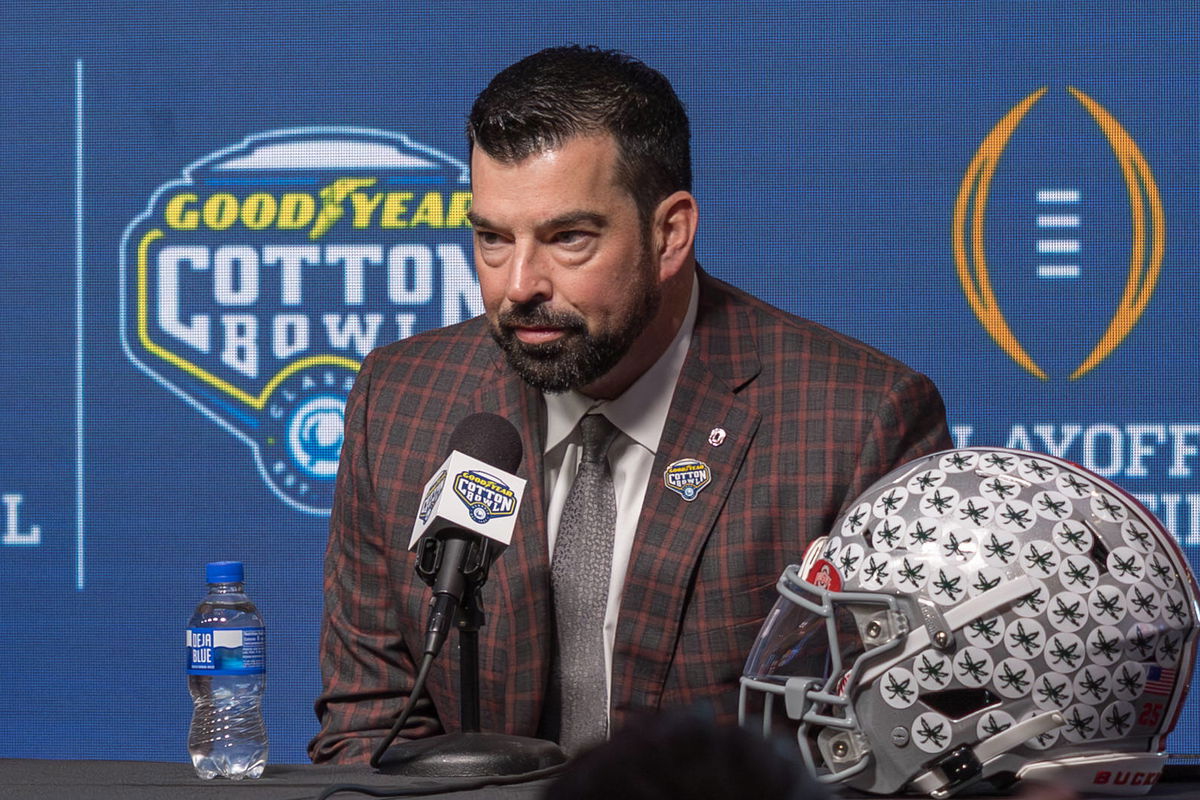
Since the NCAA approved jersey patch deals for college athletics, more than 25 programs have inked high-profile deals. OSU did it on July 28, signing a $17 million-per-year deal with financial giant JPMorgan Chase. However, before the deal became official, it faced a major roadblock. For Ryan Day, compromising on that was non-negotiable.
Watch What’s Trending Now!
“I do want to say, in full disclosure. When I first heard about this. I knew about the reputation of JP Morgan Chase, and I was excited,” Ryan Day said via Joe Nugent of NBC4. “But then I saw the logo, and I said, ‘Absolutely not, we’re not doing this.’ And then Ross said, ‘It’s not going to be blue. We’re going to do it in white.’ I said, ‘Okay, then it’s a whole different deal.’ Because that was absolutely not going to happen.”
Ohio State’s history with scarlet and gray is deeply embedded within the program. Not just that, sporting that blue ‘CHASE’ logo would also have meant using Michigan colors on the jersey. At a program that crossed out the letter ‘M’ before the ‘Game,’ using that logo is unthinkable. Thankfully, through negotiations, the $1 trillion giant agreed to use white instead of the blue it uses in its logo.
“We would say there can be an alternate color,” AD Ross Bjork said before the deal became official. “We would say, ‘Let’s talk about a white color or, you know, a gray color or something like that.”
It’s a win-win situation for OSU fans now. Not only will the program receive the agreed $17 million annually, but JP Morgan Chase has also agreed to offer NIL opportunities and other financial incentives to the Columbus program. The ‘CHASE’ logo will sit on the right side, above the Big 10 emblem, and showcase OSU’s immense financial pull. With this deal, OSU has even surpassed some NBA giants’ patch deals.
According to SI, NBA teams earn roughly $10 million on average from their jersey patch deals. Of course, teams like the New York Knicks and the Brooklyn Nets have deals that exceed $30 million. Still, other teams, like the Orlando Magic and the Utah Jazz, earn around $5 million through their patch deals.
OSU has chosen every color except blue for their jerseys
When the Ohio State football program started in the late 19th century, the initial proposed jersey colors were orange and black. However, Princeton University had already chosen those colors, so a three-student-led committee was tasked with choosing different colors for the program. Finally, they decided on scarlet and gray. For them, it was a “pleasing” combination and hadn’t been adopted by another program. The blue was not considered even back then.
The major factor influencing Ohio State was Michigan’s ‘blue’ color, and even now, it played a major role. Before the jersey patch deal, it was understood for OSU players not to wear blue on campus. Most head coaches, including Ryan Day, Urban Meyer, and Jim Tressel, have already banned such clothes inside the Athletic Center and even on team trips.
Ohio State has a long-standing relationship with Nike and is currently locked in on a $252 million 15-year deal. The apparel giant has been making OSU kits and jerseys since 2009 and has also produced them in alternate colors besides scarlet and gray. So, the Buckeyes have worn all-black jerseys, dark anthracite jerseys, metallic silver jerseys, and whiteout jerseys. But never a blue one. And it will remain so for the foreseeable future.