
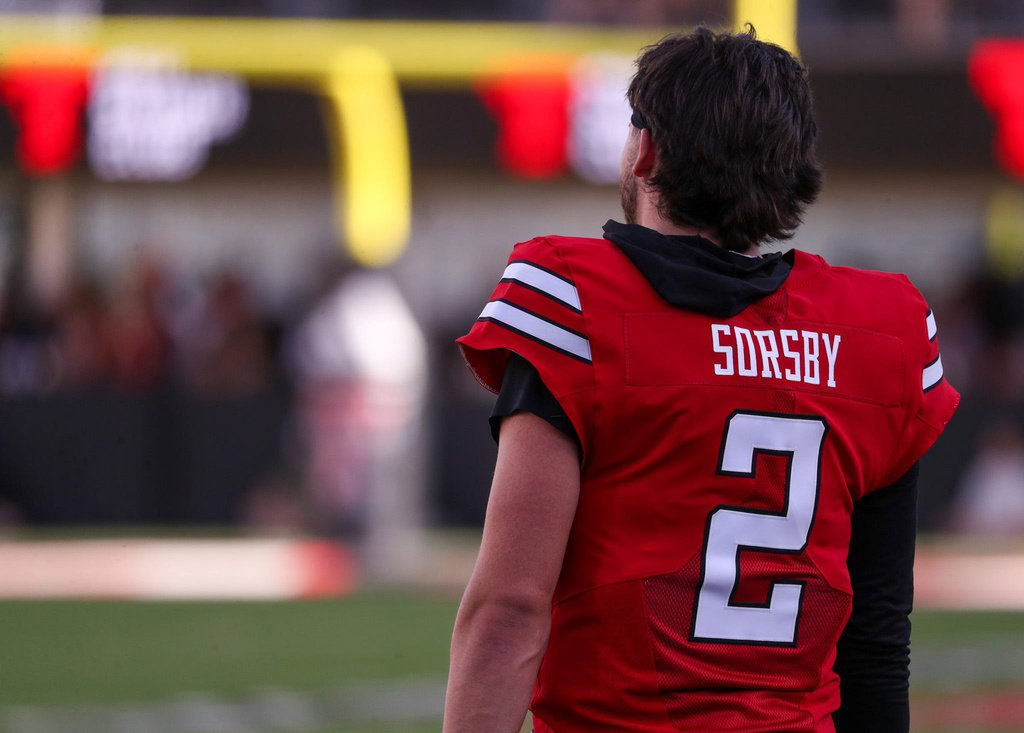
Betting on your own team was supposed to mean a permanent loss of eligibility, with no attorneys splitting the difference. That changed when a judge in Lubbock County made one of college football’s most ironclad rules negotiable after Brendan Sorsby won back his eligibility. Head coaches lost their cool and issued statements targeting the credibility of the NCAA. They are essentially asking: Do NCAA rules even matter anymore?
Watch What’s Trending Now!
When The Athletic spoke with the head coaches from around college football regarding Sorsby’s ruling, no one wanted to believe it actually happened. The numbers only fueled the outrage, with Sorsby admitting to placing over 9,000 bets totaling at least $90,000 during his college career.
“Unbelievable,” one Power 4 head coach said.
The frustration stems from District Court Judge Ken Curry’s ruling on June 8, 2026, which came after Sorsby’s attorneys argued that the NCAA failed to consider his mental health in determining punishment.
The Judge stated (per ON3 CFB Insider Pete Nakos), “This Court finds that [Sorsby] has demonstrated that he will suffer a probable, imminent and irreparable injury if this Court does not issue this temporary injunction because he will be unable to participate as a member of Texas Tech University’s 2026 football team.”
Sorsby was granted an injunction that allows him to continue playing despite admitting to betting on college sports, including wagers involving Indiana while he was on the Hoosiers’ roster in 2022.
The NCAA rules on Sports Wagering are as follows:
- The NCAA membership has adopted specific rules prohibiting student-athletes, athletics department staff members, and conference office staff from engaging in sports wagering (Bylaw 10.3). NCAA national office employees are also prohibiting from engaging in sports wagering.
- A student-athlete involved in sports wagering on the student-athlete’s institution permanently loses all remaining regular-season and postseason eligibility in all sports.
Instead, the court imposed a two-game suspension that had been proposed by Brendan Sorsby’s legal team, led by attorney Jeffrey Kessler. This will just see him miss the season opener against Abilene Christian Wildcats and Oregon State Beavers before being eligible for a return against the Houston Cougars on September 18.

Imago
NCAA, College League, USA Football: Big 12 Media Days Jul 8, 2025 Frisco, TX, USA Cincinnati quarterback Brendan Sorsby answers questions from the media during 2025 Big 12 Football Media Days at The Star. Frisco The Star TX USA, EDITORIAL USE ONLY PUBLICATIONxINxGERxSUIxAUTxONLY Copyright: xRaymondxCarlinxIIIx 20250708_rtc_cb2_1356
After the court’s decision to reduce a permanent ban to a two-game suspension, another Power 4 coach’s language showcased his frustration.
“That’s f—ing crazy! Beyond wild,” he said. “We have some serious problems that if they don’t get fixed, the entire thing is going to implode. Soon.”
Coaches question the purpose of the NCAA
The NCAA, meanwhile, has already appealed the ruling. But for many coaches, the legal argument misses the point.
“What is the purpose of the NCAA?” one Group of 6 coach asked. “I don’t understand anything about their purpose anymore if a guy can do what he just did, blatantly break the rules, go gamble, and he can get a judge in a local area to sign off, and he can go play football?”
That question kept surfacing on Monday, with yet another Power 4 coach pointing to the bigger issue.
“It speaks to the power of attorneys and politics and the lack of control the NCAA has over governance,” the coach said. “Betting on your own teams or sport has always been a death penalty. But now it’s overlooked?”
Another coach was even more direct, saying, “If gambling isn’t punishable, what is?”
“The hypocrisy is consistent throughout our profession right now,” one Big 12 head coach told ESPN. “Nobody cares about the betterment of the game and its future anymore. Everybody’s in survival mode on how they can win and survive right now.”
The case shows that college sports are operating without a clear referee. Coaches are wondering whether any enforcement actually remains intact because everything seems to be spiraling out of control. That’s why NCAA president Charlie Baker is asserting that college sports need Congress’s intervention.
Brendan Sorsby’s case shows why the NCAA needs Congress
Once the ruling became public, the NCAA wasted little time responding. In a statement Monday, the organization said it “strongly disagrees” with the ruling and warned of its “damaging, far-reaching and broadly destabilizing ramifications.” Charlie Baker used the decision to show why congressional intervention is necessary, despite pushback.
“There is no better example of why targeted intervention from Congress is necessary,” he wrote on X. “When you have schools and deep-pocketed supporters willing to look the other way on the glaring integrity threat of betting on your own team – and judges whose rulings effectively strip away our ability to stop them – only Congress can equip the NCAA to apply this common sense rule to everyone fairly and consistently. The Protect College Sports Act would empower the NCAA to enforce rules including the gambling restrictions – it’s needed now more than ever.”
Whether Congress acts remains uncertain. The SEC and Big Ten are still not on board with the proposal, fearing it could limit future conference expansion efforts. But cases like Brendan Sorsby’s show that it would need a bigger power to tame modern college sports.