
Essentials Inside The Story
- Nick Saban testified in support of the Cruz-Cantwell bill.
- Since then, his statements have received a lot of attention.
- Colin Cowherd adds to it all.
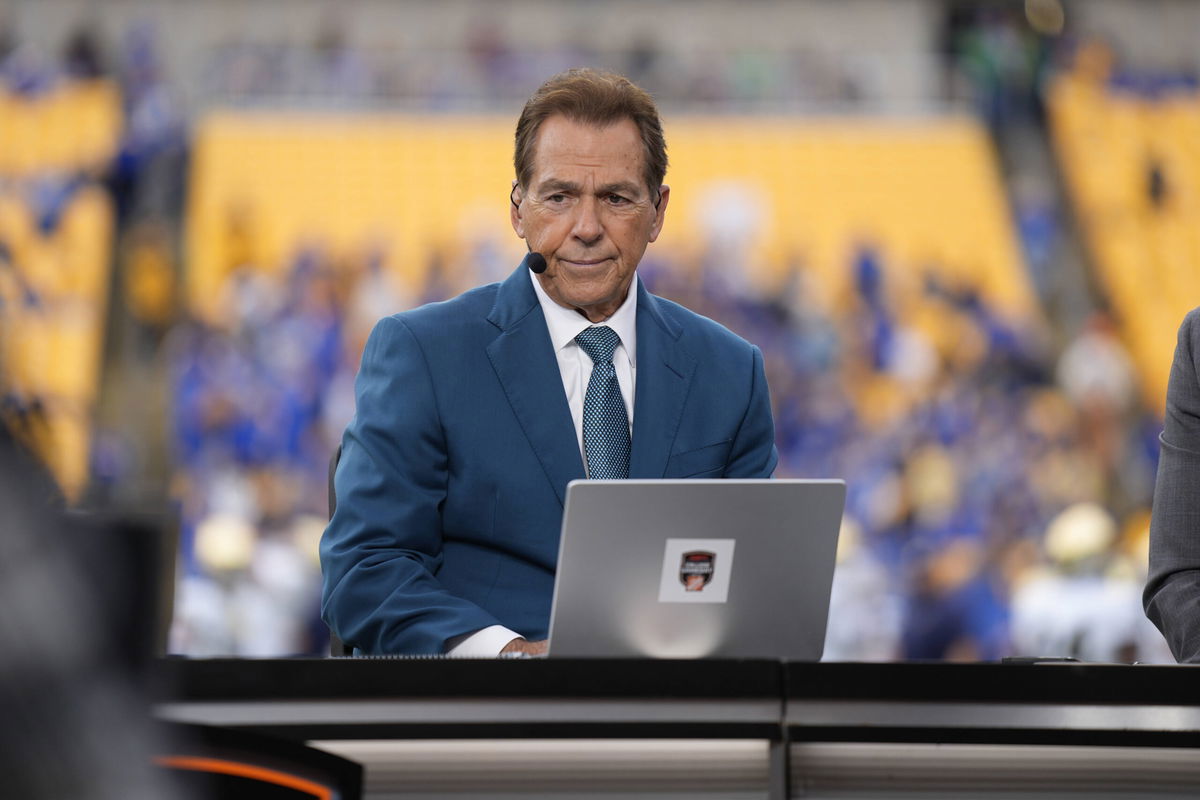
On June 3, Nick Saban testified before a Senate Committee in support of the Cruz-Cantwell bill, which is supposedly aimed at bringing stability to college sports. To illustrate the unequal nature of the status quo, the former Alabama head coach used the metaphor of tapping the brakes on the ‘biggest, baddest Ferrari’ that was going 150 miles an hour toward the Grand Canyon. That metaphor triggered Fox Sports analyst Colin Cowherd, and he was quick to point out Saban’s hypocrisy.
Watch What’s Trending Now!
“Nick Saban made over $100 million in the free market with college football and never talked much about budgets back then,” said Cowherd on his talk show, The Herd, on Saturday. “If the Alabama athletic director would have said, ‘You know, Nick, we got to make some cuts,’ Nick would have turned to his agent, Jimmy Sexton, and said, ‘Call Texas or find the money.'”
No one can deny that Nick Saban didn’t deserve what he got paid at Alabama or LSU. He brought national championships to these programs and sent countless players to the NFL. However, for the longest time, the amateur status of college athletics extended only to the players. But the salaries of head coaches grew as the revenues increased.
“One of Nick’s quotes was ‘if he had the biggest, baddest Ferrari that’s going 150 miles an hour towards the Grand Canyon, somebody needs to tap the brakes.’ Nick was never publicly tapping the brakes when he was the highest-paid coach or when there was a facilities-building war,” Cowherd added further.
“I mean, for years and years, Oregon, Texas, and Bama were spending hundreds of millions on facilities, and now we’re spending $1.2 million on a wide receiver who’s going to be a first-round pick, and we got to tap the brakes?”
To support the Protect College Sports Act, which is intended to overhaul student-athletes’ NIL and transfer rules, Saban argued that the pay-for-play schemes funded by booster collectives and unlimited transfers create chaotic bidding wars. While the focus shifted to money, it’s bad for players’ actual development, as per the coach. Saban also pointed out that the financial arms race to fund football rosters threatens the survival of Olympic and non-revenue sports.
But Colin Cowherd dismissed the idea that modern NIL rules are endangering smaller sports.

"Nick was never publicly tapping the brakes when he was the highest paid coach or there was a facilities building war!" @colincowherd reacts to Nick Saban's comments to Congress about the state of college athletics
“I didn’t hear Nick, and a lot of these coaches who worried about the Olympic sports. In college, athletic departments have been a house of cards forever. They’re bloated and nonsensical,” said the Fox Sports analyst. “So, all I know is that when coaches’ salaries exploded, nobody talked about a Ferrari in the Grand Canyon.”
The FOX analyst even pointed out Alabama’s $300 million football operations center to emphasize that elite coaches only want to “tap the brakes” as money is going to the players.
However, Saban isn’t against players earning NIL. His concern is the portal, and donor collectives created an unregulated free agency. This also results in tampering as a recurring issue in football.
During his testimony, Saban mentioned: “We have nothing to control tampering. You know, Clemson had a player that was on campus for a whole week, and they (Ole Miss) came and got him off the campus and took him someplace else.”
At the end of the day, the whole debate is missing the perspective of student-athletes. That is as true for federal attempts to reform college athletics as it is for conferences trying to expand the college football playoffs. Players’ well-being is often the last consideration.
There was no representation from the players during the March roundtable discussion organized by President Trump. And in the absence of a union (like we have in the NFL), voices like Cowherd become key to bringing nuance to the debate.
Nick Saban continues to take hits
Nick Saban has been vocal about the pay-for-play model for a long time. However, when in 2022 he claimed Texas A&M used its donor-backed NIL collective to secure the No. 1 recruiting class, then-head coach Jimbo Fisher called Saban a “narcissist.” During the White House roundtable, when Saban discussed NIL, he was labeled a “hypocrite” given his over $100 million in coaching earnings.
After the Senate hearing, Saban’s concern about unregulated NIL caught the attention of a prominent radio show host, Craig Carton, who claimed Saban illegally paid players during his time at Alabama.
“The Clown Prince Nick Saban was at it again. Talking about how NIL’s the death of college sports. Because he’s claiming that if you don’t spend up to $20 million a year in your football program, you can’t compete,” said Carton.
“It’s always funny to me when the guys who are against the legal spending on talent did it illegally for so many years are now bemoaning the fact that every team has the ability. Nick Saban is still of that era of successful, well-known coaches, whether it be football or basketball.”
The former Alabama head coach has never been formally sanctioned for paying players under the table. However, Alabama was embroiled in that before Saban arrived in Tuscaloosa.
Even former head coaches like Ed Orgeron have accepted that such deals were more common than publicly known. But beyond calling out Saban for hypocrisy, such commentary adds little to the discourse on the need for stability in college athletics.