
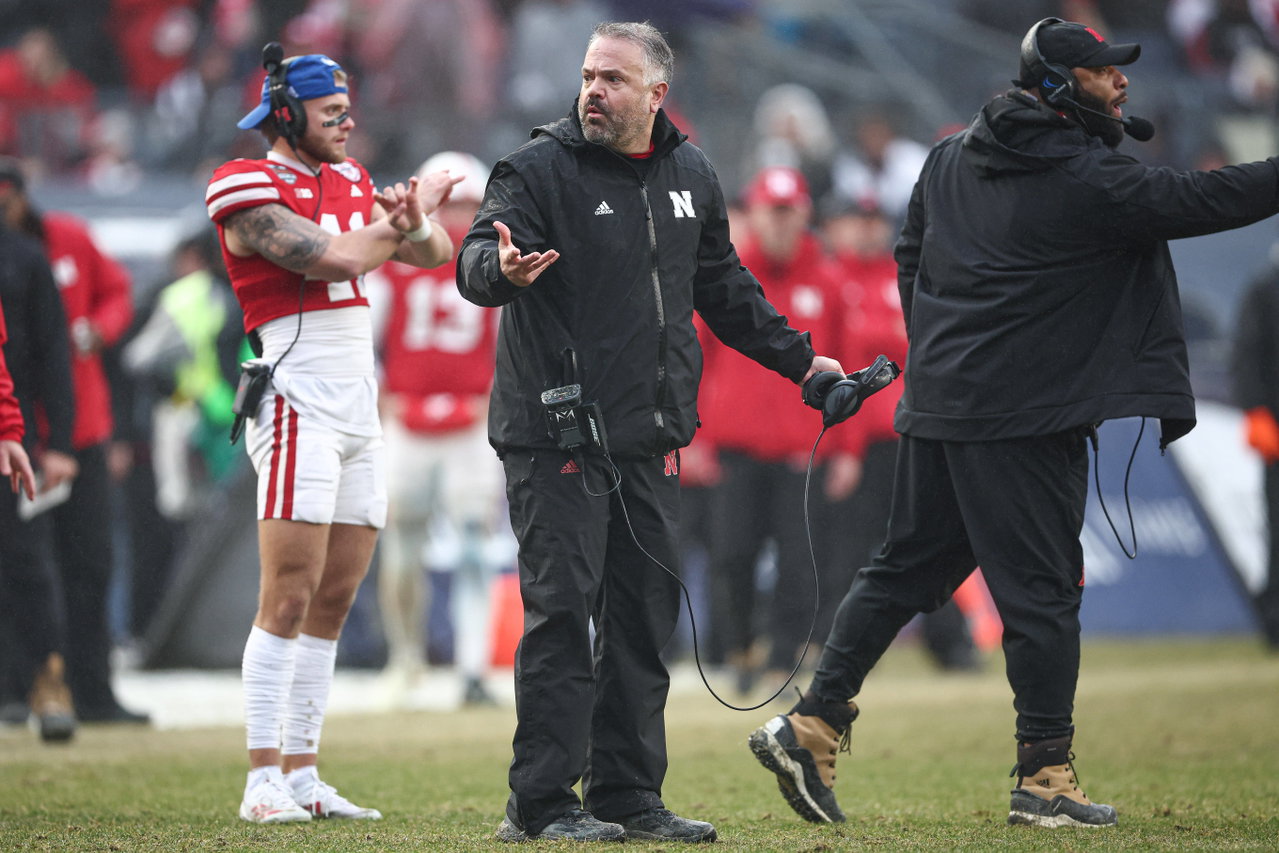
Matt Rhule’s Nebraska lost what has now become the first major enforcement fight of the post-House settlement era. On Monday night, the College Sports Commission officially won its arbitration case against eighteen Nebraska football players who challenged the CSC after the commission rejected NIL deals tied to Playfly, the school’s multimedia rights partner.
Watch What’s Trending Now!
Think of this as a broken promise. Eighteen young athletes believed they secured their future with deals worth over a million dollars. But the new sports authorities stepped in and canceled those paychecks. The players fought back to keep their money, only to lose in a closed-door legal meeting.
“A neutral arbitrator has issued a final, binding decision affirming the College Sports Commission’s (CSC) application of the rules in connection with third- party NIL agreements between Playfly and student-athletes at the University of Nebraska,” the official statement read. “The neutral arbitrator found that the CSC properly determined that Playfly is an associated entity, and properly determined not to clear the NIL deals at issue based on a lack of a valid business purpose, including a violation of the rule against warehousing NIL rights.”
Nebraska’s rejected deals involved payments through Playfly, the multimedia rights company that signed a 15-year agreement with the university worth more than $300 million. Back in December, the company reportedly agreed to redirect over $10 million toward NIL opportunities, including roughly $8 million due by June.
The complication here is that, in Nebraska’s eyes, this may have looked like smart business. Schools everywhere are trying to figure out how to survive revenue-sharing while still keeping rosters intact. Matt Rhule’s Huskers were just trying to operate ahead of it. But the CSC argued that the structure crossed the line.


The College Sports Commission has won its arbitration case against 18 Nebraska football players. CSC CEO Bryan Seeley: "This process shows the system is working as intended." on3.com/nil/news/arbit…

According to the ruling, the deals didn’t involve real products or services being sold to the public for business purposes. The CSC also argued that Playfly was buying NIL rights from players without using them right away. So the CSC views that as more like saving player rights for later instead of creating NIL opportunities now.
The bigger concern for the CSC is what would happen if deals like this were allowed. If media partners can move millions of dollars to athletes without strict rules, then schools across the country could follow the same example. That would make the NIL clearinghouse almost useless. That’s why CSC’s CEO Bryan Seeley sounded relieved with the ruling.
“We are pleased with the arbitrator’s decision to affirm the CSC’s fact-based application of the rules,” he said in a statement. “This process shows the system is working as intended.”
This ruling is also about whether the CSC actually has teeth. For months, people around the country have wondered whether the new enforcement body was simply another writing on paper. College sports have spent years pretending rules existed while everybody found creative ways around them. Nebraska just happened to become the first school daring enough to test the boundaries publicly. And now the Huskers lost.
That validation is what CSC needed because the moment the commission lost its first major arbitration case, the enforcement system could look weak before it even fully began. But now, Nebraska has become an example of what happens when you cross the line.
What is the next move for Matt Rhule’s Nebraska
Nebraska AD Troy Dannen tried to keep the tone subtle.
“I am proud of our football student-athletes and how they represented themselves during this process and the patience they have shown,” he said. “We continue to operate within the parameters of the House settlement and the CSC process, while monitoring changes in the collegiate landscape.”
But behind his statement, there’s tension building here. The state of Nebraska already passed legislation that prevents athletes from getting penalized for participating in NIL or receiving compensation. So that creates a potential collision between state law and CSC enforcement rules. But as Bryan Seeley told ACC ADs and coaches, “This case was never about whether student athletes can get paid. It was about they can get paid in this way.”
Nebraska Attorney General Mike Hilgers had previously suggested legal action was possible if the CSC prevailed. Now, people across college athletics are waiting to see whether the state actually escalates this into court. Sports attorney Paia LaPalombara added his take on the Nebraska situation.
“It’s whether their state attorney general challenges it in court and what the outcome of that is, I think that is the true test of whether this (CSC) is a legitimate governing body,” he said last week.
That’s the tension hanging over all of this. Because even though the CSC won Monday’s case, another federal hearing tied to NIL enforcement and associated entities is already scheduled later this month. So yes, Matt Rhule’s Nebraska lost the arbitration battle. But this isn’t the end of this story.