
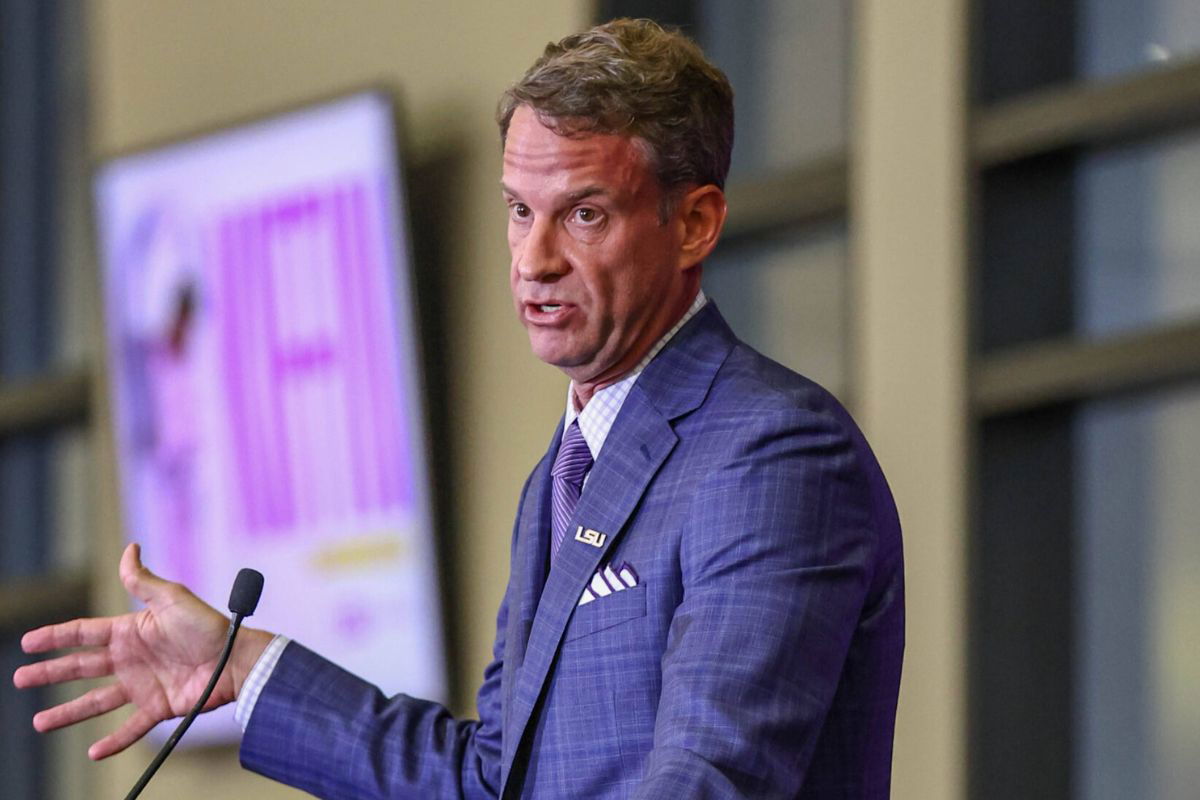
Lane Kiffin is done entertaining the outside noise. The Tigers’ head coach has chosen to focus on business rather than battles on social media. Kiffin recently made that crystal clear when he blocked an Ole Miss reporter, Chase Parham, who took shots at LSU athletic director Verge Ausberry after an interview in which Ausberry stood up for his head coach.
Watch What’s Trending Now!
Parham’s words were simple but sharp. He did not like how LSU athletic director Verge Ausberry praised Kiffin while blaming former coach Brian Kelly. To him, it sounded too much like blind trust in the new man in charge, and he said so in front of everyone on social media.
The situation escalated after Ole Miss reporter Chase Parham revealed on X that Lane Kiffin had blocked him on Twitter. “Had he waited until today’s Bluesky Live, he’d know the mute function is more effective,” read the post.
The fallout reportedly began after Parham reacted to comments made during an interview of LSU athletic director Verge Ausberry with USA Today. Parham weighed in on the interview with criticism directed toward the LSU AD’s remarks, and the conversation soon spread across social media circles tied to both Ole Miss and LSU. “That’s a real quote? Verge thinks that? Really? Oh, dear.”

Had he waited until today’s BlueSky Live, he’d know the mute function is more effective. 🤷🏼♂️

Verge Ausberry does not shy away from taking the stand for their newly appointed HC, but in a recent interview, he also hammered Brian Kelly. That interview lit the fuse. When Parham saw Ausberry standing so strongly behind Kiffin and speaking openly about Kelly’s failures, he could not stay quiet. His short post, half disbelief, half eye-roll, was enough to turn a private opinion into a public clash with LSU’s new head coach.
“That’s what Lane will do. He’ll go out there and have that conversation with the donors and the people who support the program and (say), ‘We need your help,’ and give them his cell number,” Ausberry said about Kiffin. “He’ll not say, ‘OK, I don’t want people to contact me. I don’t want people to touch me. I don’t want people to be around me.’ That’s who we had. That’s why we got what we got. There was no feel, there was no connection between the LSU football program, the coach, and the fans.”
The pressure around Brian Kelly apparently was not just about the wins and losses. Ausberry hinted that there were bigger issues behind the scenes, especially with the overall vibe and chemistry within the program. Sure, performance matters at LSU, but it sounded like the leadership also wanted a stronger connection between the coach, players, and the culture around the team. From Ausberry’s comments, it seemed the concern was less about one terrible stretch and more about whether everything inside the building was really clicking the way LSU expected.
“There was no connection and no building” when Kelly was coach, Ausberry said. “Not many employees connected. The former players didn’t connect. Yeah, I’m saying it. Now, former players live over there (at the facility), go over there, we welcome them over there, (they work out over there. That’s what we want. That’s who LSU used to be. Former players came into the weight room, and they worked out. There wasn’t a signing no form to be able to work out, or ‘Who are you? You can’t work out.’”
For LSU, these are not small complaints. Ausberry is telling fans that Kiffin is the opposite of the last coach: open, available, and willing to listen. When an Ole Miss journalist mocks those comments, it feels, in Baton Rouge, like he is mocking the belief that the new man can fix everything.
The bond between LSU and the new HC
“Parents were sitting here this weekend saying the campus’s diversity feels so great: ‘It feels like there’s no segregation.’ And we want that for our kid because that’s the real world. I just hope [my comment] comes across respectful to Ole Miss… There are some things that I’m saying that are factual, they’re not shots,” added Kiffin.
Lane Kiffin and the LSU Tigers football team seem like a perfect fit. Kiffin has the football IQ and leadership needed to help LSU compete for a national championship. Since arriving in Baton Rouge, he has focused heavily on improving and strengthening the roster, bringing excitement and high expectations with him. With all eyes on the program, this could become one of the most interesting and exciting seasons for LSU fans to watch.