
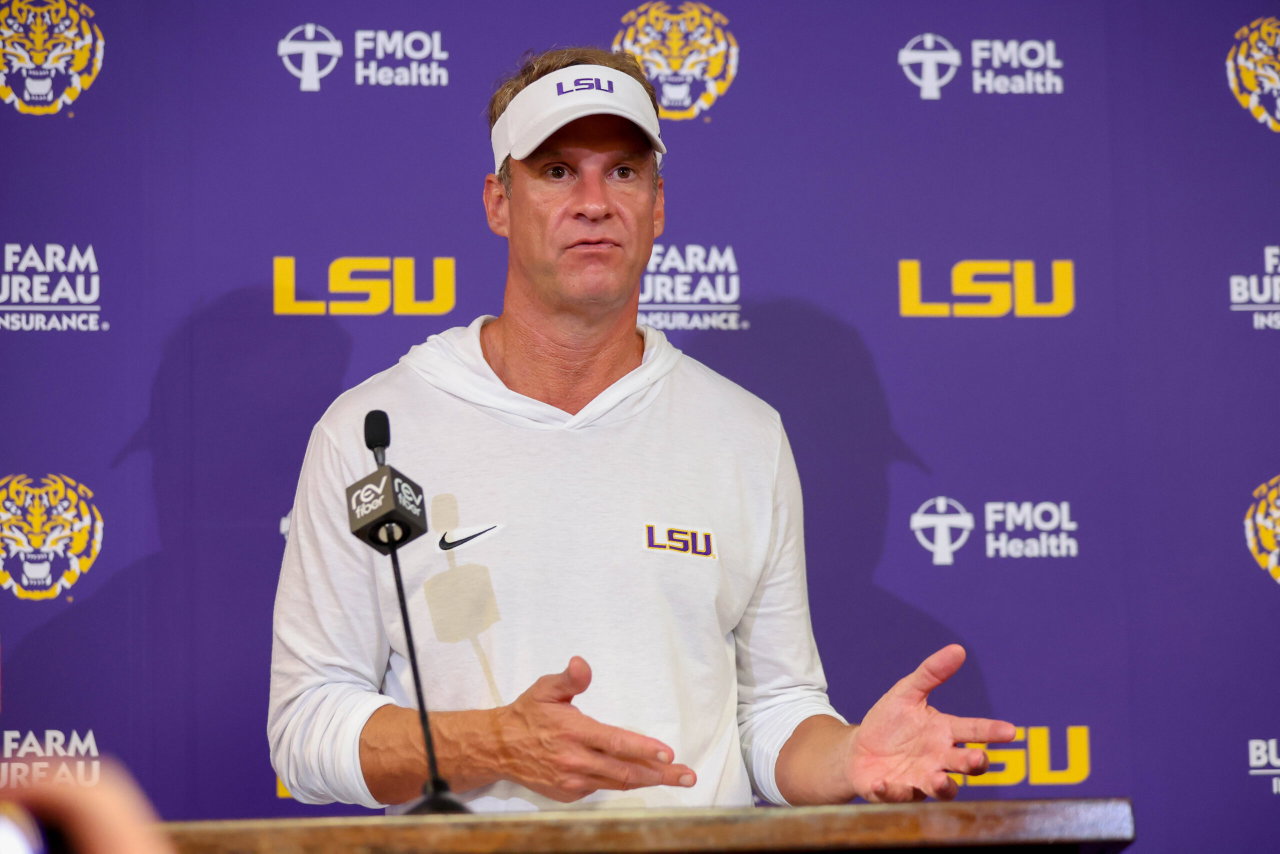
Lane Kiffin is starting to look at the LSU schedule differently. The Tigers just demolished Texas A&M 35-6, but the victory came with another injury scare. Kiffin is still thinking about it two days later.
Watch What’s Trending Now!
“It’s just I’m human. I mean, with what’s happened,” Lane Kiffin said on September 28. “These freak injuries, you’re talking about two guys out for a year with knees on kickoff. ….So, we’ll be extremely cautious this week all around.”
Sam Leavitt pulled his hamstring during the Aggies game, while linebacker Whit Weeks suffered a fractured fibula and underwent surgery Monday. Weeks could miss a significant portion of the season.
LSU won’t have safety Dashawn Spears on its roster due to a season-ending knee injury, and the same goes for WR Phillip Wright. Trey’Dez Green is also expected to miss significant time.
Weeks now joins that group after entering the year as one of LSU’s most important defensive players. He had 24 tackles and 2.5 tackles for loss through four games. Kiffin’s frustration is partly about how some of those injuries happened.
He pointed specifically to two players who suffered knee injuries on kickoff coverage without being hit. Those injuries have made the fourth game of the season feel much longer than four weeks to him.
“I took our guys out earlier in that game than I did in the previous home game,” Kiffin said. “Because just what was going on, and that just freaked me out.”
Leavitt, of course, is the immediate question for the LSU head coach. The LSU QB1 still completed 17 of 23 passes for 312 yards and two touchdowns against Texas A&M despite the hamstring problem.
He briefly left the game for Landen Clark, then returned before giving way to the backup again late in the third quarter. Interestingly, there was an odd benefit to the injury.
With his mobility limited, Leavitt stayed in the pocket more often. The result was arguably his cleanest passing performance of the season. Because of that, he also earned an impressive 91.6 QB rating from ESPN. Kiffin noticed it.
“He threw the ball really accurately,” Kiffin said, pointing to Leavitt’s ability to put the ball in places where his receivers could run after the catch. That does not mean LSU needs to rush him back against McNeese or Kentucky after that.
“It’s just the schedule you play with,” Kiffin said about the SEC’s schedule. “Once you go to nine, it’s another SEC game. I mean, it feels like we played a whole season already, and we have seven SEC games to go.”
LSU hosts McNeese on Saturday before returning to SEC play at Kentucky on Oct. 10. The Tigers then face Mississippi State, Auburn, Alabama, Texas, Tennessee, and Arkansas to finish the conference schedule.
That stretch is the reason Kiffin is thinking about the bigger workload rather than one game. LSU’s roster was built to handle the normal wear and tear of a season. Kiffin admitted the current situation is different.
“This is not a team built for a lot of top-level injuries,” he said Monday. The Tigers have already had to move players into unfamiliar roles.
Weeks’ absence pushes Davhon Keys into a bigger defensive role. Injuries elsewhere have forced backups to take on special-teams responsibilities they were not originally expected to carry.
“You lose your one and four, that’s pretty tough,” Kiffin said Monday, referring to Weeks and Charles Ross.
As for Davhon Keys, he is not an untested backup. Keys led LSU with 92 tackles last season and finished second in the SEC. He also started four of the final seven games when Weeks missed time in 2025.
Against Texas A&M, Keys played 23 defensive snaps and recorded five tackles. That history makes him the obvious player to absorb the biggest workload. Tylen Singleton should also see more action.
The third-year linebacker played 10 snaps against Texas A&M and has 18 career games under his belt. Kiffin therefore has experience available at linebacker, even if nobody can reproduce Weeks’ production immediately.
The secondary requires another adjustment. Spears’ season-ending ACL injury already forced LSU to move pieces around. Ty Benefield has moved closer to the line of scrimmage and is now getting more snaps at STAR, while Jhase Thomas has seen more action at safety.
Benefield can handle both spots, which gives the defense some flexibility. Against Texas A&M, he took 32 snaps in the slot, 23 in the box, and four at free safety. He also rushed the passer five times. The bigger headache, though, is tight end.
Green’s absence changes the offense because LSU does not have another player with his combination of size and receiving ability. Zach Grace played 42 snaps against Texas A&M and Malachi Thomas played 14, but the tight-end group combined for zero catches.
Sam Leavitt’s hamstring is the biggest variable for now. Landen Clark could get more work if LSU decides not to push him immediately.